
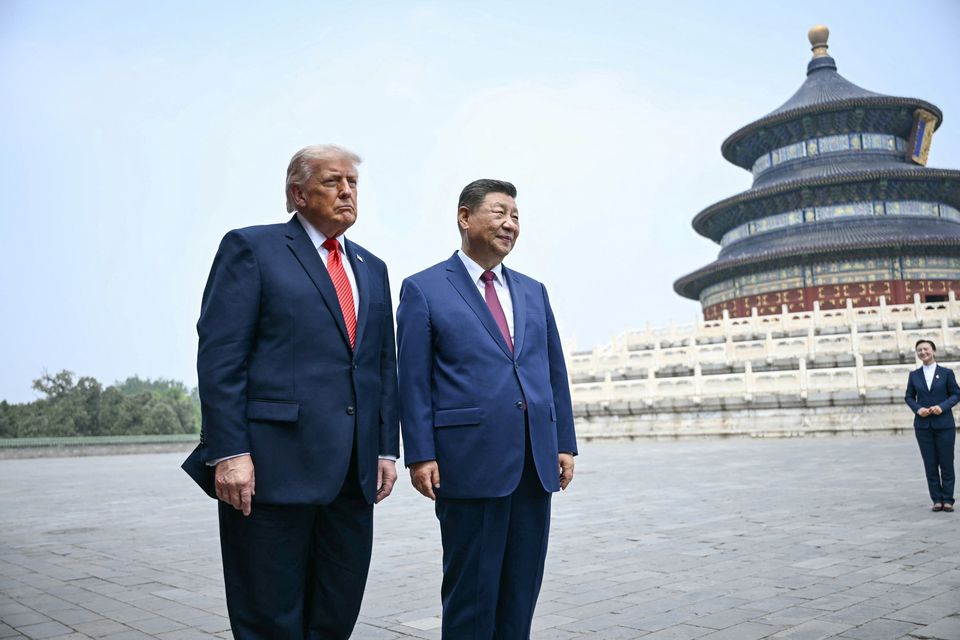
Donald Trump arrived in Beijing for what he called possibly the “biggest summit ever” and walked into a two-day meeting with Xi Jinping that is as much a reckoning with changed power dynamics as it is a negotiation over trade, Iran and Taiwan — with the American president entering the talks in a weaker position than when he last sat across from the Chinese leader, and both men knowing it.
The summit opened Thursday at the Great Hall of the People with an honor guard, flag-waving children and the ceremonial weight that China deploys when it wants a visiting leader to feel the gravity of the occasion. Xi set the tone with a formulation that managed to be both welcoming and cautionary simultaneously. “When we cooperate, both sides benefit; when we confront each other, both sides suffer,” he said in remarks open to media. He added that stable relations between the world’s two largest economies benefited the entire world — a framing that positioned cooperation as a global obligation rather than a bilateral concession.
Read also: Taiwan Issue May Dominate China-Trump Meeting, Official Says
Trump responded with the register he reserves for leaders he has decided to court. “You’re a great leader, sometimes people don’t like me saying it, but I say it anyway,” he told Xi, before invoking the summit’s potential historical scale. Both men know the choreography of these openings. What follows matters more.
Xi reported that preliminary trade negotiations between American and Chinese economic teams in South Korea on Wednesday had produced “overall balanced and positive outcomes” — language that signals forward movement without committing to specifics. The talks were aimed at sustaining the trade truce Trump and Xi struck in October, which had suspended triple-digit American tariffs on Chinese goods in exchange for Beijing stepping back from restrictions on rare earth exports essential to electric vehicle and weapons manufacturing. Neither side has a clean interest in letting that arrangement collapse, which is why it has held even as the relationship has been stressed from multiple directions.
Taiwan arrived in the conversation early and was not dressed in diplomatic softness. Xi told Trump directly that Taiwan was the most important issue in the bilateral relationship and that if handled poorly, it could lead to conflict and what he described as an extremely dangerous situation. The warning was delivered without ambiguity. Trump did not respond when a reporter shouted a question about Taiwan as the two leaders posed for photographs at the Temple of Heaven — the UNESCO World Heritage Site where Chinese emperors once performed harvest prayers, chosen as a backdrop with the awareness that symbolism is never accidental in Chinese statecraft.
A $14-billion arms package for Taiwan awaiting Trump’s approval sits in the room whether or not it is spoken of directly. China reiterated its strong opposition to the sale on Wednesday. American law requires Washington to provide Taiwan with the means to defend itself regardless of the diplomatic climate, creating a structural tension that no bilateral summit can fully resolve, only manage.
Read more: Oil Prices Surge After Trump Dismisses Iran Proposal
Iran is the other variable that neither government can avoid. Trump is expected to press Xi to use China’s leverage with Tehran to push for a deal that ends the conflict and reopens the Strait of Hormuz.
The difficulty with that request is transparent to everyone in the room. Iran functions as a strategic counterweight to American influence for Beijing, and Chinese ships sitting immobilized in the Gulf because of the Hormuz closure create pressure on Xi to support a resolution — but not necessarily enough pressure to override the broader value of maintaining Tehran as a partner. Secretary of State Marco Rubio, aboard Air Force One en route to Beijing, told Fox News that resolving the Hormuz crisis was in China’s own interest given the economic damage a prolonged supply disruption would do to Chinese exporters. Whether that argument lands will become clearer in what emerges from the summit’s second day.
The business delegation Trump brought to Beijing reflects the commercial dimension of the visit. Elon Musk, who has significant Tesla manufacturing interests in China, and Nvidia CEO Jensen Huang — a late addition whose company has been at the center of American semiconductor export restrictions targeting Chinese chipmakers — were among the executives introduced to Xi during the talks. Xi told Trump that China’s door of openness would “only open wider” and that American companies were deeply involved in China’s reform. The audience for that statement includes the executives in the room and the investors watching from New York.
Ali Wyne of the International Crisis Group noted that the power dynamics between the two capitals have shifted materially since Trump’s last Beijing visit in 2017, when China made elaborate efforts to flatter the president and purchase American goodwill in bulk. Trump is now entering negotiations with his tariff authority constrained by court rulings, his approval ratings damaged by the Iran war’s economic consequences, and his Republican Party facing genuine midterm electoral risk in November. Xi, by contrast, faces no comparable political calendar and governs an economy that has faltered but not fractured. The revival of the term “G2” — the superpower duopoly framing — when Trump met Xi in South Korea in October was read by analysts as an acknowledgment of Chinese status that the United States was not making eight years ago.
A state banquet followed Thursday’s talks. Tea and lunch are scheduled for Friday. Xi has a reciprocal visit to the United States tentatively planned for later this year — his first since Trump’s second term began in 2025.