
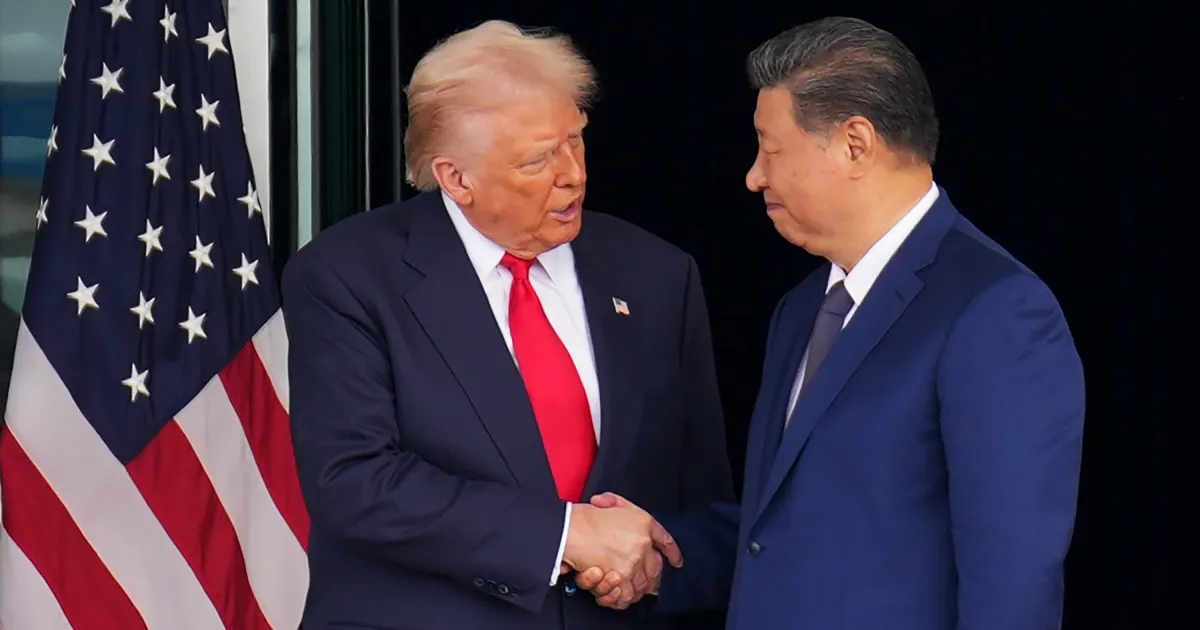
The White House emerged from the Trump-Xi Beijing summit with an agricultural purchase commitment it was willing to put numbers on — China will buy at least $17 billion worth of American farm goods annually through 2028, with a proportionate target applying to what remains of 2026, according to a fact sheet released Sunday.
The announcement added texture to a summit that had been widely characterized as long on ceremony and short on deliverables.
China will also restore market access for US beef by renewing expired listings for more than 400 production facilities and resume poultry imports from states the US Department of Agriculture certifies as avian influenza-free. Two new bilateral institutions — the US-China Board of Trade and the US-China Board of Investment — will be established to manage ongoing economic and investment relations between the world’s two largest economies.
There is a significant caveat attached to all of it. China has not confirmed any of these commitments. The Chinese Embassy in Washington did not respond to requests for comment.
Beijing’s official silence on the White House’s post-summit fact sheet is not incidental — it reflects a pattern that trade analysts have flagged as a recurring feature of Trump-era China deals, where the American side announces terms that the Chinese side has not publicly endorsed.
Read also: China’s Xi Hails Trump Trade Deal, Issues Taiwan Alert
“On agriculture purchases, I’m sceptical of any announcements that have been made by one side and not confirmed by the other. This is sometimes an issue in many relationships, but it’s acute under Trump 2, especially with China,” Deborah Elms, head of trade policy at the Hinrich Foundation in Singapore, told Al Jazeera.
She added that even if the purchases materialize in full, the economic impact on the United States would be modest. “The US is a $30 trillion economy. Even if these buys materialise, the net effect is going to be tiny.”
The $17 billion figure builds on a prior commitment. At Trump and Xi’s October summit in South Korea, China agreed to purchase at least 87 million metric tonnes of American soybeans — a number the new agricultural deal sits alongside rather than replaces. The combined package is designed to address a trade deficit that has irritated Trump since his first term, though critics of purchase-commitment deals point out that China’s previous Phase One agricultural commitments, made in 2020, were never fully honored.
US-China bilateral goods trade stood at approximately $415 billion last year, down sharply from a peak of more than $690 billion in 2022 — a collapse driven by the tariff escalation both governments have been conducting in alternating rounds for nearly a decade.
The trade truce struck in South Korea last October suspended the worst of the mutual levies and provided the diplomatic foundation for this week’s Beijing summit, which Trump attended with a delegation of CEOs including Elon Musk and Nvidia’s Jensen Huang.
The summit’s substantive output on the issues that generate the most geopolitical tension was considerably thinner than the agricultural announcements. Taiwan went unmentioned in both White House readouts — a conspicuous omission given that Xi had warned during the summit that mishandling the Taiwan question could lead to “clashes and even conflicts” between the two powers. Trump told Fox News that both Taiwan and China should “cool it,” and declined to answer when Xi asked whether the US would defend Taiwan against a Chinese attack.
Read also: Food & Drug Chief Leaving Role, Trump Announces
On Iran, the two governments agreed that the Strait of Hormuz must remain open and that Iran cannot have a nuclear weapon — the American position.
Beijing’s own readout did not endorse the nuclear formulation directly, instead calling for “a settlement on the Iranian nuclear issue and other issues that accommodates the concerns of all parties” — language that preserves China’s room to support Iranian interests while appearing aligned with Washington’s stated objectives.
What the Beijing summit produced, in the end, was a stabilization of tone, a set of economic commitments whose verification remains pending, and a conspicuous silence on the issues where the two powers’ interests are most fundamentally opposed. Whether that constitutes progress depends on the baseline against which it is measured — and on whether China confirms, in its own words, what the White House has announced in its fact sheet.