
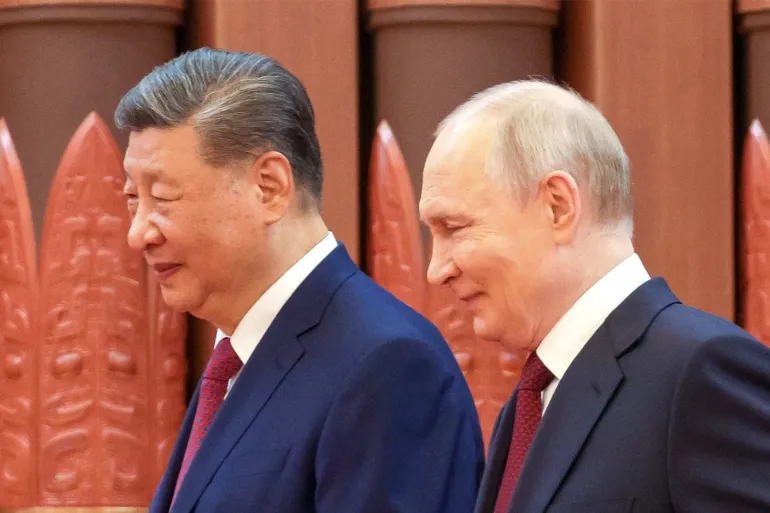
Vladimir Putin walked a red carpet into the Great Hall of the People on Wednesday as military bands played both nations’ anthems, and the imagery was deliberate — Russia and China want the world to register not just a meeting, but a message.
The two leaders shook hands beneath the ceremonial trappings of a state visit and proceeded to spend the day telling anyone paying attention that the current international order is fracturing, that Western attempts to run global affairs on unilateral terms have failed, and that Beijing and Moscow intend to offer an alternative.
In a joint statement released by the Kremlin, the two governments warned that “there is a danger of fragmentation of the international community and a return to the ‘law of the jungle.'” The statement described attempts by unnamed states — the reference to Washington required no elaboration — to impose their interests on the world as a colonial-era impulse that had run its course.
Xi set the tone in his opening remarks, telling Putin that the two countries had built something the rest of the world should study.
Their relationship, he said, had deepened political trust and strategic coordination through repeated pressure and emerged intact each time. Putin returned the framing, calling the Sino-Russian comprehensive partnership “a model for intergovernmental relations in the modern world” — a formulation that positions the two countries not as outliers but as the template.
The fanfare notwithstanding, the visit carried the texture of routine. Putin has made this trip dozens of times and has met Xi on more than forty occasions.
Read also: Xi Courts World Confidence With Putin Visit After Trump Talks
What Wednesday’s summit offered was not a breakthrough relationship but the continued reinforcement of one already deeply embedded — a contrast, in that respect, with the splashier but shallower atmospherics of President Donald Trump’s recent Beijing visit, which received the same red-carpet ceremony but generated considerably less in the way of established substance.
Energy dominated the substantive agenda, as it has in nearly every Putin-Xi meeting since Russia’s full-scale invasion of Ukraine in 2022 severed Moscow’s commercial relationships with Europe. China moved aggressively into the vacuum, absorbing Russian oil exports that had previously flowed west and becoming the economic lifeline that has kept the Russian war economy functional. Putin described energy as the “driving force” of the bilateral economic relationship — a description that is accurate but also reflects how structurally dependent Russia has become on Chinese demand.
The long-discussed Power of Siberia 2 gas pipeline remained unresolved. Kremlin spokesperson Dmitry Peskov told Russian media the two sides had reached a “basic understanding” on the pipeline’s route, but no timeline for construction exists.
The pipeline would carry Russian natural gas into China and represents Moscow’s most significant remaining energy infrastructure ambition — but Beijing has shown little urgency to lock in terms that would further entrench Russian dependence on Chinese goodwill.
Forty agreements were on the table covering tourism, education, economic cooperation and energy security. The volume of paperwork signals the breadth of engagement. The pipeline impasse signals who holds the leverage.
Xi used the meeting to weigh in on the U.S.-Israeli war against Iran, calling a comprehensive ceasefire “of utmost urgency” and warning that resuming hostilities would be “inadvisable.” His remarks placed China firmly in the camp demanding de-escalation — consistent with Beijing’s positioning throughout the conflict — and gave Putin a platform alongside which to align Russia’s stated preference for negotiated resolution.
Both leaders pledged to pursue what Putin called an “independent and sovereign” foreign policy together, aimed at playing what he described as a stabilizing role globally.
Read also: Vulnerable Nations Retain Russian Oil Lifeline Under US Waiver
Xi framed the world as “increasingly chaotic” and burdened by hegemony — language that has become so standard in Chinese diplomatic communication that it barely registers as pointed anymore, yet lands with particular weight when delivered alongside the leader of a country actively at war with a European neighbor.
Putin insisted Russia and China were “not aligning against anyone” and characterized the partnership as a project for peace and prosperity. The joint statement’s language about colonial-era impositions and jungle law suggested otherwise — not in intent, necessarily, but in effect. Two of the world’s largest military and economic powers spending a day telling the international community that the dominant Western-led order has forfeited its legitimacy is not a neutral act, regardless of how it is framed.
What Putin needed most from Beijing on Wednesday was not symbolism. It was money, gas contracts and the appearance of a peer relationship rather than a dependent one. He got two of the three.