
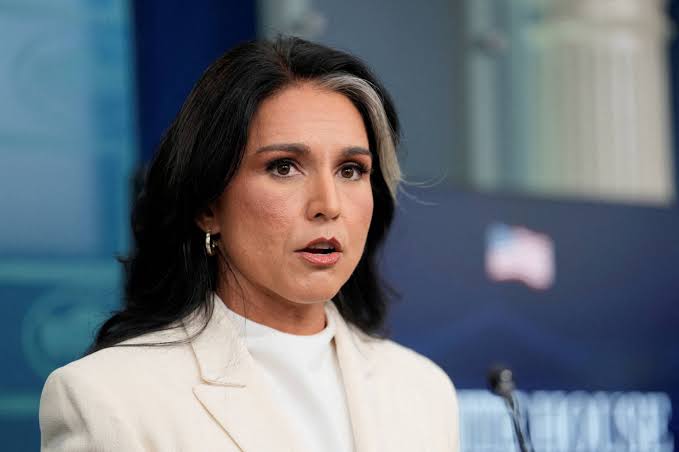
Tulsi Gabbard is leaving the job of America’s top intelligence official at the end of June, ending a tenure defined less by what she did than by what she was kept from doing — shut out of the decisions surrounding Venezuela, Iran and other major national security events while nominally overseeing the country’s 18 intelligence agencies.
The White House forced her out, according to a source familiar with the matter cited by Reuters. Fox News, which broke the story, pointed to her husband’s cancer diagnosis as the reason for her departure. President Donald Trump, posting on Truth Social, called it an unfortunate loss and praised her work, while simultaneously announcing that Aaron Lukas, the principal deputy director of national intelligence, would step in as acting director.
Those two accounts — forced resignation versus family medical circumstances — sat unreconciled in the public record Friday, as they often do when an administration official exits under pressure.
Gabbard’s letter to the president was gracious in the manner these letters tend to be, acknowledging progress made and work still unfinished. The gap between that language and the actual contours of her time at the Office of the Director of National Intelligence tells a different story.
The breaking point, or at least the most visible one, came last summer. Trump endorsed Israel’s strike on Iran and then ordered US forces to bomb Iranian nuclear facilities — a decision that flew directly in the face of Gabbard’s congressional testimony that Iran was not constructing a nuclear weapon. Trump did not merely proceed without her. He publicly dismissed her assessment as wrong and said he did not care what she had said.
Read more: Trump Says Time Is On His Side As Tehran Reviews US Position
What followed was telling. Within weeks, Gabbard was on Capitol Hill calling for the prosecution of Barack Obama and former national security officials, alleging a treasonous conspiracy to fabricate Russian interference in the 2016 election on Trump’s behalf. Obama denied the allegations. The episode read, to outside observers, as a loyalty performance — an attempt to recover standing with a president who had just humiliated her on the central professional judgment of her career.
It did not appear to work. She was excluded from discussions around the January seizure of Venezuelan President Nicolás Maduro and kept away from the policy table when February’s renewed military strikes on Iran were being decided.
An intelligence chief without a seat at the table for two of the administration’s most consequential foreign policy moves in as many months.
Her presence at an FBI raid to recover ballots from the 2020 presidential election — a domestic law enforcement operation with no connection to the foreign intelligence portfolio she was hired to manage — underscored the degree to which keeping Trump’s favor had become her operational priority.
The criticism that greeted her nomination in late 2024 now reads as prescient. Opponents had pointed to her history of echoing Kremlin positions on Russia’s war in Ukraine and to a 2017 meeting with then-Syrian President Bashar al-Assad in which she told him Syria was not an enemy of the United States. Hillary Clinton had gone further, publicly suggesting Gabbard was being cultivated by Russian intelligence.
Democratic Senator Adam Schiff, who sits on the intelligence committee, offered an assessment Friday that spared nothing. She had politicized intelligence, he wrote, dismantled agencies built to keep Americans safe and turned the intelligence community into an instrument for pursuing election fraud claims that had no factual basis. Her one useful contribution to national security, Schiff said, was quitting.
Senator Mark Warner, the committee’s vice-chair, kept his tone more measured, directing sympathy toward Gabbard’s family before calling on her successor to restore the office to what it is supposed to be — fact-grounded, independent, legally anchored. The next DNI, he said, must be someone intelligence professionals can speak truth to without fear of interference.
Read also: Trump Brings Law To Bear On Sexual Deepfake Epidemic
The office she led released its own farewell Friday, crediting her with a transformational reshaping of the intelligence community that no predecessor had attempted.
Among the cited accomplishments: revoking security clearances from what the ODNI called deep-state bad actors — career intelligence officers, by the description of those who knew them — and releasing previously classified assassination files on John F. Kennedy, Robert F. Kennedy and Martin Luther King Jr.
Gabbard is the fourth woman to leave Trump’s cabinet in just over two months. Homeland Security Secretary Kristi Noem was removed in March. Attorney General Pam Bondi was fired in April. Labor Secretary Lori Chavez-DeRemer resigned that same month following misconduct allegations.
She leaves behind an intelligence apparatus that her critics say is diminished and her defenders say is cleansed. What is not in dispute is that for much of her tenure, the country’s most sensitive national security decisions were being made without her in the room.