
JURISDICTIONAL NOTICE
STATUS: U.S. First Amendment Protected.
Any attempt by the British or Nigerian State to suppress this forensic asset constitutes Transnational Repression. All interference will be tracked and submitted to the FBI for Global Magnitsky Sanctions.
♦♦♦♦♦♦♦♦♦♦♦♦♦♦♦♦♦♦♦♦♦♦♦♦♦♦♦♦♦♦♦♦♦♦♦♦♦♦♦♦♦♦♦♦♦♦
Unmasking the Wartime Violations and Modern Revisionism
A legal account of how blockade, cabinet rhetoric, relief restriction, foreign support, and civilian collapse converged into a policy environment where hunger did not only accompany the war; it helped prosecute it.
The Law Written After the Children Died
How Biafra helped force the world toward clearer humanitarian law on starvation of civilians as a method of combat.
The Law Came After the Children
Biafra did not receive the protection that later law learned to state plainly. That is part of the cruelty. The world found sharper language after the children had already carried the evidence in their bodies. Additional Protocol II, adopted in 1977, would later say directly that starvation of civilians as a method of combat is prohibited. It would prohibit attacks on objects indispensable to civilian survival for that purpose. The words arrived with the authority of law. They arrived too late for Biafra’s dead.
This does not excuse Gowon’s regime. It condemns the earlier order and the actors who exploited it. A child did not become human in 1977. A mother did not acquire a legal personality because treaty language matured. The wounded did not first become worthy of relief when diplomats finally wrote the rule clearly. Biafra forced the world to confront what states could do when sovereignty, blockade, and internal-war classification were allowed to shield deprivation.
Image Exhibit 1 — Four children in a refugee relief camp, 1968
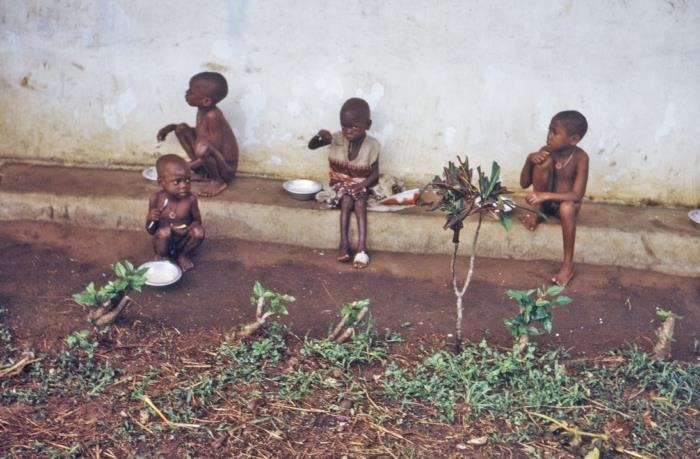
Credit: CDC/Public Health Image Library (PHIL), PHIL ID 7160 / Wikimedia Commons. Public domain. Source page: https://wwwn.cdc.gov/phil/Details.aspx?pid=7160
Editorial note: Public-domain historical image inserted as evidentiary visual material; not used as decoration.
Read also: Yakubu Gowon And The Starvation Of Biafra: Part 11
Article 14 as the World’s Answer
Article 14 of Additional Protocol II is not an abstract provision when read after Biafra. It is a legal answer to a historical method. Starvation of civilians as a method of combat is prohibited. Objects indispensable to survival—food, crops, livestock, drinking water installations, supplies, irrigation works—cannot be attacked, destroyed, removed, or rendered useless for that purpose. The article names the route by which modern war can kill without lining civilians against a wall.
Biafra belongs in the moral background of that clarity. It exposed that civilian destruction in internal armed conflict could be achieved through access, routes, food systems, medicine, and relief obstruction. The battlefield had moved into the stomach. The law had to learn to follow it there.
Image Exhibit 2 — Two malnourished children cared for in a relief camp, 1968
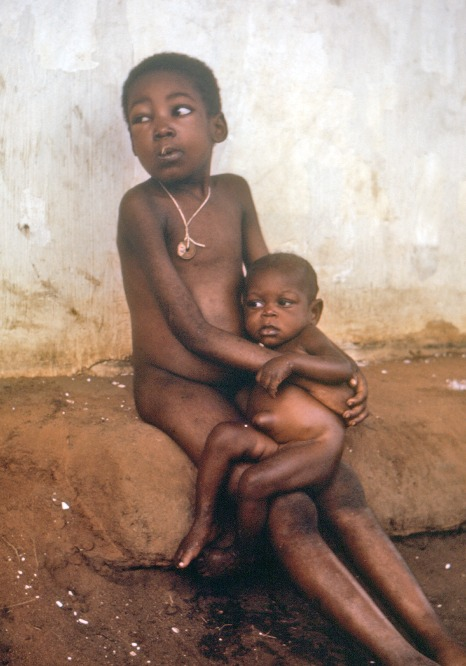
Credit: CDC/Public Health Image Library (PHIL) via Wikimedia Commons. Public domain. Source page: https://commons.wikimedia.org/wiki/File:1968_5Nigeria_CDC.png
Gowon’s Defence Under Later Light
Gowon’s defenders may argue that the later rule should not be retroactively applied as a criminal statute. That technical caution has its place. But technical caution cannot become moral acquittal. The later rule shows what the world eventually recognized as intolerable. It provides the vocabulary for judging the method, even if the historical legal framework was less explicit at the time.
The more devastating point is not that 1977 magically created wrongdoing. It is that 1977 exposed the wrong that should never have needed clearer wording. A government does not need a future treaty to know that starving children to force surrender is a violation of humanity. Gowon’s regime did not stumble accidentally into deprivation. It maintained conditions under which food, medicine, and relief were controlled while civilians collapsed. Later law did not invent the child’s injury. It finally named the method.
Britain Before the Rule
Britain also stands under the light of the later rule. London cannot hide behind the formal limits of the period as though its officials lacked moral intelligence. British policymakers knew enough about blockade, oil, federal strategy, and humanitarian suffering to understand that civilian deprivation was no peripheral matter. The later prohibition makes the British posture look worse, not better: a state that helped sustain the federal side during visible starvation later watched the world name starvation as a prohibited method of combat.
That sequence is an indictment of policy memory. Britain’s concern did not stop its support. Its knowledge did not force rupture. Its diplomacy helped preserve the recognized state’s advantage. Later law tells us what the children already told us: the survival systems of civilians must not be turned into weapons.
The Birth of Modern Humanitarianism Was Paid for in Bodies
Biafra is often described as a turning point in modern humanitarianism. That description is true and obscene at once. The crisis helped transform global aid politics, media activism, church relief networks, medical witness, and the later emergence of a more confrontational humanitarian conscience. But no society should be required to become a lesson after being starved.
The modern humanitarian movement learned from Biafra because Biafra was allowed to become unbearable. Images traveled faster than protection. Pity became global before enforcement did. Aid workers learned the limits of neutrality under siege. Doctors learned that silence could protect access while abandoning truth. The world learned, but Biafran children paid the tuition.
Read also: Yakubu Gowon And The Starvation Of Biafra: Part 10
The Final File
The completed record is now difficult to evade. Part 1 showed the sovereign pretext. Part 2 showed the Geneva breach. Part 3 showed the blockade order. Part 4 showed the calculus of famine. Part 5 showed broken corridors. Part 6 showed the body as evidence. Part 7 placed Britain in the policy field. Part 8 placed Soviet support inside the federal war machine. Part 9 exposed UN failure. Part 10 stripped the reconciliation slogan. Part 11 cross-examined revisionism. Part 12 places the whole structure under the later law that finally named starvation as a prohibited method.
This is not an argument about ancient bitterness. It is a demand that the record be read without the anesthesia of state language. Gowon did not merely preside over a difficult war. His regime governed a system in which civilians were deprived, relief was controlled, and hunger worked. Britain did not merely observe. It supported the federal advantage. The UN did not merely fail in theory. It failed while the evidence was visible.
Image Exhibit 3 — Nearly empty dried-fish box distributed to nutritionally deprived refugees, 1968
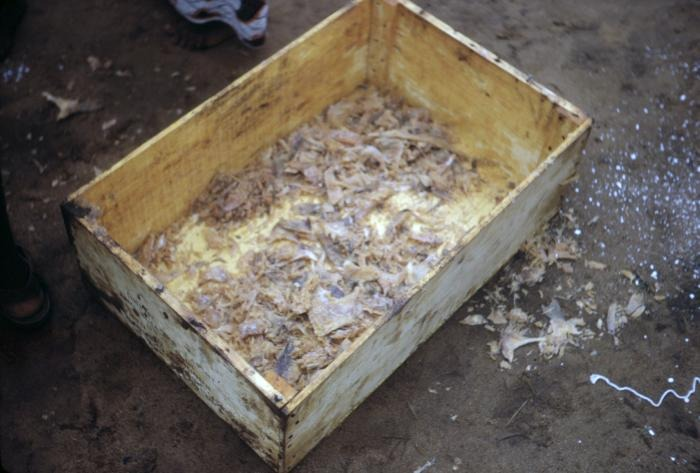
Credit: CDC/Public Health Image Library (PHIL), PHIL ID 7155 / Wikimedia Commons. Public domain. Source page: https://wwwn.cdc.gov/phil/Details.aspx?pid=7155
Closing Charge
Part 12 closes the series with the hardest legal fact: the world later wrote into law what Biafra’s children had already written into their bodies. Starvation of civilians as a method of combat is prohibited because power had proved it would use hunger when the law, diplomacy, and foreign interest allowed enough room.
Gowon’s regime can hide behind unity, but unity does not explain a siege that pushed children into starvation. Britain can plead complexity, but complexity does not erase the strategic cover it gave to federal power while civilian bodies collapsed in public view. Revisionists can retreat into distance, ambiguity, and the passage of time. The evidence does not retreat with them. Biafran children were starved before the law found its full language, but not before the world understood what was being done. That is the final charge. Biafra was not only a famine, not only a war, not only a humanitarian disaster. It was the exposure of a regime that made hunger useful, an ally that helped keep that regime protected, and an international order prepared to let starving bodies carry the cost of power.
Forensic Charts — Part 12
Chart 1 — Why Later Law Had to Speak Clearly
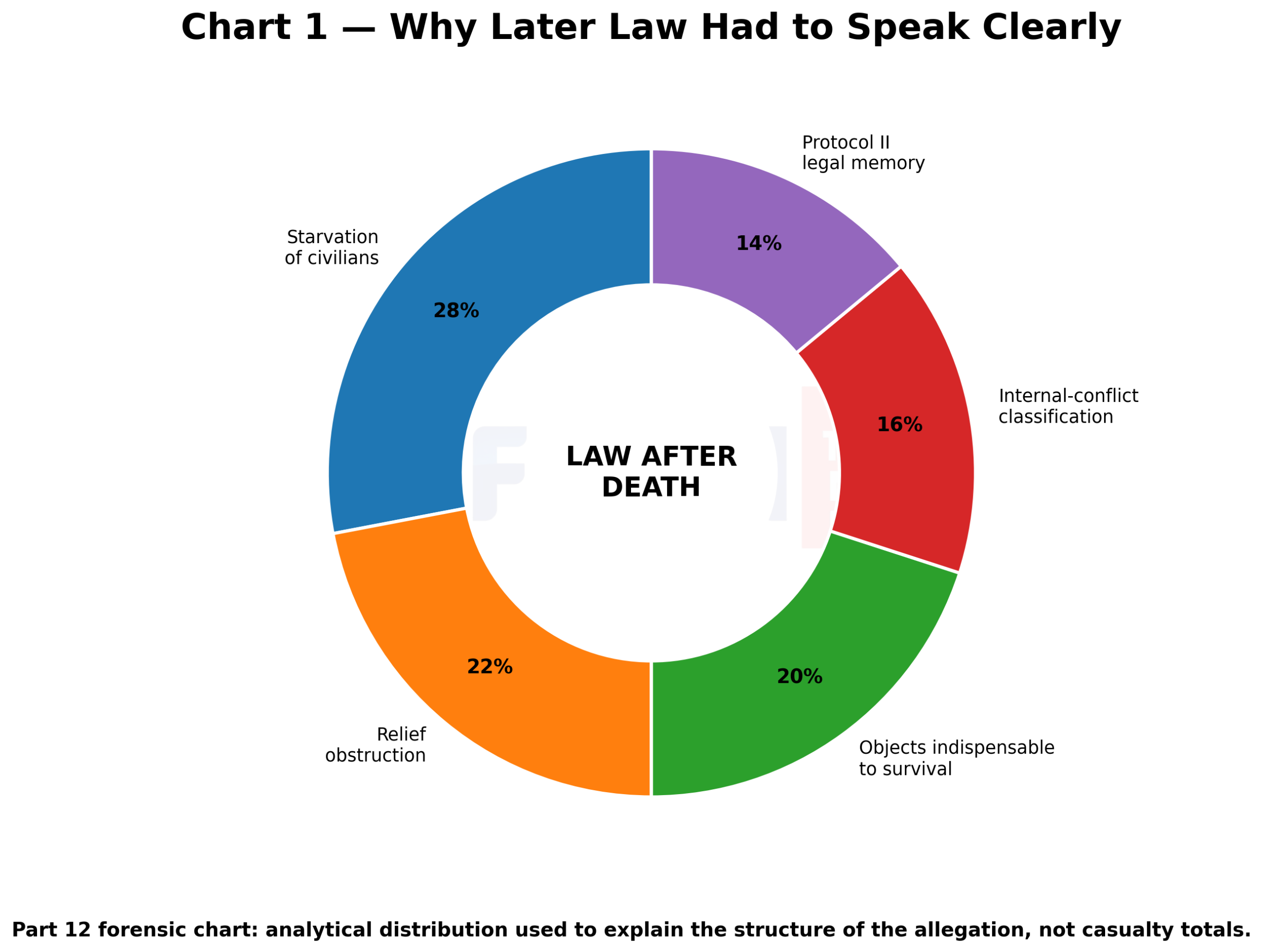
This chart shows why Biafra belongs to the legal history of starvation: civilian hunger, relief obstruction, objects indispensable to survival, internal-conflict classification, and the later Protocol II memory all form one evidentiary chain.
Chart 2 — Legal Clarity After Biafra
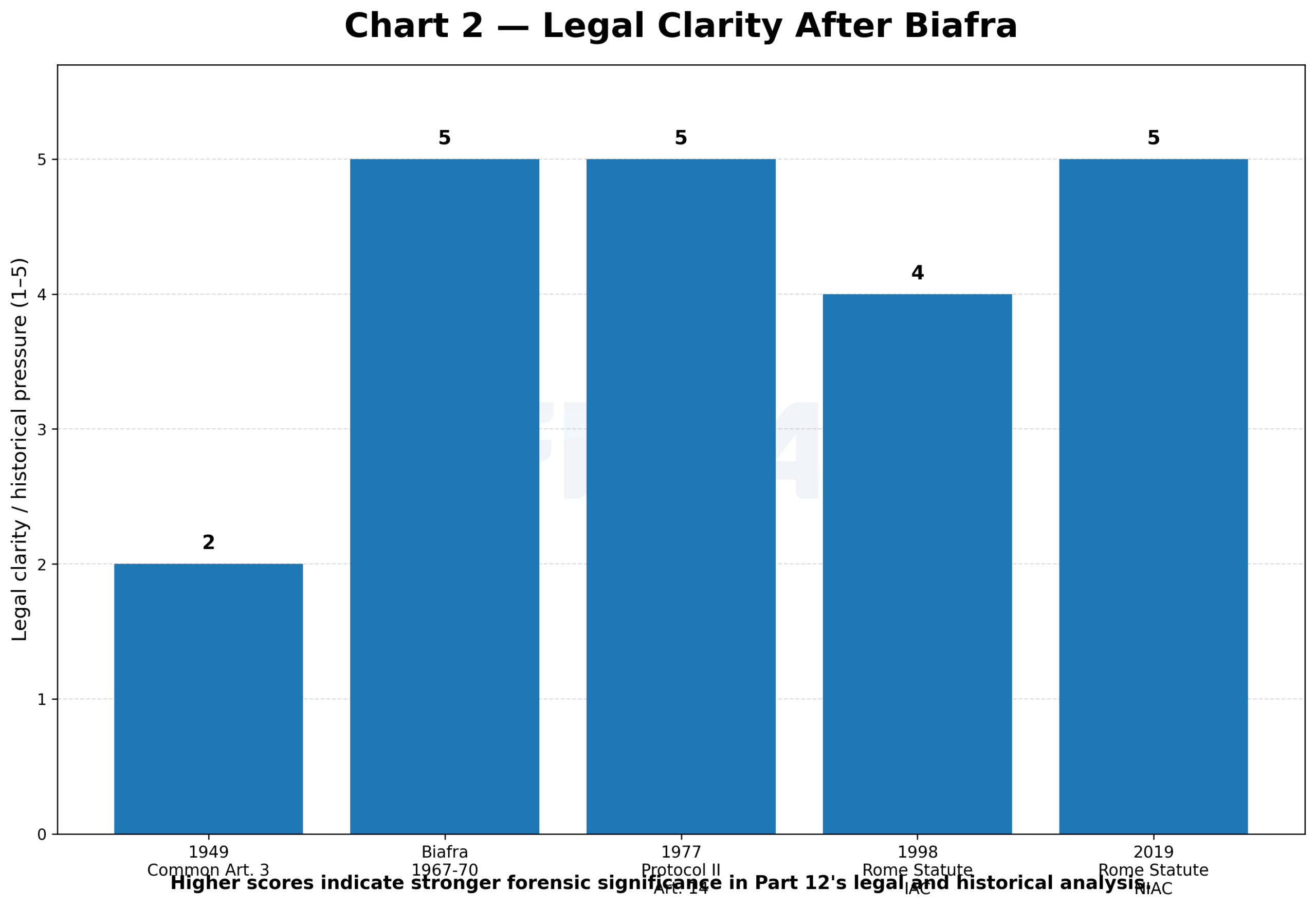
The bar chart tracks the growth of legal clarity from Common Article 3 to Protocol II Article 14 and later Rome Statute development. The point is not that law created humanity late; it is that Biafra exposed how badly clearer rules were needed.
Chart 3 — From Child Starvation to Legal Prohibition
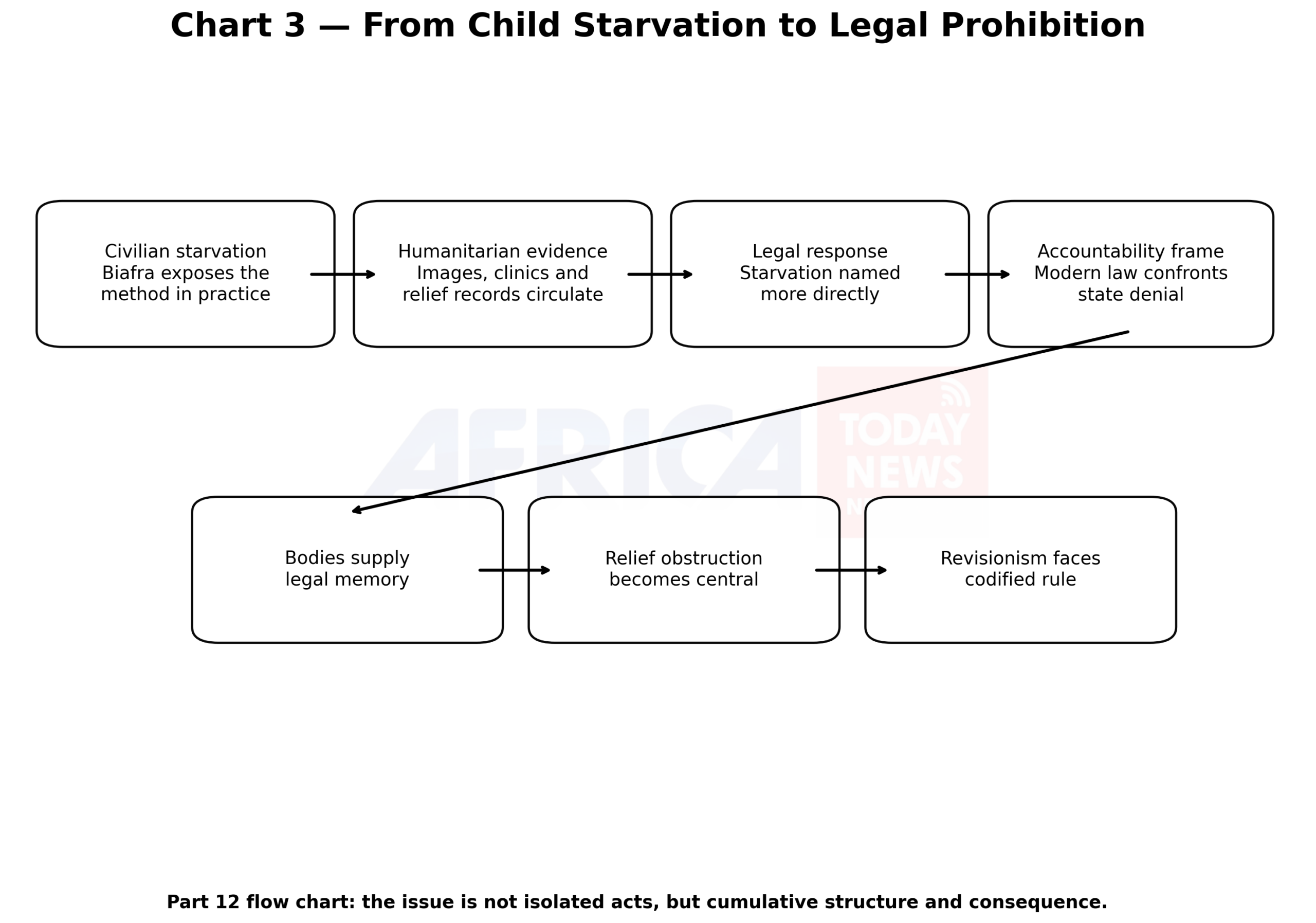
The flow chart follows the movement from civilian starvation to legal memory. Clinics, images and relief records carried evidence outward; later law named starvation more directly; modern accountability frameworks now expose the excuses Gowon’s government relied on.
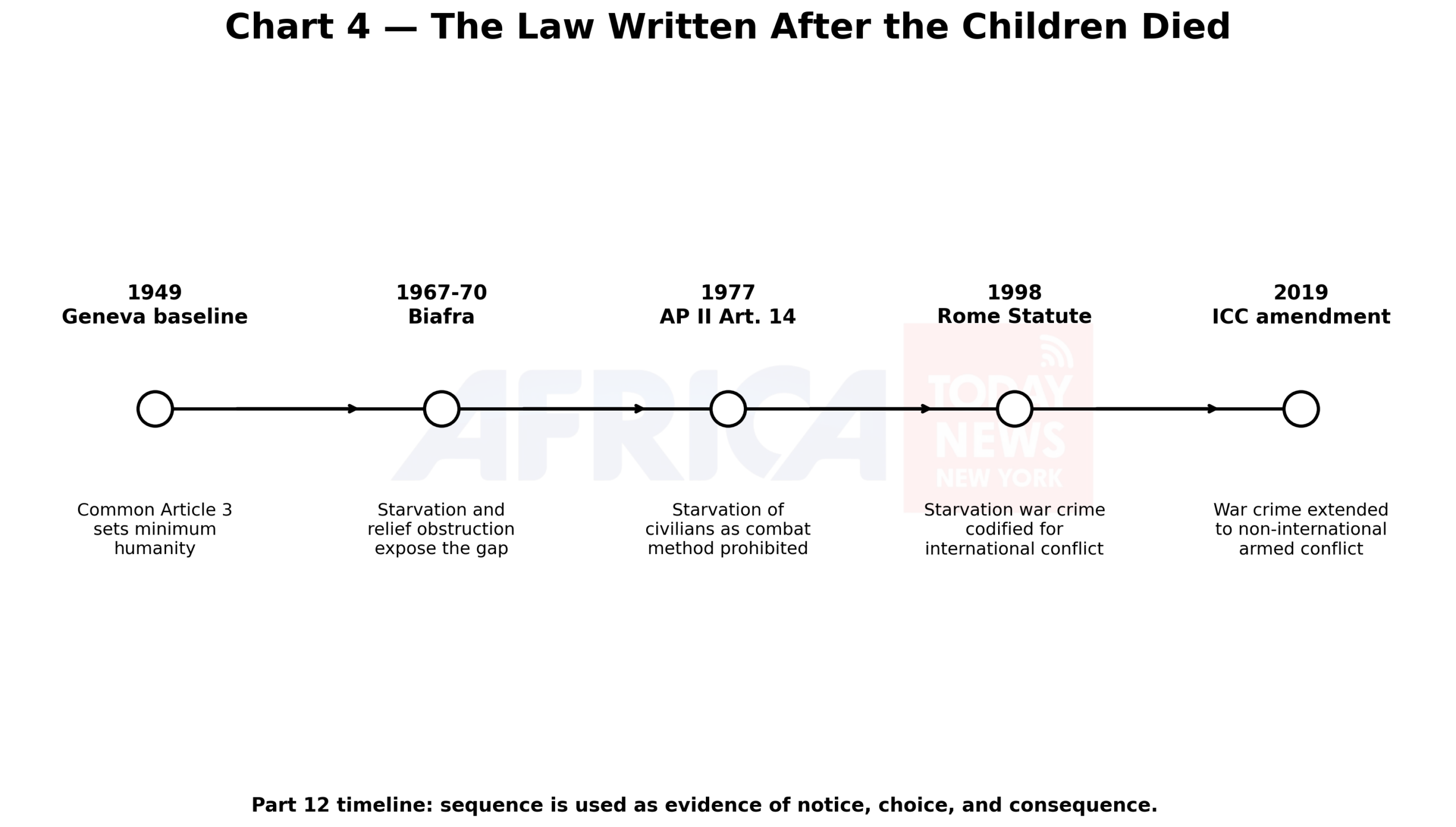
The timeline links 1949, Biafra, 1977 Protocol II Article 14, the Rome Statute, and the 2019 starvation amendment for non-international armed conflict. It shows the brutal legal lesson: the children died before the law spoke with sufficient precision.
Historical Sources, Legal Authorities, and Evidentiary Record — APA 7th Edition
Britannica. (2026). Nigerian Civil War. Encyclopaedia Britannica.
International Committee of the Red Cross. (1977). Protocol Additional to the Geneva Conventions of 12 August 1949, and relating to the protection of victims of non-international armed conflicts (Protocol II), Article 14.
International Committee of the Red Cross. (n.d.). Customary IHL Rule 54: Attacks against objects indispensable to the survival of the civilian population.
Desgrandchamps, M. L. (2018). Biafra: At the heart of postcolonial humanitarian ambiguities. Alternatives Humanitaires, 9, 86–99.
D’Alessandra, F. (2019). The war crime of starvation in non-international armed conflict. Blavatnik School of Government Working Paper.
Heerten, L. (2017). The Biafran War and postcolonial humanitarianism: Spectacles of suffering. Cambridge University Press.