
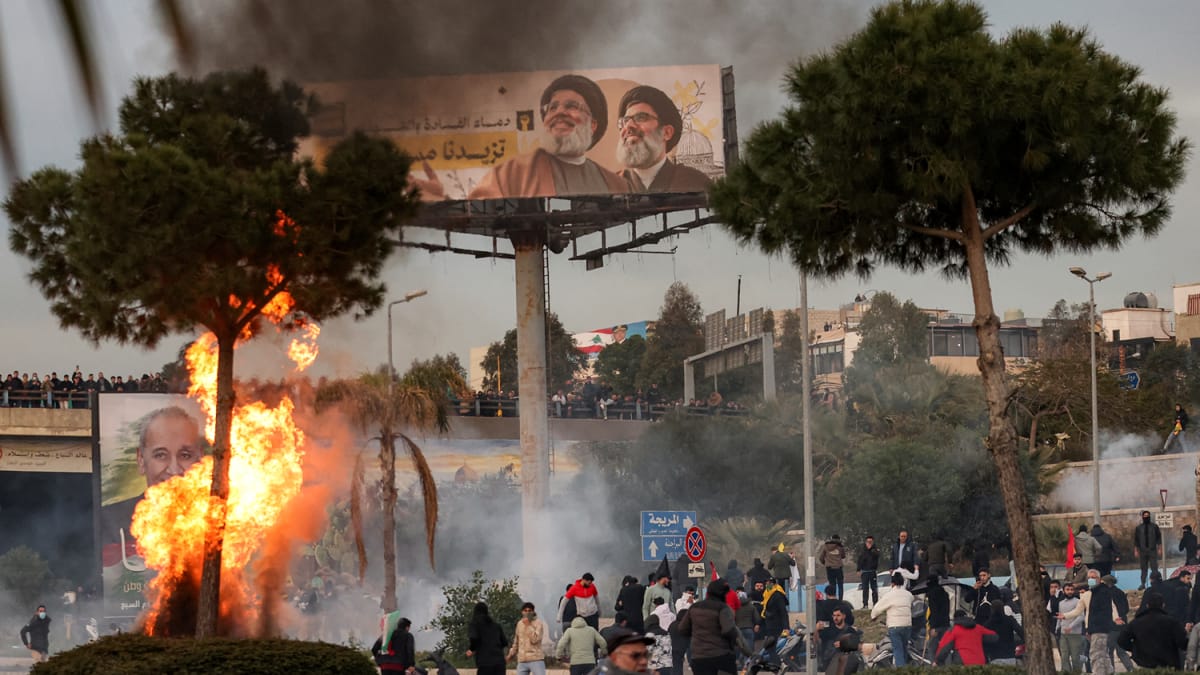
The Lebanon ceasefire that Washington built its diplomatic off-ramp around collapsed from both ends on Thursday, with Hezbollah rejecting the U.S.-brokered agreement outright and Israel declaring it had no intention of withdrawing its forces from a country it invaded three months ago, effectively destroying the one condition Iran has set for any broader peace negotiations with Washington.
The dual repudiation left the Trump administration holding a document that neither combatant recognized.
Iran had been explicit: a halt to the Lebanon fighting is a precondition — not a byproduct — of any deal with Washington. Tehran has also signaled in recent days that continued Israeli operations in Lebanon could draw it into direct intervention. With Hezbollah now on record against the pact and Israel publicly committed to pressing its campaign in the south, that condition is no closer to being met than it was when negotiations began. Hezbollah leader Naim Qassem’s rejection carried an additional political logic: the group had been excluded from the negotiations entirely, making the resulting agreement something closer to a bilateral arrangement between Israel and the Lebanese government — one that the militia that controls southern Lebanon’s operational environment had no obligation to honor.
Trump, asked about Lebanon in Washington, said progress was being made.
He also described the current state of hostilities across multiple fronts — Gaza, northern Israel, Kuwait, and the waters off Iran — as involving “shooting in a more moderate manner,” a formulation that earned no evident endorsement from residents of those areas. On Wednesday, Iranian and U.S. forces exchanged strikes in the Persian Gulf in one of the most sustained engagements since an April ceasefire was supposed to have wound down large-scale hostilities. Iranian forces struck Kuwait’s main airport, killing one person and injuring more than 60.
Read also: France Presses Lebanon Peace Plan As Israel Rejects Demand
The U.S. military struck near the Strait of Hormuz. In Oman, an alleged drone attack forced a suspension of oil loading at the Mina al Fahal terminal after an explosion, two people familiar with the matter said.
The Strait of Hormuz has been largely closed since the war began.
That closure, now entering its fourth month, has removed from normal circulation roughly one-fifth of global oil and liquefied natural gas supplies. Iranian oil exports have fallen to their lowest level in six years. Oil prices dipped about three percent on Thursday on optimism that the Lebanon ceasefire — the one just rejected by both principal combatants — might open a path toward de-escalation. The gap between market sentiment and ground conditions has rarely been wider.
Iran’s new Supreme Leader, Ayatollah Mojtaba Khamenei, said Thursday that the country’s enemies had already been defeated on the battlefield and were now attempting to manufacture internal divisions. Khamenei assumed the position after his father was killed in an airstrike at the outset of the war. He has not appeared in public since taking power.
Read also: Israel Opens Ground Push In Southern Lebanon
Tehran’s stated terms for any agreement with Washington remain consistent: access to billions of dollars in frozen oil revenue, sanctions waivers on crude exports, an end to the naval blockade on its ports, and retained leverage over the Strait of Hormuz. Trump, who has defined the war’s primary objective as preventing Iran from acquiring nuclear weapons, told reporters the United States did not need a negotiated agreement to gain access to Iran’s enriched uranium stockpiles. “I don’t think they could stop us if we wanted, but there’s no reason to,” he said. “It’s entombed.” The United Nations nuclear watchdog, reporting Thursday, found Iran’s atomic program largely unchanged despite three months of sustained U.S. and Israeli strikes.
Iran says its nuclear program serves civilian purposes.
Israel’s Defense Minister Israel Katz had no patience for diplomatic ambiguity. His forces would not withdraw from Lebanon, he said, and operations would not be halted. The commander of Iran’s Revolutionary Guards Quds Force — the unit that established Hezbollah in 1982 — set his own minimum: Israeli withdrawal to the positions it held before the war began. Those two positions are not negotiating stances separated by a narrow gap. They are incompatible outcomes.
At home, Trump absorbed a formal legislative rebuke on Wednesday when the House voted 215 to 208 to invoke the War Powers Act and block the continuation of hostilities — a vote the administration dismissed as symbolic and almost certainly heading nowhere in the Republican-controlled Senate. Trump is expected to veto any resolution that reaches his desk, and his legal team has questioned the Act’s constitutional authority over presidential military decisions. The political signal, however, is no longer dismissible: with congressional elections approaching in November and fuel prices a live domestic issue, the war’s costs are entering a phase where they press back.