
The Ebola strain spreading through eastern Democratic Republic of Congo has killed 101 people and infected 550 since it emerged in mid-May — and unlike the variants the world has learned to fight, this one has no approved vaccine and no approved treatment. Two candidate vaccines exist on paper. Neither is ready for human trials.
That absence sits at the center of an outbreak that health authorities were already behind on before it was publicly announced. The DRC government declared the emergency May 15, but officials have since acknowledged the Bundibugyo strain was circulating undetected for weeks before that date. By the time the response mobilized, the virus had seeded itself across three provinces where more than 120 armed factions operate and where the state has no reliable security footprint.
In the 24 hours preceding Monday’s situation report, 35 new confirmed cases were recorded and 10 people died — numbers that track a trajectory the World Health Organization has not been able to bend since declaring a public health emergency in mid-May.
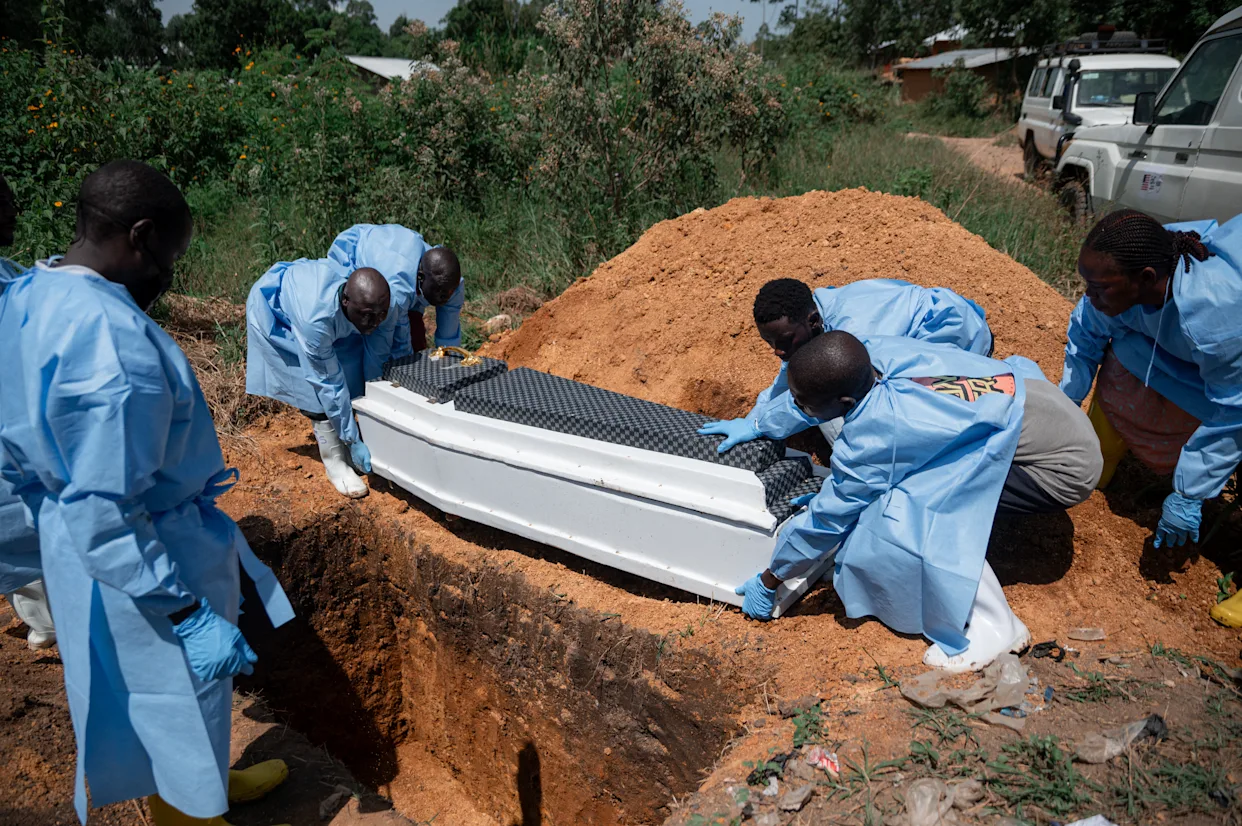
The outbreak is concentrated in Ituri, North Kivu and South Kivu, provinces that have been in various states of armed conflict for decades. The latest cases were confirmed across 17 health zones in Ituri, seven in North Kivu and one in South Kivu. In Ituri’s Djugu, Irumu and Mambasa territories, the government’s situation report said armed group activity was continuing to limit humanitarian access in multiple affected and at-risk health zones. The capital of Ituri, Bunia, was described as relatively calm — a characterization shattered the same day by events at the Nyamurongo cemetery, where a burial team was attacked on Sunday, leaving two people seriously injured and two vehicles damaged.
Read also: Uganda Woman Held In India Over Ebola Returns Negative Test
Burial teams are not incidental to Ebola containment. They are the mechanism. Safe burial is one of the most critical interventions available, because Ebola victims remain infectious after death and traditional burial practices involving physical contact with the body have historically driven transmission chains. An attack on a burial team is not just a security incident — it is a direct hit on the operational core of the outbreak response.
The conflict driving that environment is not monolithic. Researchers tracking armed group activity in the three provinces attribute the sustained violence to ethnic tensions, political rivalries, corruption, and competition for control of mineral resources in one of the world’s most resource-rich and governance-poor regions. More than 120 groups are active. WHO Director-General Tedros Adhanom Ghebreyesus flagged the area’s status as a mining zone with high levels of population movement as a specific factor elevating the risk of the virus spreading beyond its current geography.
That spread is already underway. Neighboring Uganda has recorded 19 confirmed cases and two deaths. All but five of those cases involved Congolese nationals who crossed the border; one confirmed Ugandan case involved a Congolese citizen who had traveled to the United Arab Emirates before entering Uganda. The UAE moved swiftly after that disclosure, announcing a ban on travelers arriving from the DRC, Uganda, and South Sudan. Mauritius has reportedly followed. Uganda has closed its border with the DRC entirely.
Tedros, who visited Uganda on Monday, asked authorities to reconsider. Blanket travel restrictions were ineffective, he said, and history from previous outbreaks suggests they tend to push movement underground rather than stop it. “I hope they reconsider,” Tedros said.
Read also: Ebola Outbreak: FG Moves To Reinforce Border Control
The Bundibugyo strain is itself a relatively recent addition to the known Ebola family. It was first identified in western Uganda less than 20 years ago and has now caused only the third documented outbreak linked to it. The Zaire strain — which produced the catastrophic 2014 West Africa epidemic and killed more than 11,300 people — has an approved vaccine that global health authorities can deploy. Bundibugyo does not. The comparison matters because the 2014 epidemic, the deadliest in Ebola’s recorded history, was eventually brought down by a combination of vaccine deployment, contact tracing and community engagement working in parallel. Only one of those tools is currently unavailable in eastern DRC. The other two are being disrupted by men with guns.
This is DRC’s 17th Ebola outbreak since the virus was first identified in the country in 1976. The country has survived sixteen of them. Each of the previous outbreaks occurred before a strain circulated simultaneously in a region with no medical countermeasure, an active insurgency across its epicenter, and a case already logged in the Gulf.