
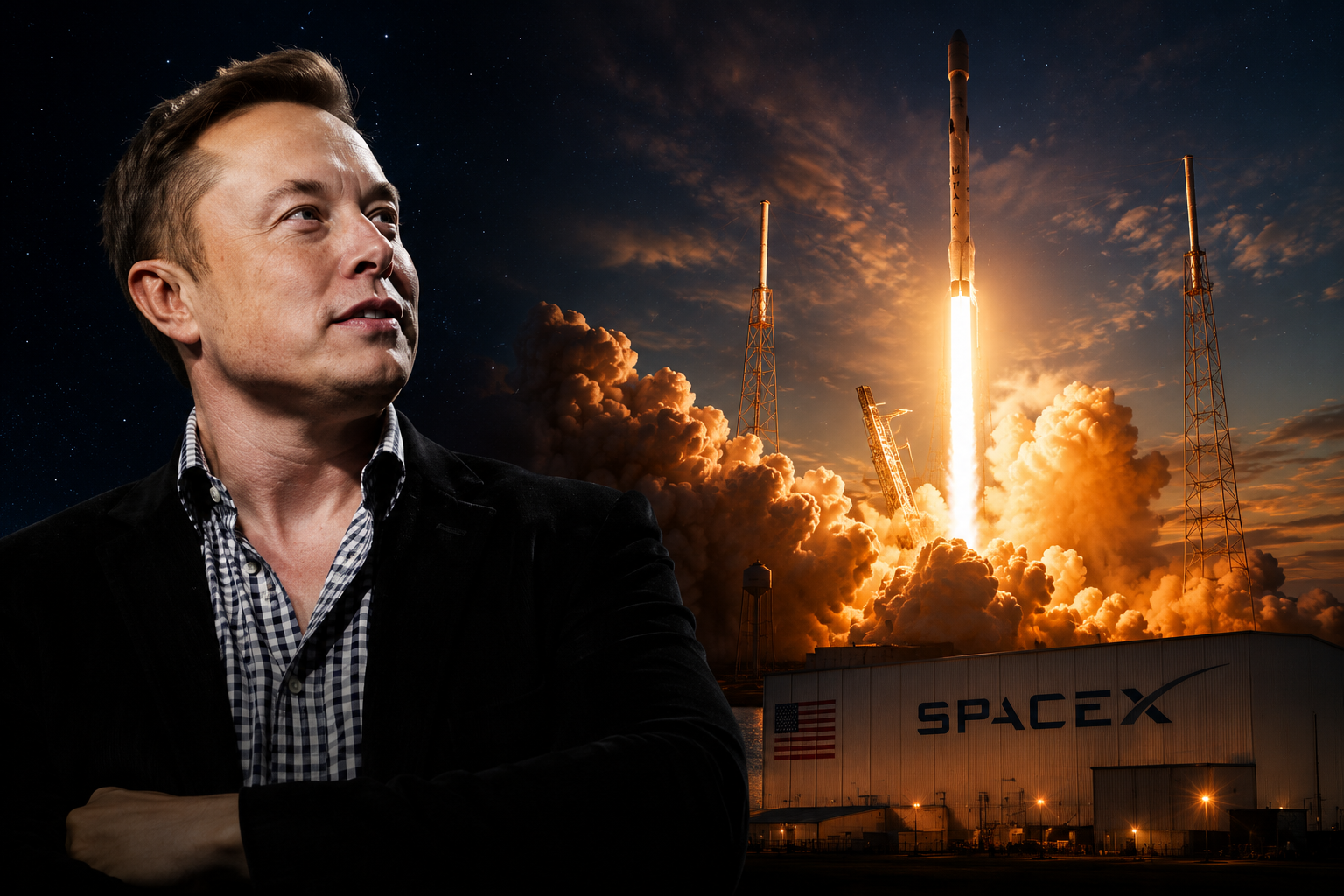
Elon Musk’s space company began trading on the Nasdaq Thursday at a listing price that set a record no company has ever reached — $1.77 trillion — after institutional investors placed orders for more than four times the available shares, sovereign wealth funds from the Gulf committed billions before a single share changed hands on the open market, and retail buyers submitted orders exceeding $100 billion for a company that lost $4.9 billion last year.
SpaceX priced at $135 a share under the ticker SPCX. It raised $75 billion, selling 555.6 million shares, in what immediately became the largest public offering in history. The demand was not close.
Saudi Arabia’s Public Investment Fund and Kuwait’s Investment Authority each committed between $1 billion and $5 billion ahead of the official pricing, Bloomberg reported, citing sources familiar with the transactions. The world’s largest asset manager placed an order for $5 billion in stock on its own — a sum nearly matching the entire $5.5 billion IPO of AI chipmaker Cerebras earlier this month, until Thursday the largest listing of 2026. Retail interest dwarfed even that: Forbes reported individual investor orders topping $100 billion for shares that were never going to be available at that volume.
Behind the frenzy sits a financial reality that not everyone in the crowd is fully pricing in.
SpaceX recorded a net loss of $4.9 billion in 2025, with the deficit deepening through the year and hitting $1.9 billion in the fourth quarter alone — a function, according to The Motley Fool, of relentless spending on rocket development and AI infrastructure.
Revenue grew 33% to $18.6 billion, a rate that actually decelerated from 2024’s 35% gain. The company is burning cash at scale, in pursuit of markets that do not yet fully exist.
Read also: Elon Musk Found Guilty Of Misleading Twitter Shareholders
Aswath Damodaran, the NYU Stern finance professor whose valuations carry weight on Wall Street, put it without embellishment. SpaceX, he said, is a growing, money-losing, cash-burning enterprise that will function as an Elon Musk vehicle — with all the advantages and hazards that status implies. Damodaran’s analysis of the 377-page pre-listing prospectus places Musk’s ownership stake at approximately 85%.
That stake, at Thursday’s IPO price, vaults Musk’s net worth to roughly $982.6 billion according to Forbes’ real-time tracker — up from $801 billion before pricing. The world’s first trillionaire will almost certainly answer to the name Elon Musk. The only question is timing.
Investment bank New Street assigned SpaceX a price target of $165 — implying roughly 22% upside from the IPO price and a valuation approaching $2.3 trillion once the company’s recent acquisition of AI code editor Cursor is factored in. In a bull scenario capturing the upper end of the company’s addressable market, New Street put the shares at $330. The bank projects SpaceX generating $195 billion in revenue and $65 billion in operating earnings by 2030.
SpaceX’s evolution from a rocket and satellite business into something considerably more sprawling accelerated with its acquisition of xAI, Musk’s artificial intelligence venture founded in 2023, which brought with it the Grok chatbot and the Colossus supercomputer cluster.
That acquisition reshaped the company into three operating divisions: space, connectivity, and AI. Colossus now sits on SpaceX’s balance sheet, leased to Anthropic — separately valued at $965 billion and itself awaiting a public offering — for $1.25 billion per month.
New Street values the Starlink direct-to-home satellite business alone at $400 billion, the direct-to-cell service at $250 billion, and third-party launch operations at $100 billion. It assigns an additional $575 billion to xAI, arguing that controlling the underlying compute infrastructure warrants at least a 60% premium over rivals, with orbital data center plans adding further potential upside.
Read also: Trump Floats Deporting Elon Musk As Clash Heats Up
The bears have history on their side, even if the crowd is not listening. The Motley Fool notes that stocks debuting at very large market capitalizations have consistently underperformed the broader market over time, and that companies achieving valuations at this level have, without exception, eventually given back substantial ground — on average close to three-quarters of peak value. The timing, it acknowledges, is impossible to predict.
SpaceX is the first of several landmark listings expected this year. Anthropic, which recent funding rounds have pushed to a reported $965 billion valuation, is expected to file for an IPO targeting more than $60 billion in proceeds, with October cited as a likely window. OpenAI is also in the queue, with no confirmed date from either company.
Thursday’s debut places SpaceX among the eight most valuable publicly traded companies on earth — a position it reached before generating a dollar of profit, on the strength of what it might eventually become, in markets it is still in the process of building. Whether that faith holds is what the next several years of trading will determine.