
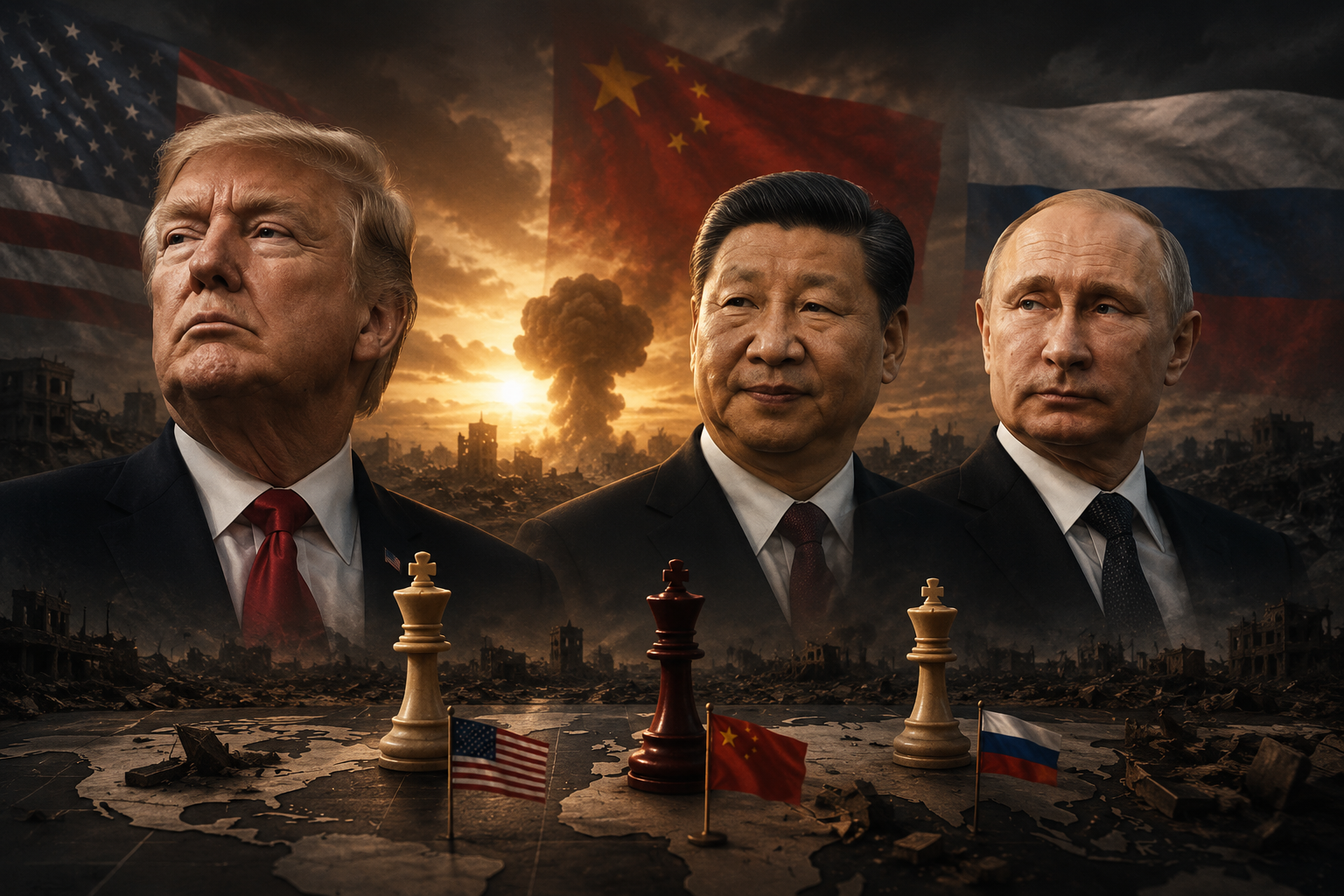
At the Group of Seven summit in Evian-les-Bains, France, Donald Trump offered his most pointed public gratitude of the post-ceasefire period Wednesday — not to the allies who fought alongside the United States in the war against Iran, but to two leaders his administration spent years casting as the principal threats to American global influence.
Speaking at a press conference on the French Riviera, Trump thanked Chinese President Xi Jinping and Russian President Vladimir Putin for remaining neutral during the conflict, saying both men had chosen not to interfere and that he was grateful for it. Their restraint, in his telling, had helped secure the ceasefire he arrived in Europe to mark. The same assessment did not extend to American treaty partners in Europe and Japan, whom Trump has criticized throughout the war for insufficient military contributions and slow progress clearing the Strait of Hormuz — the Iran-blocked maritime passage whose closure disrupted global energy flows for weeks, triggering oil price spikes that rippled across importing economies.
The praise landed against a record that complicated it considerably. Beijing had condemned U.S. and Israeli strikes on Iranian territory as a brazen violation of Iran’s sovereignty. U.S. intelligence officials assessed that China supplied Tehran with goods capable of serving military purposes during the conflict, according to people familiar with the matter.
China’s independent oil refiners absorbed a substantial portion of Iranian crude output while the fighting continued, defying the American sanctions framework designed to constrain Tehran’s war economy. Russia warned repeatedly that the war risked producing a nuclear arms race across the Middle East — and both Moscow and Beijing carry deep economic and political ties with Tehran that long predate the fighting.
What Trump chose to credit was none of this. It was the escalation that didn’t happen.
“They could have sent in an oil ship with six destroyers alongside of it, on each side,” he said of China. “They didn’t do that. President Xi helped me. He tried to help, and I think he probably helped get it solved.”
Read also: African, Asian Immigrants Poisoning US Blood, Trump Declares
The logic turned on a threshold — not what Beijing and Moscow did during the conflict, but what they withheld. Absent military escorts for Iranian tankers, absent direct weapons shipments to the front lines, both countries cleared the bar Trump set for gratitude. The allies who deployed forces did not. It was a standard that rewarded non-belligerence among rivals more generously than active sacrifice among partners — an implicit hierarchy that several allied governments left Evian quietly examining.
That inversion found its sharpest expression in the summit’s own setting. The G7 convenes annually as a forum for the world’s largest democratic economies to coordinate strategy — and, frequently, pressure — toward precisely the kind of authoritarian state actors Trump was now publicly praising. None of the delegations in Evian represented China or Russia.
Read also: Trump Threatens Musk Amid Fierce Budget Bill Dispute
China’s embassy in Washington moved to reinforce the framing after Trump’s remarks. A spokesperson said Beijing’s position had remained consistent throughout the war and that Chinese officials had been working continuously toward an end to the fighting. The statement did not address intelligence assessments about dual-use goods or the oil purchases that kept Iranian revenues flowing under American sanctions. Russia’s embassy in Washington did not respond to a request for comment.
The ceasefire settled the immediate fighting but left its deeper questions open. Iran’s nuclear infrastructure, struck by U.S. and Israeli forces in March, remains at the center of active diplomatic negotiations. No terms have been disclosed regarding the future of Iranian enrichment, the conditions for sanctions relief, or the permanent status of the Strait of Hormuz — whose months-long closure showed how thoroughly a single choke point can rewire global energy markets and expose the limits of American military reach.
Trump gave no indication those outstanding issues complicated his accounting of the war. He stood at a lectern in the French Alps and offered his thanks to two men whose governments spent the conflict condemning the operation he ordered, trading with the country he targeted, and warning of the instability his campaign had set in motion.
The leaders whose nations fought alongside the United States left Evian without a similar word.