
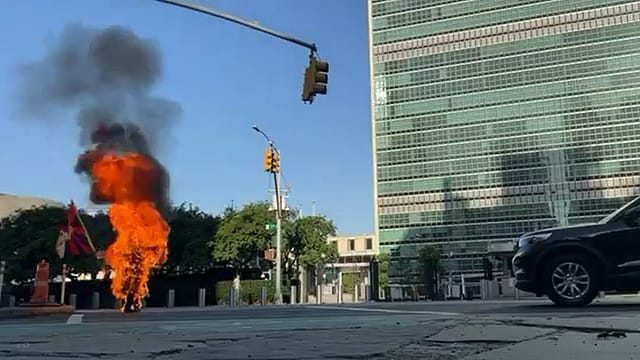
A New York cab driver who spent four decades in exile from Tibet died Thursday night after setting himself on fire on First Avenue, steps from the United Nations headquarters, in one of the only known instances of Tibetan self-immolation ever recorded on American soil.
Police identified the man as 52 years old and said he suffered burns across his entire body before being rushed to a hospital, where he was later pronounced dead. New York’s government-in-exile and a fellow activist who knew him identified him as Lobga Rangzen, also known as Lobsang Palden.
The moment was captured on a livestream from a Facebook account bearing his name. Footage shows him pausing along the avenue opposite UN headquarters, a Tibetan flag in hand, before flames engulf him. He collapses to the pavement as traffic continues past. Two bystanders eventually extinguish the fire with hand-held extinguishers.
A second video, posted to the same account around the same time, shows him urging Tibetans to unite for what he called the independence of their homeland. He accused Beijing of pursuing policies “aimed at destroying the Tibetan identity, culture and language.”
The act followed by days the passage of a sweeping ethnic unity law in China that broadens the mandatory use of Mandarin in schools and government offices across minority regions and pushes for deeper “Sinicization” of religious practice. Rights groups and Tibetan advocates have described the legislation as a fresh threat to cultural survival in Tibet; Chinese authorities maintain the law safeguards the interests of all ethnic groups within the country.
Read also: New York’s Court Reverses Harvey Weinstein’s Rape Conviction
Jamyang Norbu, a prominent Tibetan writer who also confirmed the victim’s identity, described him in a video posted by New York—based Tibetan activist groups as a longtime independence organizer and community figure. He had left Tibet in the 1980s, eventually settling in New York, where he drove a taxi.
Self-immolation has a long, documented history as a form of political protest against Chinese rule in Tibet, with dozens of cases recorded over the past two decades, according to figures maintained by the Tibetan government-in-exile. Nearly all of those cases occurred inside Tibet or in neighboring regions of China.
An act of this kind on American soil is exceptionally rare.
Penpa Tsering, president of the Tibetan government-in-exile, issued a statement Friday saying he was “deeply saddened” by the death and appealed to Tibetans everywhere to preserve their lives for what he called the long-term struggle for Tibet. Human life, he said, “is precious and must be preserved.”
Read also: New York Street Named After Soccer Legend Thierry Henry
Tsering’s statement also invoked the new unity law directly, framing it as evidence that Tibetans face what he termed a severe crisis. He called on foreign governments, exile communities and international rights organizations to speak out.
Crowds gathered outside the UN compound Thursday night in the hours after the incident, with video circulating on social media showing supporters and protesters holding vigil along First Avenue. Organizers with Tibetan advocacy groups in New York helped coordinate the gathering.
China has governed Tibet since 1951 and considers the territory to have been part of its sovereign land for centuries, a position it has defended through decades of international scrutiny. Display of the Tibetan flag is outlawed within China and treated by authorities there as a symbol of separatism.
Generations of Tibetans both inside the country and in exile communities abroad have pushed back against what they describe as escalating controls on religious worship, language instruction and cultural expression — accusations Beijing has consistently denied.
A spokesperson for the United Nations said the self-immolation took place after the day’s scheduled meetings had already concluded, and that no UN proceedings were affected by the incident, according to the Associated Press.
Rangzen spent roughly forty years building a life in a country that never became the one he was fighting for. He drove strangers across a city that rarely paused to ask where he came from. On Thursday evening, steps from an institution built to mediate the world’s disputes, he made sure it did.