
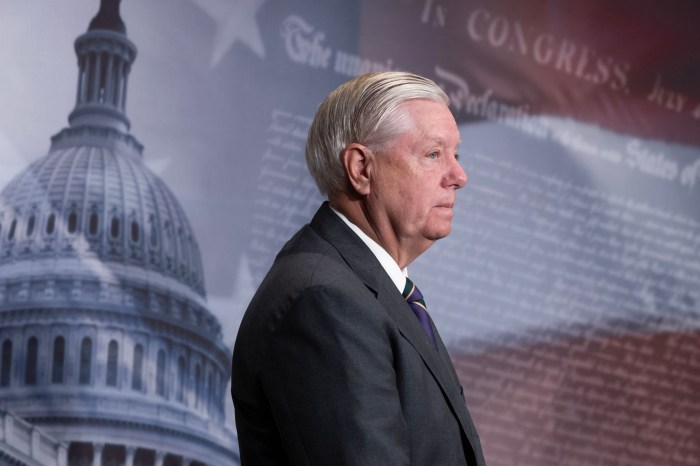
Sen. Lindsey Graham, the South Carolina Republican who spent two decades shaping the party’s hawkish foreign-policy wing, died Saturday night at his Capitol Hill residence, his office disclosed early Sunday. He was 71.
His staff attributed the death to a brief and sudden illness and asked for privacy as the family navigates what it called an incredibly difficult stretch.
Africa Today News, New York, learned that police scanner traffic obtained by NBC News shows first responders were summoned to Graham’s home Saturday evening on a report of cardiac arrest. Images from the scene captured paramedics wheeling a stretcher toward a waiting ambulance, with squad cars and fire apparatus lining the block. A senior aide said nothing beforehand had signaled the senator was ailing; he’d been penciled in for a Sunday appearance on NBC’s “Meet the Press.”
Graham held his seat since 2003, most recently steering the Senate Budget Committee, and had cleared a crowded primary field just last month to seek a fifth term. His departure now forces South Carolina Republicans to scramble for a replacement nominee ahead of a special primary state law requires by Aug. 11. In the interim, Gov. Henry McMaster holds the power to name a placeholder senator, whose tenure would run only through Jan. 3.
The senator had touched down from Kyiv only days earlier, having sat down Friday with Ukrainian President Volodymyr Zelenskyy. In a statement, Zelenskyy recalled a running dialogue with Graham that he said he’d sorely miss, noting the senator had lately been maneuvering to tighten the sanctions vise on Moscow. European Commission President Ursula von der Leyen credited him with pressing Ukraine’s cause to his last days in office. Israeli Prime Minister Benjamin Netanyahu called Graham’s death a loss for one of Israel’s staunchest champions, pointing to his decades spent cementing the U.S.-Israel partnership. State outlets in Iran, which have long painted Graham as an unrepentant hawk toward Tehran, carried news of his death, while exiled former crown prince Reza Pahlavi wrote online that Graham had sided with Iranians resisting their own government.
Stateside, President Donald Trump set the tone for tributes, posting on Truth Social that Graham was a true American patriot. Senate Majority Leader John Thune framed him as a steadfast ally to nations that prize freedom, while McMaster remembered a man who fought harder for South Carolina than almost anyone.
The news arrives weeks into a parallel health scare for Republican colleague Mitch McConnell, hospitalized since paramedics answered a cardiac-arrest call at his residence last month. A spokesperson says McConnell is improving but has offered scant further detail.
Graham’s roots trace to Central, South Carolina, where his family ran a restaurant and pool hall and where he became the first among them to reach college. After a law degree from the University of South Carolina, he spent 33 years threading military service through elected office — as a judge advocate in the Air Force, its reserves, and the state’s Air National Guard — retiring a colonel in 2015 while still serving in Congress.
Read also: Boeing CEO To Appear Before US Senate Amid Safety Crisis
He first won a House seat in 1994, holding it until 2003, when he claimed the Senate seat Strom Thurmond was vacating. Once in the chamber, Graham carved out a niche as a foreign-policy hard-liner, pushing successive administrations — Trump’s and Biden’s alike — toward firmer backing for Ukraine and tougher posturing against Iran. He found kindred spirits in the late Sen. John McCain and former Sen. Joe Lieberman, the trio earning the nickname “Three Amigos” for their aligned hawkishness. Graham chaired the Judiciary Committee from 2019 to 2021 before moving to Budget, where he helped muscle through a sweeping tax and spending package during Trump’s second term.
Geopolitical analyst Michael A. Horowitz told NBC News that Graham stood as the GOP’s last genuinely persuasive voice for the notion that American power ought to shape world events before adversaries seize the initiative. Under Trump, Horowitz added, that influence migrated from rallying broad Senate support to working on the president’s own instincts — using personal loyalty to keep hard-line positions on Iran, Ukraine and Syria alive even as the party’s base drifted inward.
Graham’s bond with Trump wasn’t always warm. He challenged him in the 2016 primary, cautioning that nominating Trump would spell disaster for Republicans, and ultimately cast his general-election ballot for a third-party candidate rather than back Trump or Hillary Clinton. Over the following decade the two men drew closer, Graham emerging as one of Trump’s most visible Senate defenders even while occasionally pushing back on policy behind closed doors. Describing himself to the Press in February as the president’s “north star,” Graham said Trump understood his positioning even when the two men parted ways on substance.