
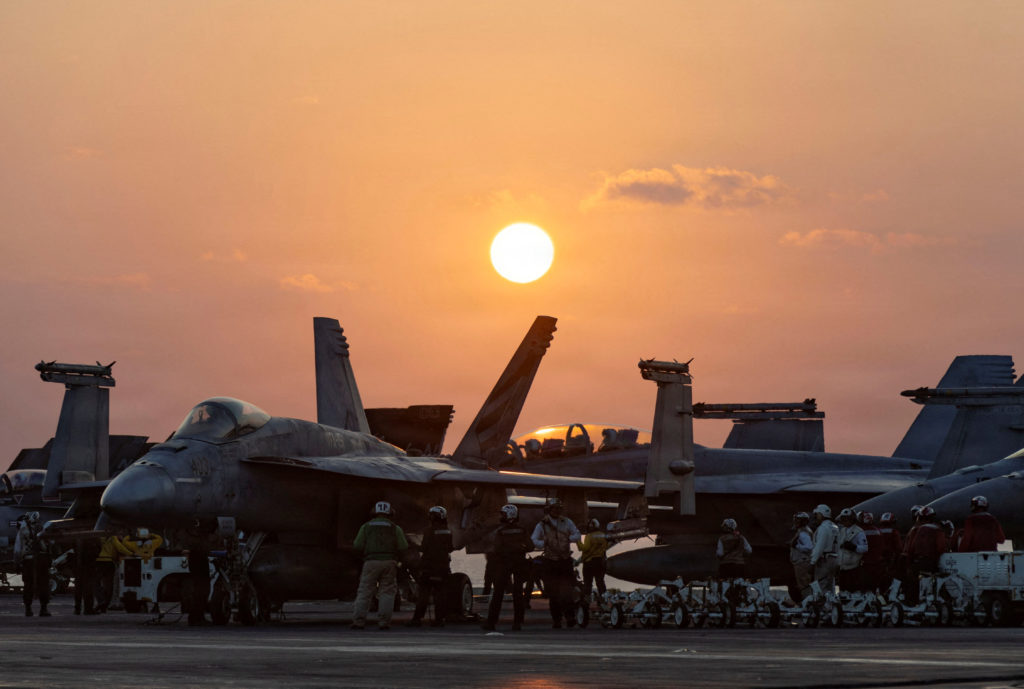
U.S. Central Command said it completed a third round of strikes against Iran late Saturday, hitting approximately 140 military targets after Iranian forces attacked a Cyprus-flagged container ship transiting the Strait of Hormuz, prompting Tehran to declare the waterway closed to shipping.
The targets struck Saturday included Iranian missile and drone sites, naval capabilities, ammunition storage facilities, communication networks and coastal surveillance locations, CENTCOM said. Over three consecutive nights of strikes this week, U.S. forces have hit more than 300 targets in total, the command added.
CENTCOM said the strikes followed an attack by the Islamic Revolutionary Guard Corps on the M/V GFS Galaxy roughly nine nautical miles off the coast of Oman. The vessel suffered an onboard fire and significant engine-room damage, and one civilian crew member was reported missing, according to CENTCOM.
Britain’s UKMTO maritime security agency separately reported that the ship’s crew had abandoned it for a lifeboat after the attack.
Read also: Syria’s Kurds Warn Iran’s Kurds: Don’t Trust Washington
CENTCOM said Iran had been given another opportunity to demonstrate compliance with the Memorandum of Understanding after being held accountable for earlier attacks on commercial vessels, but had again failed to do so; the command added that the strikes were carried out on President Donald Trump’s orders to impose a cost on Iran for threatening commercial shipping. Defense Secretary Pete Hegseth wrote on social media that Iran had made “a poor choice,” adding, “Now they pay.”
Iran’s Revolutionary Guards navy said it had closed the Strait of Hormuz until further notice after firing a warning shot at a vessel it said had switched off its tracking systems and strayed onto an unauthorized route. “A vessel that had jeopardized maritime security by switching off its systems was struck and brought to a halt,” the IRGC said in a statement carried by state media, adding that no vessel would be permitted to cross the strait and warning that any further U.S. military action would draw a harsh response. Iranian state media reported explosions in multiple locations along Iran’s southern coast following the U.S. strikes, including in the port city of Bandar Abbas and on Qeshm Island. Iran’s Revolutionary Guards separately claimed to have struck communication towers and military bases in the region, including Jordan’s Prince Hassan Air Base, saying they had destroyed drone hangars and a command center there; the United Arab Emirates and Qatar said they had intercepted Iranian attacks. None of those claims could be independently verified.
Roughly a fifth of the world’s oil supply typically transits the Strait of Hormuz, and war-risk insurance premiums for vessels crossing it had already climbed sharply in the days before Saturday’s closure. The strait has been the site of repeated attacks on commercial vessels since February, including strikes on tankers and container ships that CENTCOM has linked to Iranian forces and mines.
The current standoff follows the collapse of nuclear talks between Washington and Tehran in Geneva and echoes a shorter, 12-day air war between the two countries in 2025. Attacks on shipping in the strait escalated further in recent weeks: Iranian forces struck the Singapore-flagged container ship Ever Lovely on June 25, drawing a CENTCOM retaliatory strike the next day on sites including Qeshm Island, and hit two tankers — the Qatari-owned Al Rekayat and the Saudi-flagged Wedyan — on July 7.
Read also: Iran’s Path To Washington
Diplomatic efforts to de-escalate the standoff showed little sign of progress Saturday. Trump declared the Islamabad Memorandum of Understanding, the agreement that had underpinned a fragile ceasefire, effectively dead earlier this week. Iranian Foreign Minister Abbas Araghchi nonetheless met his Omani counterpart, Badr bin Hamad Al Busaidi, in Muscat on Saturday to discuss what Iran’s foreign ministry described as mechanisms for the safe passage of ships through the strait. Oman has floated a compromise that would leave the strait’s southern shipping lane open while requiring vessels in the northern lane, which runs through Iranian waters, to obtain Tehran’s approval without paying a toll; neither government has said whether it would accept the proposal.
Jason Brodsky, policy director at the advocacy group United Against Nuclear Iran, said the latest attacks showed Tehran responding to diplomatic outreach “with a clenched fist.” The group has argued in a recent analysis that Iran has violated the Islamabad memorandum’s provisions on the use of force, negotiations and freedom of navigation.
“Commercial vessel transits through the vital international maritime corridor continue,” CENTCOM said in its Saturday statement.