
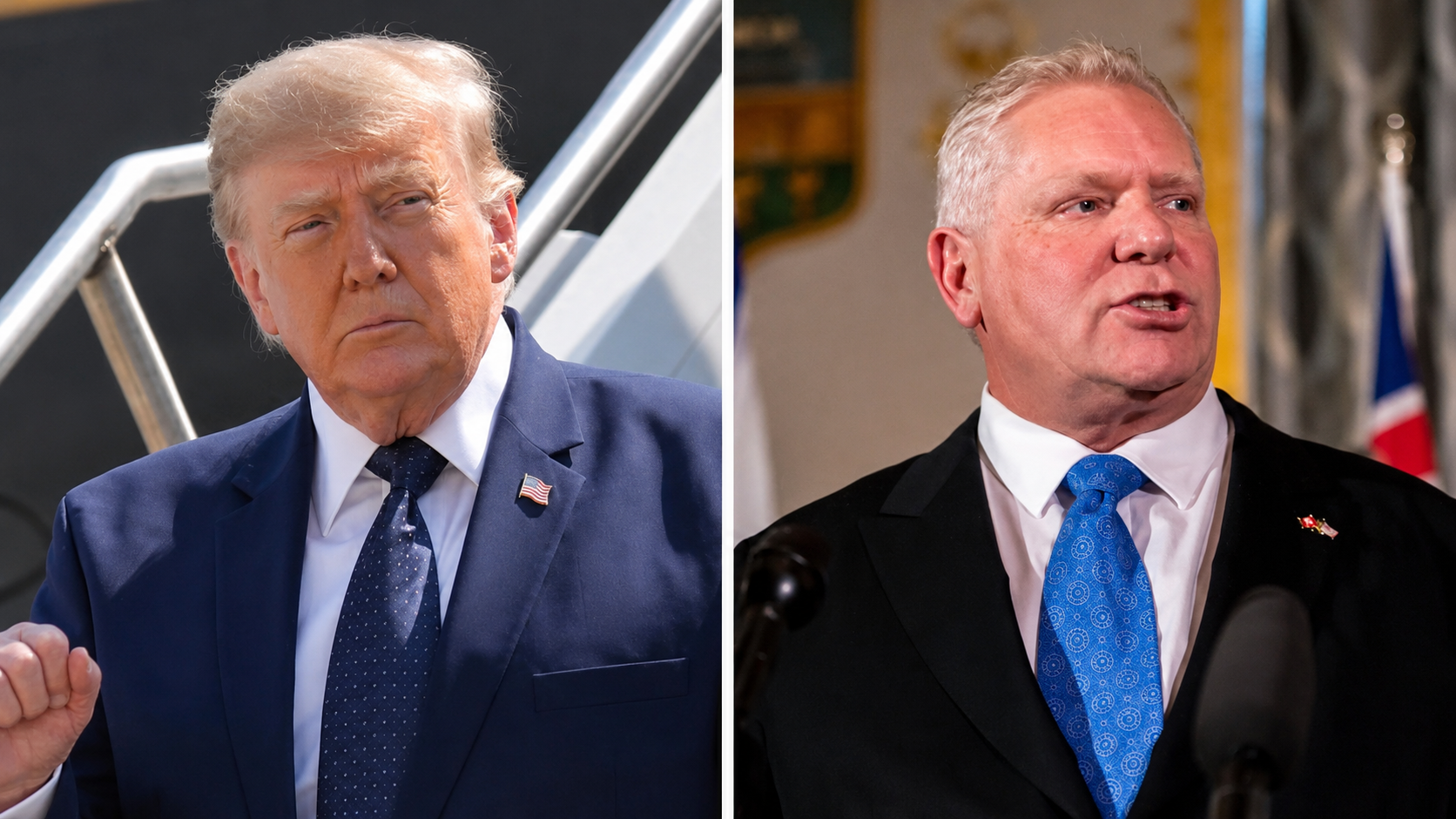
President Donald Trump threatened Friday to add the cost of wildfire smoke pollution to existing tariffs on Canadian goods, prompting Ontario Premier Doug Ford to call the criticism coming from Trump and congressional Republicans “totally unacceptable” a day later.
Trump wrote on Truth Social that Canada’s government had shown willful negligence and failed at basic forest management, blaming those failures for smoke that has blanketed parts of the Midwest and East Coast in recent days. “The United States is being unnecessarily invaded by filthy, polluted, and unhealthy air,” Trump wrote, estimating the pollution was costing the U.S. billions of dollars and saying he would tack the cost of dealing with the smoke onto tariffs already in place on Canadian exports. He said he planned to call Prime Minister Mark Carney to press Canada on its response to the fires.
The scale of the fires is large by any measure. Canada had 955 active wildfires as of Saturday afternoon, according to the Canadian Interagency Forest Fire Centre, including 191 in Ontario, where Ford said 81 remained out of control. Roughly 655,000 hectares, or about 2,528 square miles, were burning in the province alone. More than 100 million people across 18 U.S. states and the District of Columbia were under air quality alerts as of Saturday, with smoke reaching as far as the New York area ahead of Sunday’s men’s World Cup final at MetLife Stadium.
Read also: Trump Threatens To Block Detroit-Canada Bridge Opening
Ford, speaking at a news conference in Thunder Bay, called the rhetoric from Trump and Republican lawmakers shameful and described the fire situation as a terrible scenario, saying his heart broke for people who had lost homes, camps and businesses. He rejected the idea that Canada deserved blame or punishment, pointing to Canadian crews who helped fight wildfires in California, Georgia and South Carolina last year without waiting to be asked. “You don’t get on and start threatening and criticizing, because, guess what? One day, it’s going to be your turn,” Ford said, adding that Canada would send help south again just as readily if the need arose.
Ford also turned Trump’s forest-management argument back on Washington, challenging the administration to drop U.S. softwood lumber tariffs, which currently exceed 45% on Canadian producers, if it wants Canada shipping more wood south to support forest-management efforts. The White House has acknowledged there is no legal mechanism to impose a tariff on smoke itself, meaning any move Trump makes would likely come as an increase to tariffs already levied on Canadian goods rather than a new, freestanding charge.
Read also: Trump Threats Push Canada Closer To Nordic Arctic Partners
Thunder Bay, a city of about 110,000 people more than 1,300 kilometers northwest of Toronto, is at full capacity sheltering evacuees from wildfires across northwestern Ontario, Mayor Ken Boshcoff said. The province announced Friday it would purchase 11 additional firefighting aircraft to reinforce its response to the fires.
Air pollution from the fires has also drawn frustration from congressional Republicans, some of whom have pushed for consequences beyond tariffs. Sen. Bernie Moreno of Ohio has called for sanctions against Canada over what he described as its failure to prevent the fires from starting and spreading, part of a broader chorus of GOP criticism that Ford’s remarks were aimed at rebutting.
The dispute unfolds against a backdrop of fraying trade relations between the two countries. On July 1, U.S. Trade Representative Jamieson Greer formally declined to renew the Canada-U.S.-Mexico trade agreement in its current form, triggering a system of annual reviews that has added uncertainty to the broader trading relationship even before Trump’s tariff threat over the smoke. The relationship had already been strained earlier this year after Trump suspended trade talks with Canada over an Ontario-funded television advertisement featuring former President Ronald Reagan making the case against tariffs, a dispute that prompted Trump to threaten an additional 10% levy on Canadian goods at the time.
The United States is also experiencing an above-average wildfire year of its own. Roughly 3.7 million acres have burned nationwide so far in 2026, compared with a 10-year average of 2.7 million acres for the same period, according to the National Interagency Fire Center.
Trump had not said by Saturday whether he had reached Carney by phone, and the White House had not detailed how any smoke-related tariff increase would be calculated or applied.