
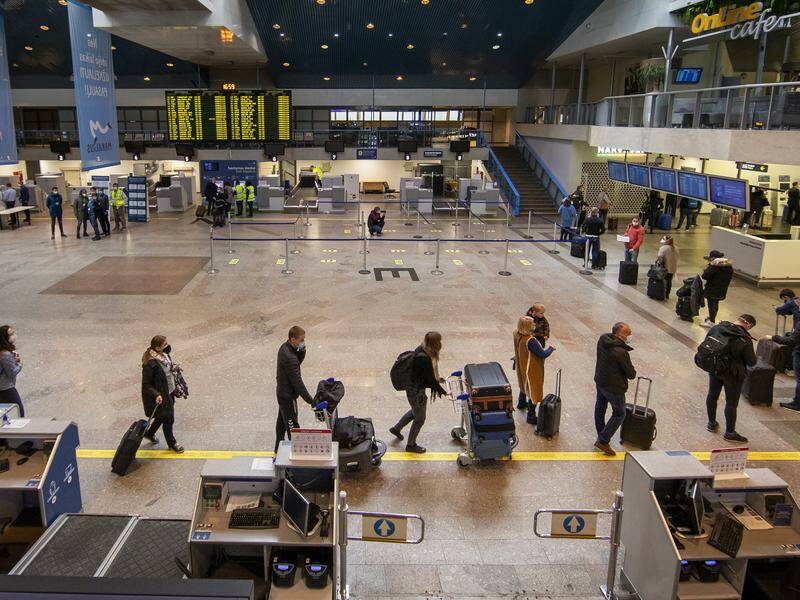
Air operations at Vilnius International Airport, Lithuania’s busiest aviation hub, resumed early Sunday morning after being suspended overnight due to reports of unidentified balloons drifting into national airspace.
The airport’s operator confirmed that flight activities were restored at 4:50 a.m. local time (9:50 p.m. ET, Saturday), following hours of uncertainty that saw several inbound and outbound flights either grounded or diverted to neighboring countries.
Authorities decided to temporarily shut the airspace late Saturday amid warnings of “a possible series of balloons heading toward Vilnius Airport.” Lithuania’s public broadcaster, LRT, cited the head of the National Crisis Management Centre as saying that 13 balloons were believed to be approaching the capital’s air corridor.
Notices later issued by the U.S. Federal Aviation Administration (FAA) described the incident as involving “hot air balloon flights,” though local officials treated the situation as a potential security threat.
Read also: Drone Incident Spurs Lithuania To Request NATO Air Cover
During the suspension, numerous flights were redirected to Riga, Latvia, and Warsaw, Poland, while departures from Vilnius were canceled. A Copenhagen-bound flight was reportedly forced to return to Denmark.
The brief disruption adds to a series of recent aviation alerts across Europe involving unauthorized aerial objects. Airports in Copenhagen and Munich have also faced temporary shutdowns in recent weeks after drone sightings and similar incursions.
Lithuania’s Ministry of Defense has not indicated whether the balloons originated from neighboring Belarus, though such concerns have grown increasingly common. The country — a NATO member and vocal supporter of Ukraine — shares a 679-kilometer (422-mile) border with Belarus, whose government remains closely aligned with Moscow.
In August, Lithuania established a 90-kilometer (56-mile) restricted air zone parallel to the Belarusian frontier after repeated drone entries from that direction. Officials said the restriction was designed to allow faster military response to any future airspace violations.
Vilnius, the Lithuanian capital, sits just 30 kilometers (18.6 miles) from the Belarusian border — a proximity that has made its skies particularly sensitive since Russia’s invasion of Ukraine began.