
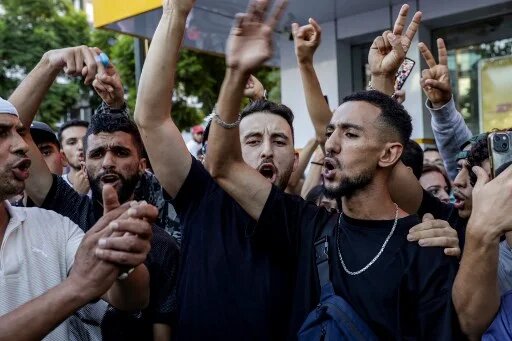
Thousands of young Moroccans poured onto the streets again Thursday night, demanding the dismissal of Prime Minister Aziz Akhannouch and sweeping reforms to revive the country’s crumbling public services, as frustration with the government deepens ahead of King Mohammed VI’s address to parliament.
The protests, led by the Gen Z 212 movement, erupted simultaneously in Rabat, Casablanca, and Tangier, signalling the resilience of a youth-led uprising that has outlasted government warnings and police crackdowns. The loosely organised collective — born on social platforms like TikTok and Discord, where it now boasts over 200,000 followers — has become the unexpected voice of a generation disillusioned by corruption and inequality.
“We no longer have confidence in the government,” said Raghd, a 23-year-old engineer protesting in the capital. “We’re waiting for the king to talk to us — he has to save his people.”
The demonstrations, which began after eight pregnant women died at a hospital in Agadir, have grown into a nationwide reckoning over governance and priorities. Protesters accuse officials of funnelling state funds into glittering projects — such as the new stadiums planned for Morocco’s co-hosting of the 2030 FIFA World Cup — while hospitals and schools fall into disrepair.
Read also: UAE Commits To $25bn Nigeria-Morocco Gas Pipeline Deal
At least three protesters have been killed in clashes with security forces since the movement began on 27 September, according to rights groups. More than 60 demonstrators now face vandalism charges, and hundreds more have been detained in what activists describe as an increasingly heavy-handed response.
The government has sought to ease tensions. Spokesperson Mustapha Baitas said Thursday that “the message has been received,” promising that authorities were accelerating long-delayed healthcare projects and inviting Gen Z 212 to dialogue.
Yet the movement’s demands have grown bolder. In a public letter to the monarch last week, organisers urged King Mohammed VI to dissolve the government, free political detainees, and convene a national forum on corruption. “We, the youth of Morocco, request your majesty’s intervention for profound and just reform that restores rights and punishes the corrupt,” the letter read.
With the king expected to address parliament later Friday, many young Moroccans say this may be a defining moment — not only for their generation but for Morocco’s political future.