
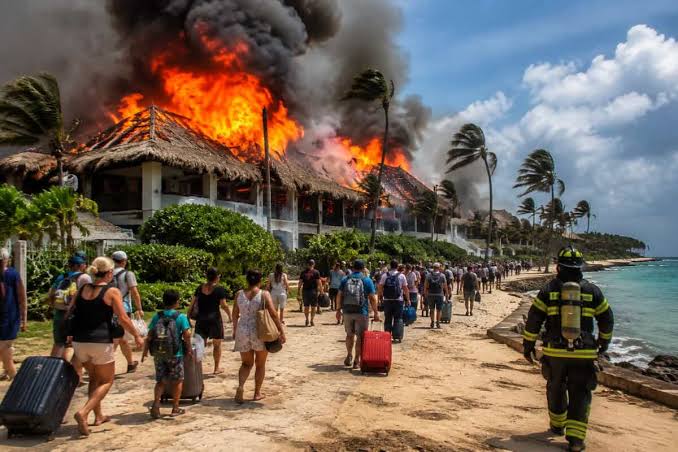
Emergency crews evacuated nearly 1,700 tourists from a beachfront hotel in the Dominican Republic on Friday after fire tore through sections of its palm-thatched roof, killing a 46-year-old Italian woman, according to the country’s emergency response agency.
The victim was identified as Francesca Valentino. She died in the blaze at the Viva Wyndham Dominicus Beach Hotel, in the resort town of Bayahibe on the country’s southeastern coast, the emergency service DAEH said in a statement.
Three people were hospitalized. Six others — a mix of guests, visitors and emergency responders who took part in the response — were treated for injuries at the scene, DAEH said. The agency did not specify the nature of the injuries or release further details about those affected.
Footage shared by local media and circulating on social platforms showed thick black smoke rising over the Caribbean shoreline as flames consumed parts of the resort’s roofing, much of it built in the traditional palm-thatch style common to beach properties across the region. One clip, credited to a witness on the scene, showed onlookers gathered at a distance as the fire spread across the structure.
The Emergency Operations Center, the government body that coordinated the response and is known locally by the acronym COE, said preliminary observations pointed to two contributing factors: the construction material and the weather. The fire spread quickly “due to the flammable nature” of the roof sections built from palm, compounded by wind conditions at the time, the center said. COE described its findings as preliminary and said a definitive cause had not yet been established.
Investigators remained at the site Friday working to determine what ignited the blaze.
Read also: Truck Accident Leaves At Least 10 Migrants Dead In Mexico
Firefighters brought the flames under control before they could spread beyond the affected structures. Evacuated guests were relocated to other hotels in the area, COE said. The chain’s adjacent sister property, the Viva Wyndham Dominicus Palace, sustained no damage and continued operating.
Wyndham Hotels and Resorts had not responded to a request for comment as of Friday evening. The U.S.-based company franchises roughly 8,400 hotels worldwide across multiple brands, and the Dominicus Beach property is one of several Viva-branded resorts it franchises in the Dominican Republic, a country whose tourism economy depends heavily on large-scale, all-inclusive beach properties marketed to North American and European travelers.
Bayahibe sits within La Altagracia province, home to some of the country’s busiest resort corridors and a gateway for boat excursions along the southeastern coast. COE said tourist activity elsewhere in Bayahibe and the surrounding area continued without disruption following the fire, with operations at other properties unaffected.
Read also: Jamaica Braces As Hurricane Melissa Becomes Grade 3 Monster
The scale of the evacuation — nearly 1,700 people moved out of a single property — reflects the density of the all-inclusive resorts that line this stretch of coastline, where guest counts at individual hotels can run into the thousands during peak season. Friday’s blaze does not appear to have prompted any broader evacuation order beyond the Dominicus Beach property itself, based on the information released by COE.
DAEH and COE both continued to coordinate their response into Friday evening, with neither agency providing a timeline for when the investigation into the fire’s cause would conclude.
The Dominican Republic recorded approximately 5.6 million visitor arrivals in the first five months of 2026, according to official tourism figures, making it the most-visited destination in the Caribbean. That status rests in large part on beachfront resorts built in the same architectural tradition as the one that burned Friday — open-air structures topped with palm roofing designed to evoke the region’s coastal character, the same material that, by the government’s own preliminary account, allowed the fire to spread as fast as it did.