
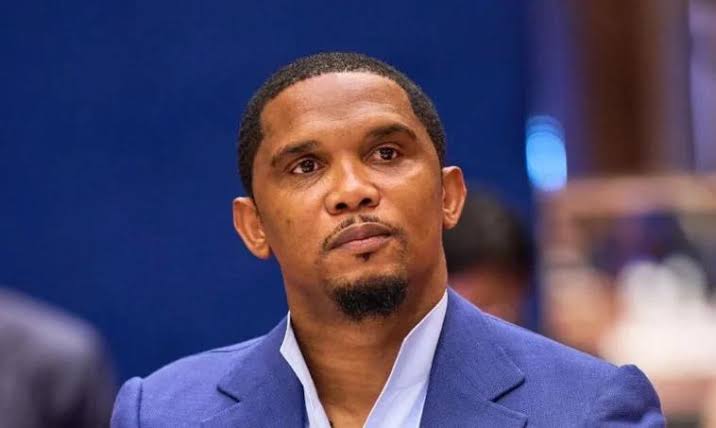
Samuel Eto’o, president of the Cameroonian Football Federation (FECAFOOT), has been accused of influencing national team selections to prevent striker Vincent Aboubakar from breaking his long-standing goal-scoring record. The allegations, circulating in local and international reports, claim Eto’o played a role in Aboubakar’s omission from Cameroon’s Africa Cup of Nations squad.
According to the reports, Aboubakar was unexpectedly left out of the AFCON list despite remaining one of the nation’s most experienced and productive forwards. The suggestion is that Eto’o, who scored 56 goals in 118 caps, feared Aboubakar — currently on 45 goals in 117 appearances — was closing in on his record and could surpass it during the tournament.
Cameroon’s official explanation for squad decisions has not referenced any statistical rivalry, and no concrete evidence has been presented to confirm that Eto’o personally intervened. Nevertheless, the claims have sparked widespread debate within Cameroonian football circles, with supporters and analysts questioning the transparency of the selection process.
Aboubakar, captain of the national team at the 2022 World Cup and a key figure in recent AFCON campaigns, has consistently been one of Cameroon’s most reliable performers. His exclusion prompted strong reactions online, with many fans insisting that footballing merit alone should determine national team call-ups.
FECAFOOT has not issued a detailed public response refuting the reports, although insiders close to the federation describe the allegations as speculative. They maintain that technical decisions rest with the coaching staff, not the federation president. Still, Eto’o’s high-profile position and influence within the federation continue to fuel questions about internal decision-making.
Read Also: Chris Ngige Arraignment Over N2.2bn Fraud Case
The situation places additional scrutiny on Cameroon’s AFCON preparations, already under pressure due to form inconsistencies and squad selection debates. Analysts note that such controversies risk destabilizing the team ahead of a major continental competition.
While the claims remain unverified, the discussion highlights broader concerns about governance, influence and accountability within African football federations. The coming days may bring clarity if FECAFOOT addresses the issue directly, but for now, the debate around Aboubakar’s omission continues to shape conversations among fans and commentators, reflecting the intensity and passion surrounding Cameroon’s footballing legacy.