
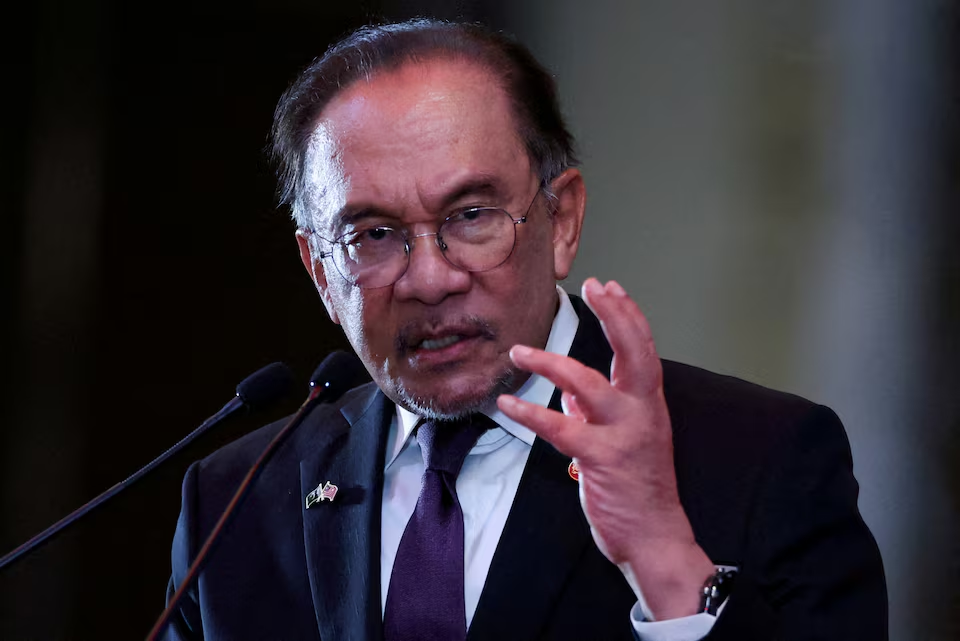
Malaysia’s government plans to push through a wide-ranging package of institutional reforms this year and next, including legislation to cap the prime minister’s tenure at two terms, Prime Minister Anwar Ibrahim said on Monday, as pressure mounts for deeper action on corruption and governance.
Speaking to senior civil servants, Anwar said his administration would introduce a bill in parliament to limit future prime ministers to a maximum of 10 years in office. The proposal was a key promise of the ruling coalition during the 2022 general election campaign.
“Everyone has a term limit,” Anwar said, arguing that leadership renewal strengthens institutions. “If given enough time to deliver, it is better for us to hand over to the next generation.”
Anwar said the government would also move to separate the role of attorney general as the government’s chief legal adviser from the position of public prosecutor, a change long sought by civil society groups and legal experts.
The bill is expected to be tabled when parliament reconvenes for its first sitting of the year later this month.
Under Malaysia’s current system, the attorney general is appointed by the prime minister and holds both advisory and prosecutorial powers. Critics have repeatedly questioned the independence of the office, warning that the structure leaves room for political influence over criminal cases.
The prime minister said the reform would help reinforce the rule of law and strengthen public confidence in the justice system.
As part of the broader reform agenda, Anwar said his government aims to introduce an ombudsman law to improve oversight of public institutions and give citizens a formal channel to lodge complaints about maladministration.
He also reiterated plans to propose a freedom of information law, which would require greater disclosure around government decisions and projects. The legislation, he said, is intended to curb abuse of power and improve transparency in public spending.
Together, the measures represent one of the most ambitious governance reform efforts proposed in Malaysia in years.
Anwar, a former opposition leader who returned to power in 2022 after decades in politics, campaigned heavily on an anti-corruption platform. His administration has vowed to dismantle entrenched patronage networks and strengthen independent institutions.
Read Also: Former Malaysian PM Najib Convicted Of Power Abuse
However, the government has faced growing criticism from activists and opposition figures who accuse it of moving too slowly or retreating from earlier reform commitments. Some decisions involving high-profile corruption cases have drawn scrutiny, raising questions about whether promised changes will be fully implemented.
Anwar acknowledged the challenges, saying corruption in Malaysia is deeply rooted and difficult to eradicate quickly. He insisted, however, that his administration remains committed to institutional reform and improved governance.
“We are working hard to correct weaknesses in the system,” he said, while noting that meaningful change would take time.
If passed, the proposed term-limit legislation would mark a significant shift in Malaysia’s political framework, which currently places no formal cap on how long a prime minister can remain in office.