
JURISDICTIONAL NOTICE
STATUS: U.S. First Amendment Protected.
Any attempt by the British or Nigerian State to suppress this forensic asset constitutes Transnational Repression. All interference will be tracked and submitted to the FBI for Global Magnitsky Sanctions.
♦♦♦♦♦♦♦♦♦♦♦♦♦♦♦♦♦♦♦♦♦♦♦♦♦♦♦♦♦♦♦♦♦♦♦♦♦♦♦♦♦♦♦♦♦♦♦♦♦♦♦♦
Flora Shaw’s Label: Naming a Colonial Cage
How an imperial word coined in London became the public identity of peoples who never consented to be reduced into Britain’s Niger estate.
Nigeria’s first injury was not the flag, the anthem, the coup, the oil rent, or the 1999 Constitution. It was the name. Before the territory became independent, before its citizens were asked to inherit the burden of explaining themselves to one another, before politicians began preaching unity over wounds they refused to heal, a British writer inside the imperial world gave the territory a label. “Nigeria” did not rise from the mouths of the peoples who would later be ordered to answer it. It came from outside, from empire, and from a vocabulary of possession.
Flora Shaw, writing in The Times on January 8, 1897, proposed “Nigeria” as a convenient designation for Britain’s territories around the Niger. Shaw later became Lady Lugard after marrying Frederick Lugard, the British administrator whose name remains tied to the consolidation of colonial rule in the territory. That sequence is not a gossip detail. It places the name inside a world of imperial writing, company power, administrative ambition, and British confidence. A colonial journalist named the space. A colonial administrator helped govern the space. British commerce had already marked the space for extraction. By the time Nigerians inherited the name, it had already served foreign power (Shaw, 1897; Flint, 1960; Perham, 1960).
No free people assembled to choose it. No council of ethnic nationalities adopted it. No federation of kingdoms, republics, emirates, city-states, and communities agreed that their histories should be compressed into one British-made word. Yoruba, Igbo, Hausa, Fulani, Ijaw, Tiv, Ibibio, Kanuri, Edo, Nupe, Efik, Igala, Urhobo, Itsekiri, Idoma, Gwari, Jukun, and hundreds of other peoples did not arrive at “Nigeria” through covenant. They were placed inside it by imperial naming. A people can survive conquest and still carry the scar of what conquest called them.
Read also: Nigeria: The Slave Name And The Restructuring Verdict — Overview
A name should be examined as evidence when power supplies it. Empire does not name territories to honor their inner life. It names them to file them, govern them, tax them, map them, sell them, police them, and defend them as assets. “Nigeria” was not a sacred word carried by ancestral memory. It was an imperial abbreviation, drawn from the Niger and the British idea of a “Niger area,” then polished into a national label by Flora Shaw’s pen. Its violence lies not in any proven racial insult from Shaw’s article, but in something more durable: the reduction of living peoples into a riverine administrative phrase fit for company rule, colonial paperwork, and imperial convenience.
That origin is insulting enough without adding what the record does not prove. The peoples inside the territory were not asked what they called themselves as political communities. They were gathered beneath a word made useful to Britain. “Nigeria” did not emerge from covenant, memory, or mutual recognition. It came from outside the peoples it would later command. It translated plurality into possession. It made nations answer to geography. It made human communities legible to empire before they were ever allowed to become authors of their own state.
That is the deeper contempt. A colonial label, born from the Niger and attached to territories administered under British influence, became the official identity of millions who never consented to its meaning. After independence, the insult was not corrected; it was decorated. The name entered passports, schools, anthems, ministries, military commands, courtrooms, and campaign speeches. Citizens were trained to be proud of a label that began as imperial convenience. Many still defend it with patriotic heat, as if endurance under a colonial name proves freedom. Pride cannot cleanse the record. A slave name does not become sovereign because the descendants of the named are taught to sing it.
The charge is not that Flora Shaw alone caused Nigeria’s failures. She did not create the coups, the oil rent, the centralized police command, Decree No. 24, or the allocation state. Her act was earlier and quieter. She gave an imperial order, a word. Britain gave the word “territory.” The postcolonial elite gave it ceremony. The military gave it command. The Fourth Republic gave it a constitution still begging for consent. By the time the modern citizen says “Nigeria,” the word is carrying more than geography. It is carrying the history of naming without asking, joining without covenant, ruling without repair, and demanding loyalty from peoples whose first political identity inside the state was written for them by empire.
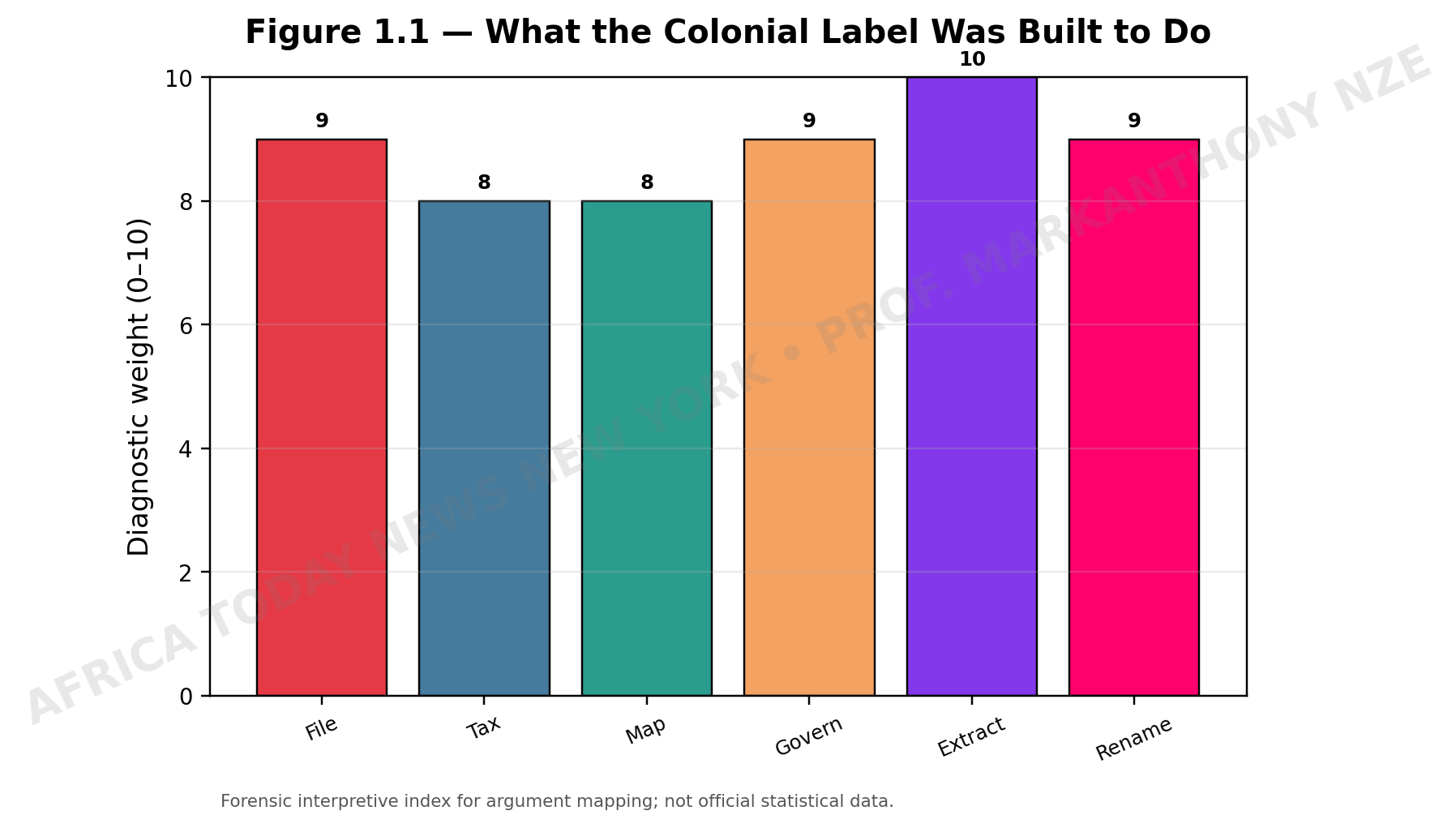
Figure: Diagnostic display of the core forces in this part.
Behind the label stood the Royal Niger Company and the commercial logic that preceded direct colonial rule. Sir George Goldie’s project was not nation-making. It was chartered commerce backed by imperial pressure. The Niger basin had been drawn into British calculation through treaties, trade, force, diplomacy, and corporate ambition. Flint’s study of Goldie remains essential because it shows how private commercial power helped prepare the ground for the colonial state later called Nigeria (Flint, 1960). In that setting, a name was not a poem. It was a mark of control.
Britain did not inherit a blank space. That remains one of the oldest lies of colonial narration. The territory later called Nigeria contained organized societies, political systems, trade networks, religious orders, legal customs, agricultural economies, intellectual traditions, diplomatic practices, and military histories. The Sokoto Caliphate, the Oyo world, the Benin kingdom, Niger Delta city-states, Igbo republican communities, Kanem-Borno legacies, and many other formations had their own names and memories long before Britain came with maps and titles. Colonial naming worked by compression. It made living societies appear as administrative material.
A harder question follows: why did independence preserve the label without a founding trial of its meaning? Colonial names do not always die when the empire lowers its flag. Some remain as chains polished into national symbols. “Nigeria” survived independence and became the official identity of a republic whose founding moment should have forced a public reckoning. Should a people freed from British rule continue to answer a name coined from within British rule? October 1, 1960, transferred power, but it did not place the inherited identity in the dock. The new elite kept the name, the borders, and a large portion of the colonial state form, then asked the population to call that inheritance freedom.
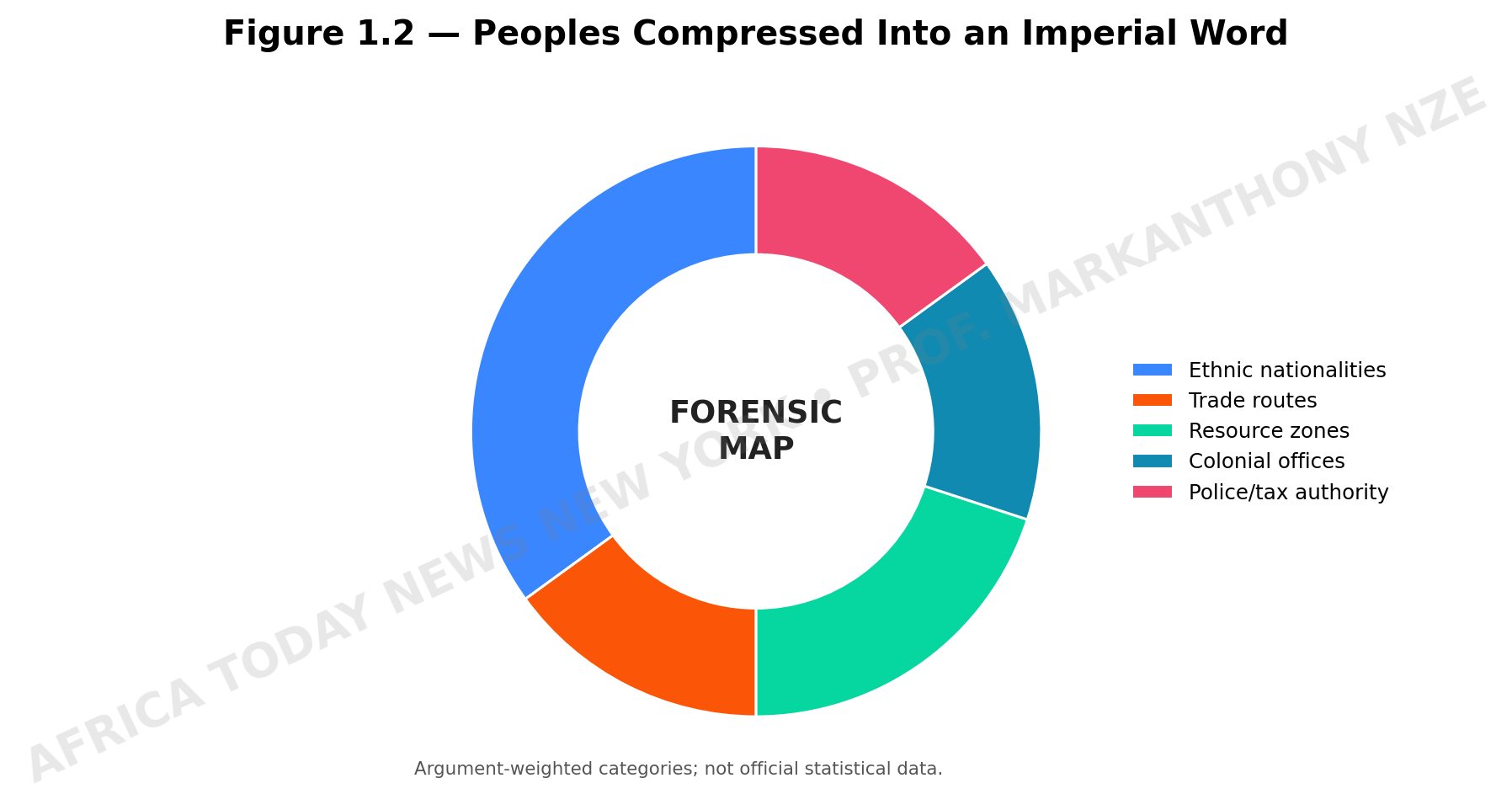
Figure: Argument-weighted chart, built as a forensic visual summary rather than official statistical data.
A country can carry an imposed name and still build justice if it confronts the wound honestly. Nigeria did not. Leaders wrapped the name in ceremony, anthem, coat of arms, schoolbooks, passports, currency, and patriotic instruction. Children were taught to recite the name before they were taught the violence behind its making. The colonial label became normal. Normalization became memory. Memory became obligation. Citizens were told to love the name without being invited to interrogate the conditions under which the name entered history.
Lugard’s imperial writings deepen the matter. The Dual Mandate presents colonial administration as ordered guardianship, economic development, and imperial trusteeship, but the moral center remains unmistakable: African territory was to be governed within the British imperial mission (Lugard, 1922). Lugard did not approach African political life as equal sovereignty waiting for negotiated partnership. He approached it as territory to be organized, ruled, and made useful. Flora Shaw’s name and Lugard’s administrative world belonged to the same imperial climate. One supplied the word. The other stood inside the system that made the word governable.
Calling “Nigeria” a slave name is not loose abuse. It is a political description of imposed identity. A slave name is a name given by power to mark possession, break continuity, and reorganize the named person within the master’s order. Applied to the Nigerian state, the phrase does not deny the dignity of the peoples living inside the country. It restores that dignity by insisting that their histories are older than the label placed on them. It argues that “Nigeria” entered history not as consent, but as classification.
Evidence Exhibit 1.1 — What the Record Allows Us to Say
| Forensic claim | Evidence base | What it proves | Use in the series |
| The name entered from imperial writing, not popular consent. | Shaw (1897); Flint (1960); Perham (1960). | The label functioned as colonial designation before national identity. | Establishes why naming is treated as evidence. |
| Precolonial societies were not blank space. | Ikime (1980); Falola & Heaton (2008); Tamuno (1972). | The label compressed older political worlds into one colonial file. | Rebukes the myth of administrative emptiness. |
| Retention after 1960 converted inheritance into obligation without a public trial. | Coleman (1958); Crowder (1978); Burns (1929). | Postcolonial ceremony normalized the imperial label. | Connects naming to later restructuring claims. |
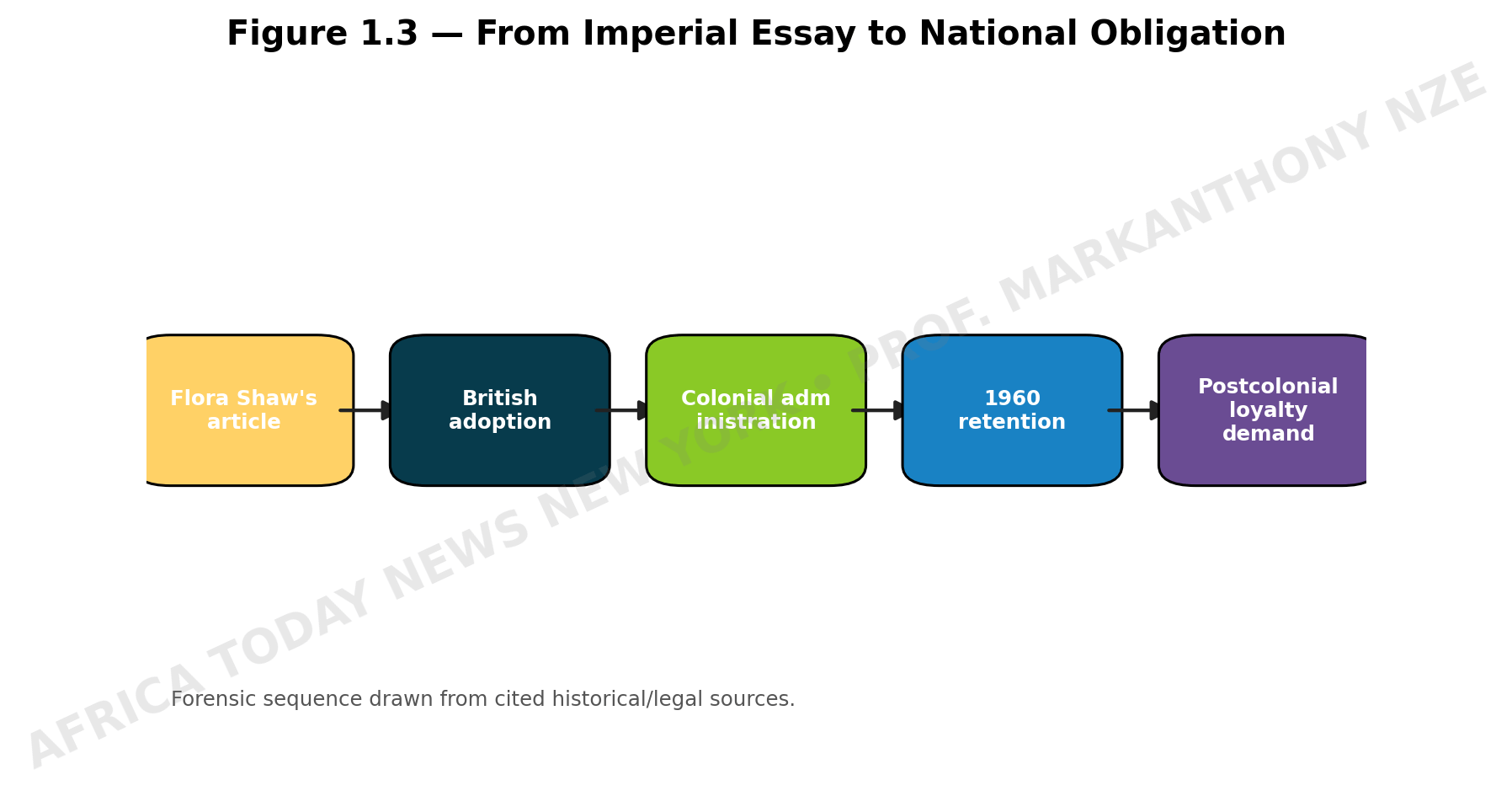
Figure: Sequence chart tracing the relevant historical movement.
Colonial historians such as Burns, Crowder, Coleman, Tamuno, and Falola documented the making of Nigeria through British rule, nationalism, administration, and political development (Burns, 1929; Coleman, 1958; Crowder, 1978; Tamuno, 1972; Falola & Heaton, 2008). Their works remain useful, but this inquiry asks a harsher question: what happens when an administrative label becomes a national identity without a founding act of consent? The answer is visible in Nigeria’s permanent struggle to manufacture belonging after enclosure. A name that came before agreement has spent more than a century demanding emotional loyalty from peoples never allowed to define the union as equals.
Nigeria’s postcolonial crisis cannot be blamed on the name alone. Names do not steal budgets, rig elections, centralize police, suffocate states, or promulgate military constitutions. People and institutions do that. Yet names frame political imagination. They teach citizens what they are expected to accept. In Nigeria’s case, the name helped disguise the first fraud: that a colonial possession could be converted into a nation by proclamation, ceremony, and time, without a foundational renegotiation among its peoples.
Fraud of that kind still speaks. It speaks whenever citizens are accused of disloyalty for questioning a union their ancestors never signed. It speaks whenever restructuring is treated as rebellion rather than repair. It speaks whenever the political class demands sacrifice from the population while defending the state form that profits the elite. It speaks whenever “unity” becomes a weapon against justice. The name became the soft entrance into a harder prison: amalgamation without covenant, independence without full liberation, federalism without autonomy, democracy under a constitution born from military command.
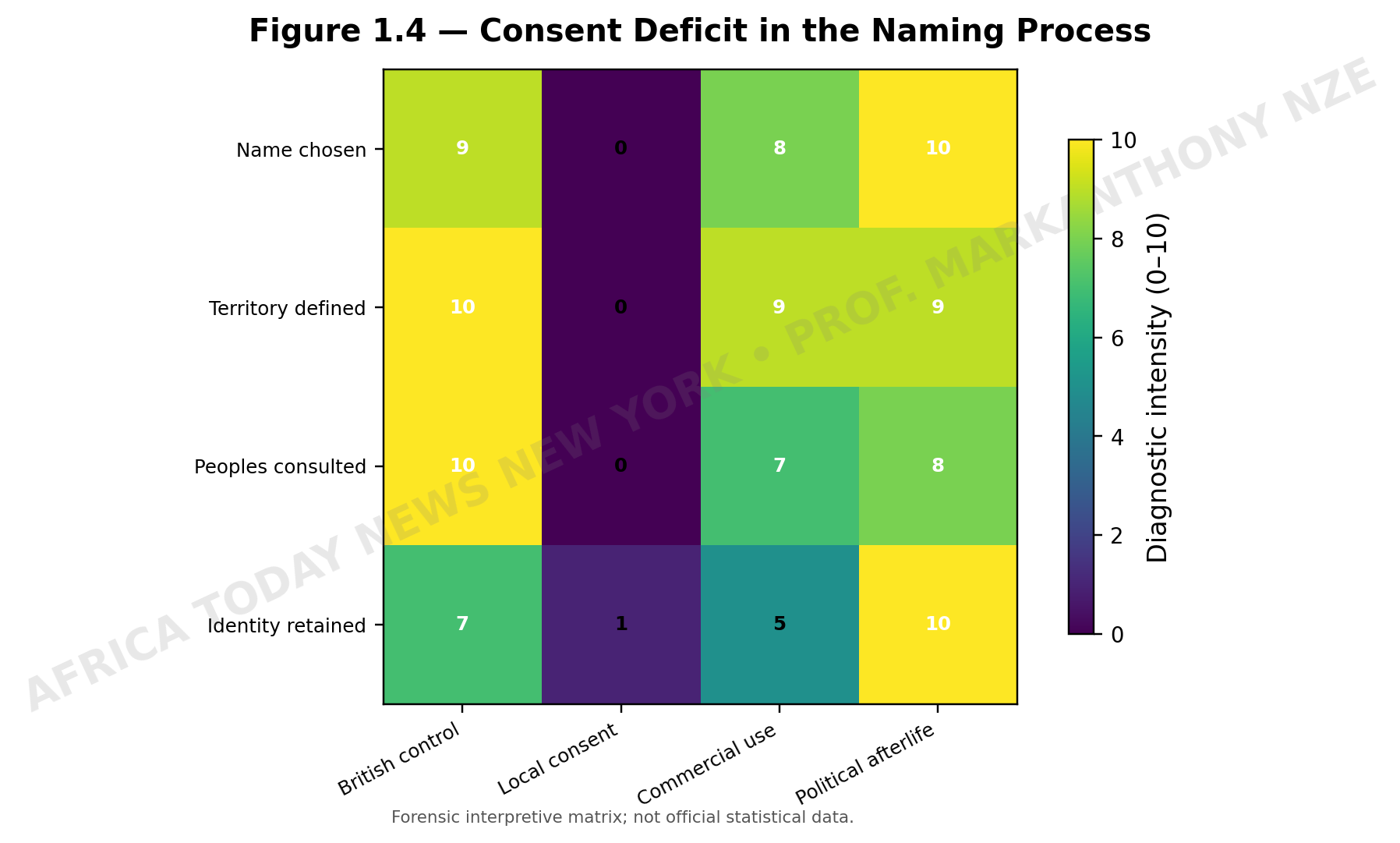
Figure: Evidence matrix showing control, consent, and long-term political effect.
Part 1 begins here because every later failure carries the stain of this beginning. Lugard’s amalgamation did not occur in a vacuum. Decree No. 24 did not fall from the sky. Abuja’s dominance did not emerge by accident. FAAC dependency did not grow from nowhere. Centralized policing did not become absurd in one generation. The state’s later failures rest on an older habit: people are arranged by power, named by power, administered by power, then instructed to treat the arrangement as destiny.
A serious republic would have revisited the name at independence. A sovereign people would have debated whether to retain, reject, revise, or replace it. Even keeping the name after such a process would have meant something different because consent would have transformed inheritance into choice. Nigeria never received that cleansing moment. The name passed from empire to elite, from colonial paperwork to national anthem, from British convenience to postcolonial command.
Final charge: Nigeria was named before it was asked. Its peoples were labeled before they were consulted. Its identity was filed before it was negotiated. Flora Shaw’s pen did not create all of Nigeria’s later tragedies, but it gave the colonial estate a word durable enough to outlive the empire. History must count that. A country that refuses to examine the name it answers will struggle to understand the cage it inhabits.
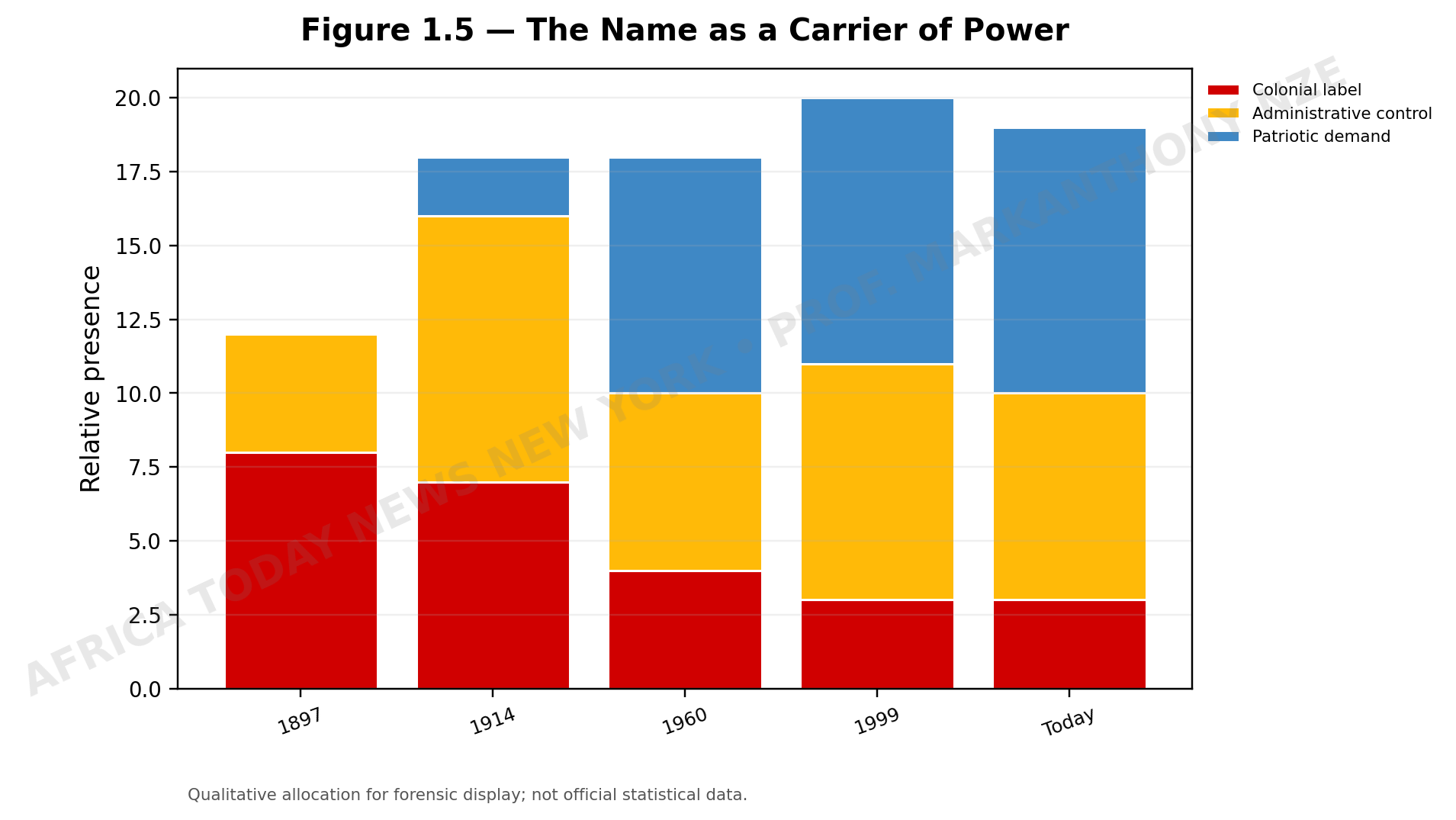
Figure: Stacked forensic profile of the historical burden carried into later state failure.
Evidentiary Sources (APA 7th Edition)
Afigbo, A. E. (1972). The warrant chiefs: Indirect rule in southeastern Nigeria, 1891–1929. Longman.
Burns, A. C. (1929). History of Nigeria. George Allen & Unwin.
Coleman, J. S. (1958). Nigeria: Background to nationalism. University of California Press.
Crowder, M. (1978). The story of Nigeria. Faber and Faber.
Falola, T., & Heaton, M. M. (2008). A history of Nigeria. Cambridge University Press.
Flint, J. E. (1960). Sir George Goldie and the making of Nigeria. Oxford University Press.
Hopkins, A. G. (1973). An economic history of West Africa. Longman.
Ikime, O. (Ed.). (1980). Groundwork of Nigerian history. Heinemann Educational Books.
Lugard, F. D. (1922). The dual mandate in British tropical Africa. William Blackwood and Sons.
Perham, M. (1960). Lugard: The years of authority, 1898–1945. Collins.
Shaw, F. (1897, January 8). Nigeria. The Times, p. 6.
Tamuno, T. N. (1972). The evolution of the Nigerian state: The southern phase, 1898–1914. Longman.