
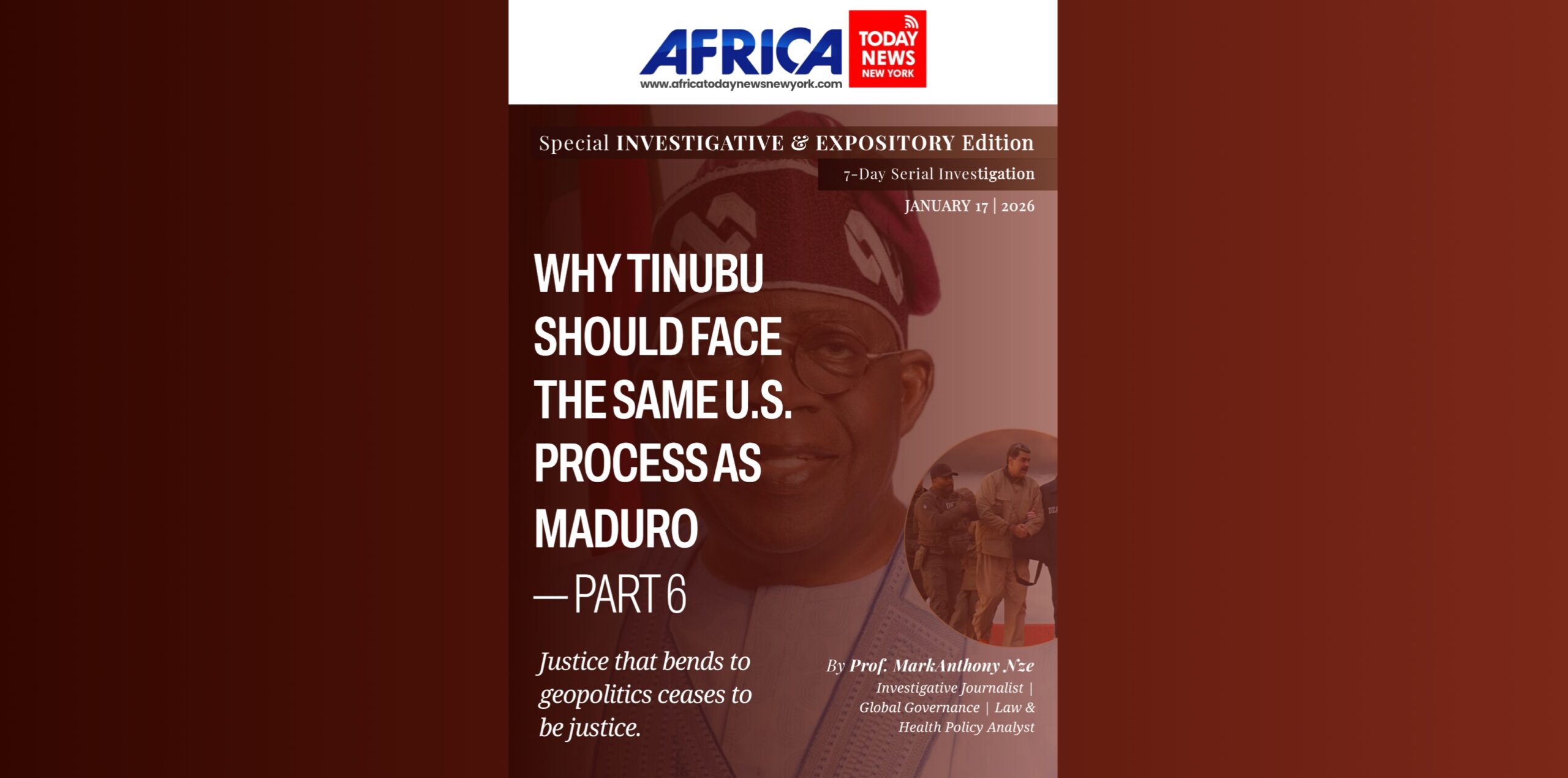
The Line the Law Draws: Discretion, Exemption, and the Tinubu Record
Justice that bends to geopolitics ceases to be justice.
By Prof. MarkAnthony Nze
The most corrosive failure of law is not error. It is selectivity. The gravest betrayal of legal norms is not that outcomes sometimes disappoint; it is that the same set of rules applied to one actor produces a rigorous path to accountability, while applied to another they dissolve into silence. When enforcement produces radically different procedural sequences depending on the identity or power of the subject, the system’s claim to neutrality collapses from a theoretical assertion into an observable fiction. This part depicts that collapse in stark procedural relief, illustrating how discretion—lawful in its origin—mutates into exemption when it is allowed to evaporate into silence. This mutation is not detectable in rhetoric, which can be shaped to any political need; it is detectable in process: what the state initiates, and what it fails to complete.
Selective enforcement is not what prosecutors say; it is what they do—and what they refuse to finish.
Discretion’s Narrow Lane—And the Abyss Beyond It
American law accepts prosecutorial discretion as a functional necessity. It is the mechanism by which finite resources are allocated, case priorities are sequenced, and forums are chosen. But discretion is not a blank check; it is a delegated authority constrained by principle, reviewability, and fidelity to stated policy aims. Contemporary scholarship on nonenforcement emphasizes that discretion must remain reviewable and principled; when it becomes opaque and outcome‑determinative, it ceases to be an exercise of law and becomes an instrument of power without accountability. Reviewability, consistency with announced goals, and the possibility of challenge are not optional trimmings; they are the sine qua non of legality itself. Absent those features, discretion collapses into exemption—a state of nonenforcement that shields actors not through the transparent exercise of judgment but through the disappearance of process (Parsh & Hessick, 2025).
This boundary between lawful discretion and unlawful exemption is most critical after the state has crossed a constitutional and statutory threshold: probable cause, seizure, and invocation of serious criminal statutes. Once state power has been activated, the law imposes downstream obligations. The steps that follow are not discretionary free agents; they are procedural obligations. At that point, the system owes motion or explanation. Anything else is not discretion. It is an exemption cloaked in bureaucratic stillness.
Read also: Why Tinubu Should Face The Same U.S. Process As Maduro—Part 5
What Selective Enforcement Looks Like in Practice
Selective enforcement rarely announces itself with fanfare. It hides in gaps: cases that begin loudly and end quietly; records that exist without conclusions; seizures without closure. The empirical evidence on enforcement inequality shows that when state power is applied unevenly, legitimacy erodes fastest among those who can see the inconsistency most clearly—citizens, courts, and international observers alike (Harris, Evans, & Beckett, 2018).
Legal analysis reinforces this finding. Remedies for selective enforcement are notoriously difficult precisely because the proof lies in comparative outcomes rather than explicit admissions. Prosecutors and law‑enforcement agencies seldom articulate their inconsistency; they reveal it through patterns of action and inaction. But when similar facts meet different fates, a pattern emerges, and the rule of law’s claim to uniformity unravels (Rubinstein, 2025).
The Comparator the Law Itself Supplies
The United States does not lack a valid comparator; it supplies one. When federal authorities determine that evidence supports a narcotics‑linked conspiracy by a foreign political figure, the methodology for enforcement is well established. Investigations are sealed, indictments are prepared, and charges are unsealed when prosecutors are ready to proceed. The U.S. government’s prosecution of Nicolás Maduro and associated actors followed this script: visible escalation, public charging, and judicial testing. The mechanics were orthodox and the sequence completed in open court (Department of Justice, 2020).
This sequence is not about personalities or geopolitical preferences; it is about whether the system treats like cases alike. The rule of law demands that actors facing similar evidence confront similar procedural paths. Where this does not occur, the discrepancy is not a matter of prosecutorial whimsy; it is a violation of the principles that undergird legitimacy.
The Tinubu Record—And the Silence That Followed
In the Tinubu matter, a forfeiture record exists. Probable cause was asserted. Assets were seized under statutes reserved for serious criminal conduct. According to the governing statutory framework, those steps are not ceremonial—they trigger obligations downstream (18 U.S.C. § 983). Department of Justice policy describes forfeiture, especially in narcotics and money‑laundering contexts, as an early enforcement step that commonly precedes criminal review (Department of Justice, 2023).
What followed in the Tinubu matter diverges starkly from that framework. There is no public indictment. There is no formal declination explaining why prosecution would not proceed. There is no judicial resolution on the merits of the forfeiture. The record thins precisely where the law expects density. The procedural sequence that begins with probable cause and seizure mysteriously halts where accountability is supposed to crystallize.
This absence does not prove innocence. Courts determine guilt. But this absence does prove a failure of process—one that transforms discretionary judgment into unexplained exemption.
Why “No Charges” Is Not a Neutral Outcome
The absence of charges is often misread as exculpation. That inference collapses under scrutiny. Probable cause authorizes seizure and continued investigation; it does not compel indictment, but it does compel resolution. According to the judiciary’s own articulation, probable cause is the constitutional threshold for state action—action that must remain accountable and reviewable (U.S. Courts, 2022).
When the system halts without explanation, the silence becomes performative. Silence is not neutrality; it is a shield. It is deployed domestically as insulation and internationally as convenience. But in neither setting does it speak law.
Oversight, Transparency, and the End of Procedural Amnesia
Oversight bodies have warned against precisely this outcome. Inspector General audits emphasize that unresolved enforcement actions undermine integrity and invite perceptions of uneven application (Office of the Inspector General, 2021). Transparency doctrine supplies the backstop. Freedom of Information Act scholarship explains that secrecy tools—especially Glomar responses denying even the existence of records—are least defensible where enforcement activity has already been acknowledged; courts increasingly distinguish legitimate secrecy from mere avoidance (Pozen, 2019; Electronic Privacy Information Center, 2023).
Recent Supreme Court jurisprudence on property and due process underscores the same principle: government power must complete its work in daylight. Retention without justification violates constitutional norms (Tyler v. Hennepin County, 2023; Culley v. Marshall, 2024). The logic of these decisions extends directly to enforcement pathways that begin and then vanish. Where the path is obscured, due process is not fulfilled; where process is unanchored, legitimacy dissolves.
Global Consequences of Domestic Selectivity
Selective enforcement does not stay local. Global governance analysis shows that when powerful actors are treated differently, deterrence weakens and credibility collapses (Transparency International, 2022). A global anti‑narcotics regime cannot command confidence if its application depends on alignment rather than evidence. Comparative legitimacy is fragile. According to the World Justice Project’s Rule of Law Index, consistency in enforcement is a core determinant of public trust; deviations are noticed and remembered (World Justice Project, 2023). Systems that preach uniformity but practice exception pay a reputational price.
From a global perspective, unresolved gaps in enforcement in high‑profile matters are not isolated failures; they are symptoms of systemic erosion. When procedural silence replaces adjudicative scrutiny, the entire architecture of deterrence and accountability weakens. The rule of law overseas becomes what practitioners cynically call “the law that works where it can, and shelters where it must.”
Prosecutorial Choice—And Its Costs
Modern analyses of prosecutorial decision‑making emphasize that choices are shaped by incentives, institutional culture, and external pressures; legitimacy depends on making those choices intelligible and consistent (Warren, 2024). When outcomes cannot be reconciled with stated standards, skepticism hardens. Research on courtroom workgroups and prosecutorial guidelines shows that visible escalation signals seriousness; quiet stalling signals something else (Journal of Criminal Justice, 2025). In this light, the silence that surrounds the Tinubu record is not neutral. It is a signal—perceived at home and abroad as a signal that exemptions are available to the powerful.
Why This Is Devastating to Democratic Credibility
Democracy rests on process, not personality. Citizens do not lose faith because allegations exist; they lose faith when institutions refuse to let scrutiny finish its work. In the Tinubu matter, unresolved U.S. process becomes political capital at home; domestically, it is wielded as evidence of double standards. Internationally, it corrodes the United States’ claim to be a consistent defender of the rule of law. The cost for Nigeria is acute; the cost for the United States is systemic.
When a system allows powerful records to calcify into procedural silence, it diminishes its own moral authority. The law cannot insist on openness abroad while tolerating opacity where it is inconvenient. Where the sequence does not complete, legitimacy unravels.
Professor MarkAnthony Ujunwa Nze is an internationally acclaimed investigative journalist, public intellectual, and global governance analyst whose work shapes contemporary thinking at the intersection of health and social care management, media, law, and policy. Renowned for his incisive commentary and structural insight, he brings rigorous scholarship to questions of justice, power, and institutional integrity.
Based in New York, he serves as a full tenured professor and Academic Director at the New York Center for Advanced Research (NYCAR), where he leads high-impact research in governance innovation, strategic leadership, and geopolitical risk. He also oversees NYCAR’s free Health & Social Care professional certification programs, accessible worldwide at:
https://www.newyorkresearch.org/professional-certification/
Professor Nze remains a defining voice in advancing ethical leadership and democratic accountability across global systems.
Selected Sources (APA 7th Edition)
Congressional Research Service. (2023). Crime and forfeiture: Legal overview. U.S. Congress.
https://crsreports.congress.gov/product/pdf/R/R43890
Didwania, S. H. (2025). Asset forfeiture and inequality. Stanford Law Review, 77(1), 159–210.
https://review.law.stanford.edu/wp-content/uploads/sites/3/2025/01/Didwania-77-Stan.-L.-Rev.-159.pdf
Electronic Privacy Information Center. (2023). Glomar responses and FOIA litigation.
https://epic.org/issues/open-government/glomar/
Harris, A., Evans, H., & Beckett, K. (2018). Drawing blood from stones: Legal debt and social inequality in the contemporary United States. American Journal of Sociology, 123(6), 1753–1799.
https://www.journals.uchicago.edu/doi/10.1086/696589
Office of the Inspector General, U.S. Department of Justice. (2021). Audit of the Department of Justice asset forfeiture program.
https://oig.justice.gov/reports/audit-department-justice-asset-forfeiture-program
Parsh, M. R., & Hessick, C. B. (2025). The nuances of prosecutorial nonenforcement. William & Mary Law Review, 67(2).
https://wmlawreview.org/sites/default/files/Parsh%20Hessick_WML_67-2.pdf
Pozen, D. E. (2019). Freedom of information beyond the Freedom of Information Act. University of Pennsylvania Law Review, 165(5), 1097–1158.
https://scholarship.law.upenn.edu/penn_law_review/vol165/iss5/1/
Prosecutorial guidelines and courtroom workgroups. (2025). Journal of Criminal Justice.
https://www.tandfonline.com/doi/full/10.1080/07418825.2025.2572686
Reforming our prosecutorial system is no longer just a proposition. (2023, June 29). Brookings Institution.
https://www.brookings.edu/articles/reforming-our-prosecutorial-system-is-no-longer-just-a-proposition-it-is-an-urgent-imperative/
Rubinstein, G. (2025). Remedying selective enforcement. George Washington Law Review, 93, 789–830.
https://www.gwlr.org/wp-content/uploads/2025/08/93-Geo.-Wash.-L.-Rev.-789.pdf
Simmons, R. (2021). Race and reasonable suspicion. Florida Law Review.
https://www.floridalawreview.com/api/v1/articles/81012-race-and-reasonable-suspicion.pdf
Transparency International. (2022). Exporting corruption: Enforcement of foreign bribery laws.
https://www.transparency.org/en/publications/exporting-corruption-2022
U.S. Courts. (2022). Probable cause. Administrative Office of the U.S. Courts.
https://www.uscourts.gov/glossary/probable-cause
U.S. Department of Justice. (2023). Asset forfeiture policy manual.
https://www.justice.gov/afp/asset-forfeiture-policy-manual-2023
University of Pennsylvania Law Review. (2025). Mandatory prosecution: Comparative perspectives on justice systems.
https://www.law.upenn.edu/live/
Warren, R. G. (2024). An integrated model of prosecutor decision-making. Law & Society Review. Cambridge University Press.
https://www.cambridge.org/core/journals/law-and-society-review/article/an-integrated-model-of-prosecutor-decisionmaking/8CBA602B69BE7CB0D28D498133540EC2
World Justice Project. (2023). Rule of Law Index 2023.
https://worldjusticeproject.org/our-work/research-and-data/wjp-rule-law-index-2023