
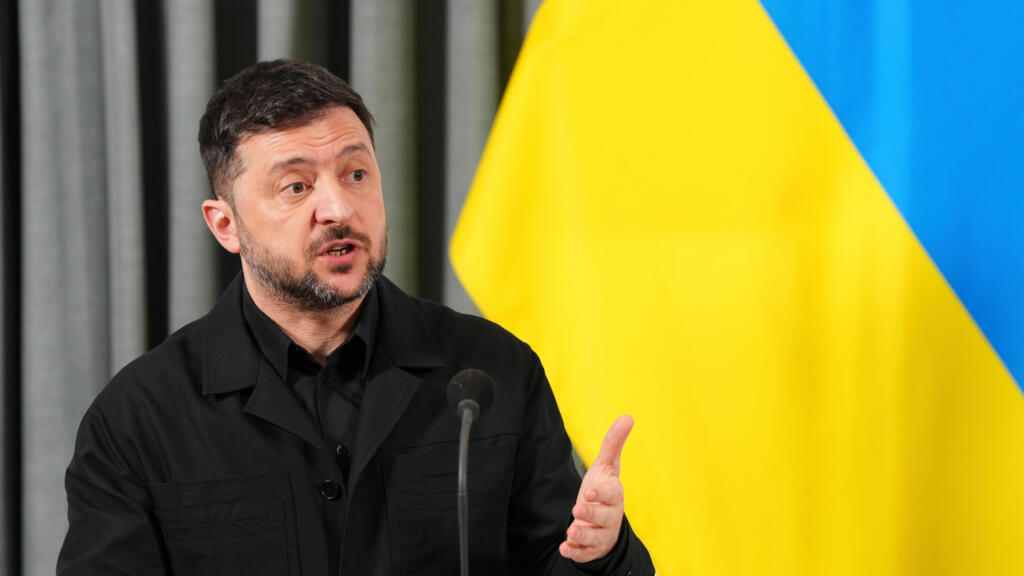
Ukrainian President Volodymyr Zelenskiy is preparing to outline a plan to hold presidential elections alongside a national referendum on any future peace agreement with Russia, according to officials familiar with the discussions.
The announcement is expected on February 24, the third anniversary of Russia’s full-scale invasion of Ukraine, a date Kyiv has often used to signal major political and strategic directions. The plan would mark the first formal step toward restoring Ukraine’s national electoral process after nearly three years of war.
Ukraine has not held a presidential vote since before the invasion in 2022. Zelenskiy’s five-year term officially ended in 2024, but elections were postponed under martial law, which remains in force because of ongoing hostilities. Ukrainian law prohibits national elections while the country is under martial law, citing security risks and the difficulty of guaranteeing free and fair voting during active conflict.
Officials involved in the planning say the concept under discussion is to link any future peace deal with a popular vote, allowing Ukrainians to decide both on the country’s leadership and on whether to accept the terms of a settlement with Moscow. Under this framework, voters would cast ballots for president at the same time as they vote in a referendum on a proposed agreement.
U.S. and Ukrainian negotiators have previously discussed such a structure as part of broader talks about how a political process could follow a ceasefire or peace arrangement. People familiar with those talks said the idea of holding elections and a referendum together as early as May has been raised, although no final timetable has been agreed and everything depends on security conditions.
Any move toward elections would require either lifting or suspending martial law, at least temporarily, and passing related legal changes through Ukraine’s parliament. Officials have said repeatedly that voting cannot take place while large parts of the country remain under missile attack and while Russian forces still occupy Ukrainian territory.
The government’s view is that elections and a referendum would only become possible once there is a credible halt to large-scale fighting. The aim would be to ensure that any vote is not only legal but also meaningful, with broad participation and protection against interference.
Read also: Russia Warns Foreign Troops In Ukraine Would Be Fair Targets
Supporters of a referendum say putting any peace deal to a popular vote would give it democratic legitimacy, especially if it includes difficult compromises. It would also give Ukrainians a direct role in deciding the country’s future rather than leaving the outcome solely to diplomats and political elites.
Zelenskiy has repeatedly said that Ukraine’s sovereignty and territorial integrity are not negotiable and that any settlement must respect international law. At the same time, he has acknowledged that the public must ultimately have a voice in major national decisions, including the terms under which the war might end.
The issue is complicated by the scale of displacement caused by the conflict. More than six million Ukrainians are living abroad as refugees, according to the United Nations, and several million more are internally displaced. Organising voting for citizens outside their home communities would require large-scale logistical planning, including secure overseas polling arrangements and special provisions for displaced voters.
There are also unresolved questions about how any vote would be conducted in regions near the front lines or in areas still under Russian control. Ukrainian authorities have said it would be impossible to guarantee free and fair voting in occupied territories, raising the prospect that those regions would be excluded from the process until control is restored.
Ukraine’s Central Election Commission would be responsible for organising any national ballot. That would include setting dates, registering candidates, updating voter lists and designing mechanisms for participation by citizens abroad. The commission has not yet made public statements on the reports.
Read also: Ukraine Peace Talks Next Week, Zelenskiy Awaits US Details
Inside Ukraine, the question of wartime elections has prompted cautious debate. Some opposition figures argue that delaying elections for too long risks weakening democratic norms. Others say holding a vote while the country remains under attack could endanger voters and be exploited by Russia to sow disruption or disinformation.
Western governments have generally supported Ukraine’s decision to suspend elections under martial law, saying Kyiv has the right to determine its constitutional process during a national emergency. At the same time, allies have stressed the importance of restoring regular democratic procedures once conditions allow.
Russia has not commented publicly on the idea of a Ukrainian referendum linked to a peace deal. Moscow has previously rejected Kyiv’s peace proposals, which call for the withdrawal of Russian troops from all occupied Ukrainian territory. Russian officials have said any settlement must reflect what they call “realities on the ground,” a reference to areas under Russian control.
Zelenskiy has said in earlier remarks that elections would be held “as soon as possible” after the war enters a different phase. He has argued that Ukraine remains a democracy even under martial law but that survival and defence must take priority while fighting continues.
Linking a referendum to elections is seen by officials involved in the planning as a way to reset Ukraine’s political system after the war, providing a renewed mandate to the country’s leadership and a clear public endorsement, or rejection, of any peace framework.
For now, the plan remains contingent on developments on the battlefield and in diplomatic channels. No ceasefire is in place, and heavy fighting continues along much of the eastern and southern front.
The next formal step is expected to be Zelenskiy’s address on February 24, when he is likely to outline the concept, the conditions under which elections and a referendum could be held, and the legal process that would be required to move forward. Further details would then be taken up by parliament and election authorities if and when security conditions permit.