
JURISDICTIONAL NOTICE
STATUS: U.S. First Amendment Protected.
Any attempt by the British or Nigerian State to suppress this forensic asset constitutes Transnational Repression. All interference will be tracked and submitted to the FBI for Global Magnitsky Sanctions.
♦♦♦♦♦♦♦♦♦♦♦♦♦♦♦♦♦♦♦♦♦♦♦♦♦♦♦♦♦♦♦♦♦♦♦♦♦♦♦♦♦♦♦♦♦♦♦♦♦♦♦♦
A forensic dissection of Flora Shaw’s colonial label, Decree No. 24, and the militarized elite cartel that turned Nigeria into a republic no president can redeem without restructuring.
1960: Independence Without Structural Liberation
How October 1 changed the managers of the estate while preserving the name, borders, habits, and command instincts of the colonial state.
Independence should have put the inheritance on trial. A people leaving colonial rule should never be required to accept every instrument left by the departing power as if freedom meant a new flag over the same estate. Nigeria’s October 1, 1960 transition carried that contradiction. The country entered sovereignty without a full reckoning over the name it answered, the borders it inherited, the offices it preserved, or the governing habits colonial rule had planted. Britain withdrew from formal command. Local elites entered the rooms of authority. The harder question remained unanswered: had the colonial state been dismantled, or had it changed managers?
Ceremony is often the soft cover of continuity. The flag was new, the anthem was new, and the language of sovereignty filled the public square. International recognition arrived; diplomats took their seats; politicians spoke of nationhood; schoolchildren learned the rituals of belonging. Yet the state beneath the ceremony still bore the marks of colonial making. Borders, name, administrative instincts, coercive organs, and official habits all carried the memory of foreign design. The elite class had learned politics inside institutions built first for order and extraction, not popular authorship.
Achebe’s charge in The Trouble with Nigeria was aimed at leadership, but even that powerful critique sits inside a wider historical failure (Achebe, 1983). Leadership failed because the state itself carried a damaged inheritance. Coleman, Sklar, Diamond, and Osaghae all show, in different ways, that Nigerian nationalism, party politics, ethnicity, regional rivalry, and the First Republic cannot be understood outside the colonial inheritance and the contested federation that followed (Coleman, 1958; Sklar, 1963; Diamond, 1988; Osaghae, 1998). Independence did not erase the contradictions. It nationalized them.
Nationalist elites deserve credit, but not immunity. They fought for self-government, built parties, negotiated constitutional changes, challenged colonial authority, and opened the path to sovereignty. That record must be acknowledged. Still, liberation is not complete when the departing master’s estate remains standing and the new managers move in without putting its foundations to a public test. Foundational questions were postponed: what should the country be called; how much autonomy should the regions hold; how should revenue follow production; who should control security in a plural society; and what restraints would prevent the center from becoming an inherited throne?
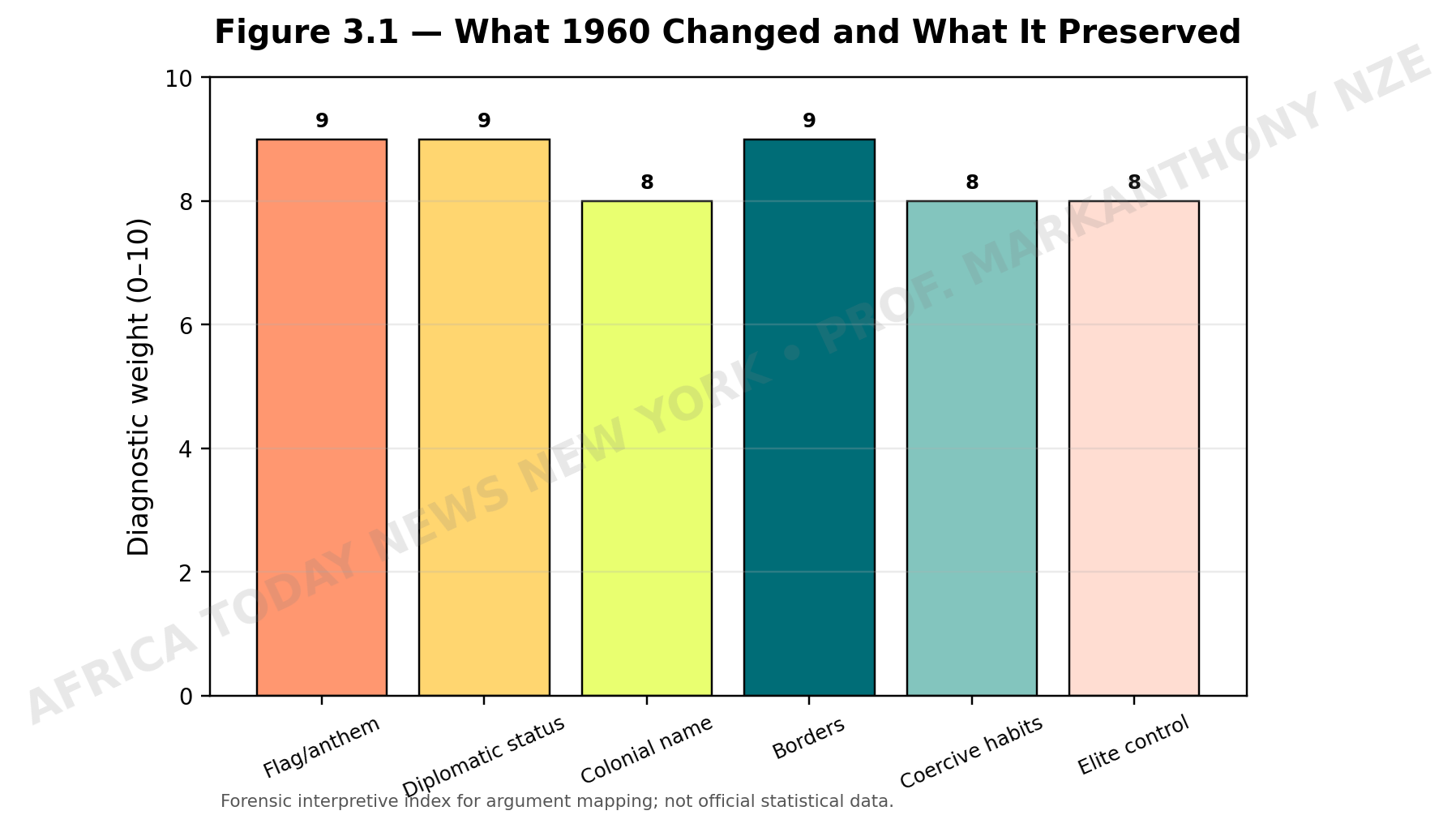
Figure: Diagnostic display of the core forces in this part.
Early federal order had strengths that later generations would miss. Regional governments possessed significant authority. Competition among regions produced energy in education, agriculture, infrastructure, and local development. Awolowo’s federal arguments remain important because they recognized that Nigeria’s diversity required a serious federal answer, not a unitary appetite disguised as national unity (Awolowo, 1947). The country had a chance to build from its plural foundations. That chance was compromised by the weight of inherited suspicion, census disputes, electoral violence, regional rivalry, minority fears, and a political class that increasingly saw control of the center as survival.
Read also: Nigeria: The Slave Name And The Restructuring Verdict — Part 2
Independence without constitutional cleansing left the colonial name intact as a national demand. Citizens were not invited into a founding referendum over identity and union. No sovereign convention of all peoples was asked to decide whether the inherited arrangement should remain, be renamed, be restructured, or be renegotiated. Nigeria became a state that expected emotional loyalty before it had performed the hard work of consent. Patriotism was taught as duty while the terms of belonging remained underexamined.
Postcolonial elites often defended continuity as stability. That defense was convenient. Retaining the colonial state form meant inheriting its tools: bureaucracy, police, taxation, official language, territorial command, and the capacity to discipline dissent. For elites stepping into power, the colonial state was not only an inheritance; it was an asset. It offered offices, titles, revenue, contracts, appointments, and control. The population received flags and speeches. The ruling class received the keys.
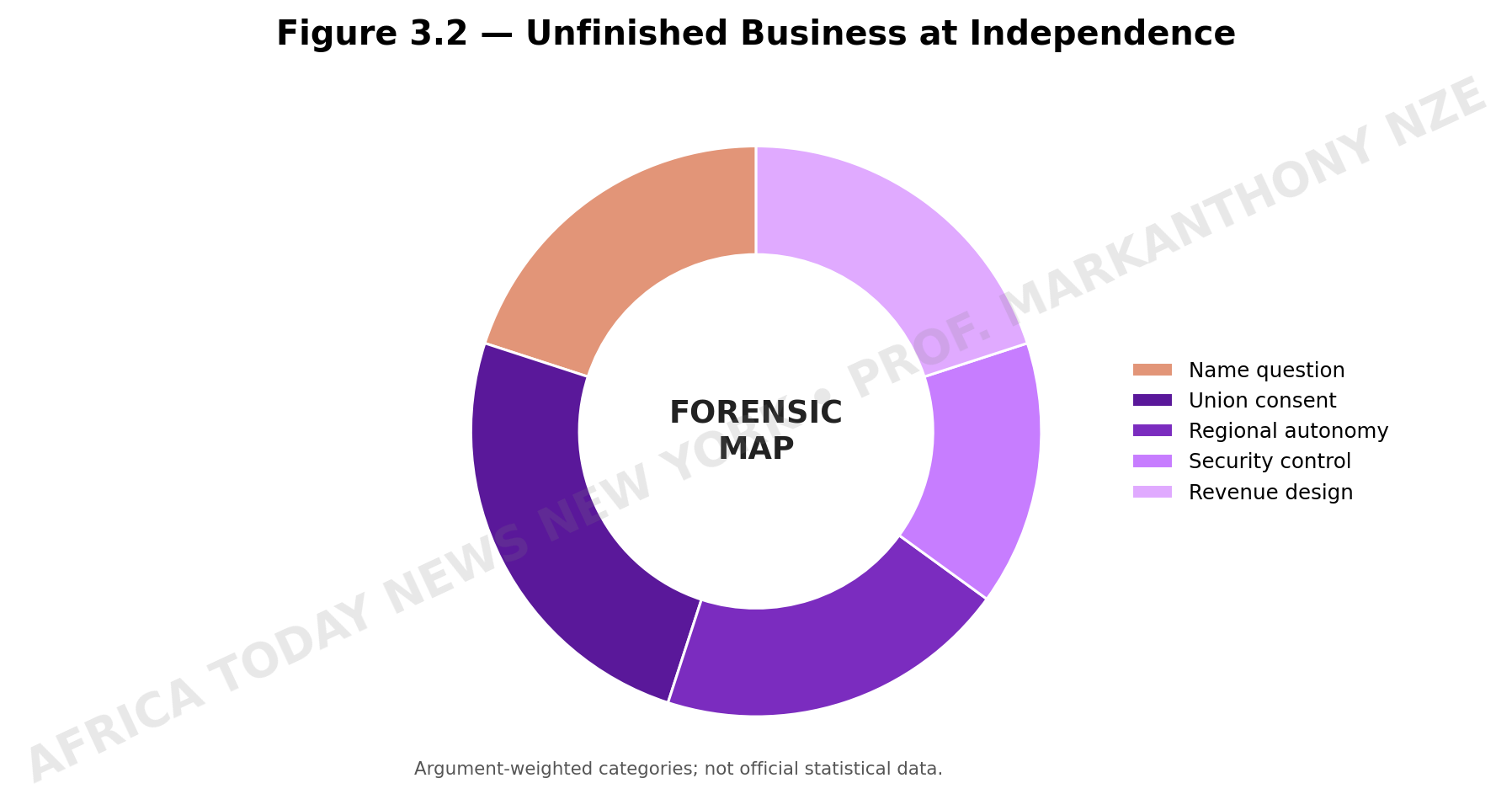
Figure: Argument-weighted chart, built as a forensic visual summary rather than official statistical data.
Ekeh’s “two publics” thesis remains crucial here because it helps explain the moral fracture between civic obligation and primordial belonging in postcolonial Africa (Ekeh, 1975). Nigeria’s citizens were asked to serve a civic public whose origins many experienced as imposed, distant, extractive, or morally thin. Loyalty to family, village, ethnicity, religion, and region often felt more immediate than loyalty to a state first encountered as colonial authority. The problem was not that Nigerians lacked moral life. It was that the inherited state had not earned the same moral intimacy as the communities it claimed to govern.
Moral distance helped weaken public accountability. A state seen as alien, extractive, or captured invites a politics of taking rather than building. Citizens learn to demand their share from government because government is understood as a distant storehouse. Politicians learn to raid the center because the center appears as the supreme prize. Parties become bargaining vehicles. Public office becomes an opportunity to secure the group, the faction, the family, or the network. The republic begins to look less like a covenant and more like a contested estate.
Read also: Nigeria: The Slave Name And The Restructuring Verdict — Part 1
Still, blaming the people would be dishonest. Citizens did not design the inheritance. They were born into it, taxed by it, policed by it, conscripted into its symbols, and judged by their loyalty to it. The deeper responsibility lies with those who converted independence into occupancy instead of refounding. A serious postcolonial moment would have subjected the inherited state to a national reckoning. Nigeria required a founding assembly with real moral authority, not a limited transfer of power within a British-designed territorial container.
Evidence Exhibit 3.1 — What the Record Allows Us to Say
| Forensic claim | Evidence base | What it proves | Use in the series |
| 1960 transferred sovereignty without a full refounding. | Coleman (1958); Nwabueze (1982); Mackintosh (1966). | Symbols changed faster than the inherited state form. | Frames independence as incomplete liberation. |
| Regional federalism carried promise but remained vulnerable. | Awolowo (1947); Sklar (1963); Diamond (1988). | Autonomy existed, yet trust and center-seeking politics weakened the republic. | Prepares the later argument on military centralization. |
| The civic public inherited moral distance from colonial rule. | Ekeh (1975); Osaghae (1998); Ake (1996). | Citizenship struggled against a state experienced as alien or extractive. | Explains why restructuring is delayed liberation. |
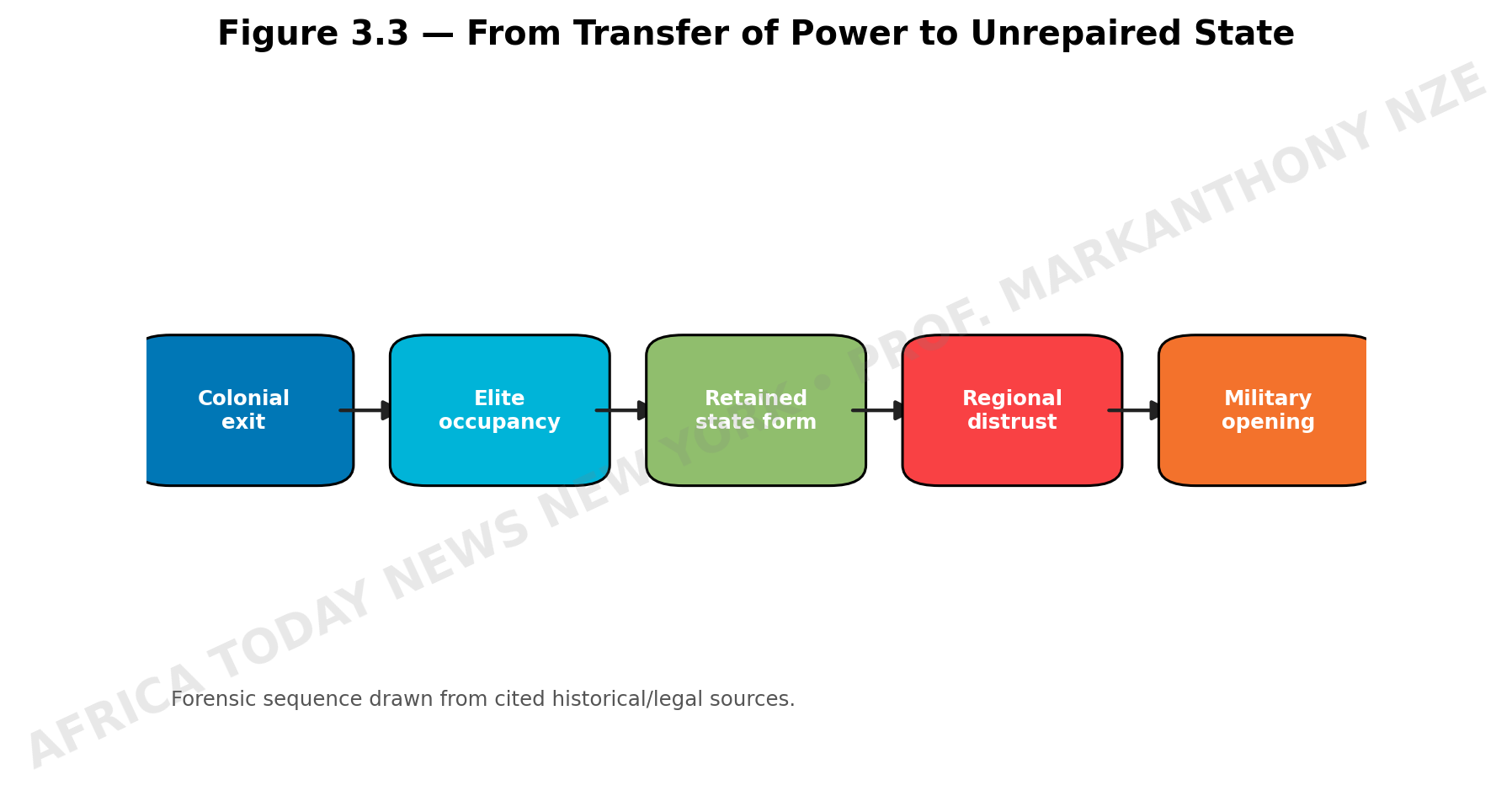
Figure: Sequence chart tracing the relevant historical movement.
Failure became clearer as politics hardened. The First Republic struggled under regional competition, disputed elections, census controversies, minority anxieties, and corruption. Military intervention in 1966 did not come from nowhere. It fed on a weakened civic order and then made it worse. Soldiers presented themselves as rescuers from civilian failure, but they would soon centralize the country more aggressively than the civilians they condemned. The postcolonial failure of refounding opened a door through which the barracks entered the republic.
Regional federalism could have been repaired. Instead, the military years would break it. That later rupture is the subject of Part 5, but its roots are visible here. A state that never fully renegotiated its founding terms was vulnerable to command. A union held together by inherited legality and elite bargain rather than deep consent could be seized by men who believed discipline could replace legitimacy. Once soldiers entered, the colonial habit of ruling from above found new uniforms.
Mythologizing independence as complete liberation also shields later constitutional fraud. If 1960 is treated as complete freedom, then every later failure appears as poor management. If 1960 is examined as partial freedom, then the deeper indictment becomes unavoidable. Nigeria inherited a colonial name, a forced map, centralizing instincts, and a ruling class attracted to the advantages of command. The military did not invent every problem. It inherited a weakened civic foundation and turned it into a harder cage.
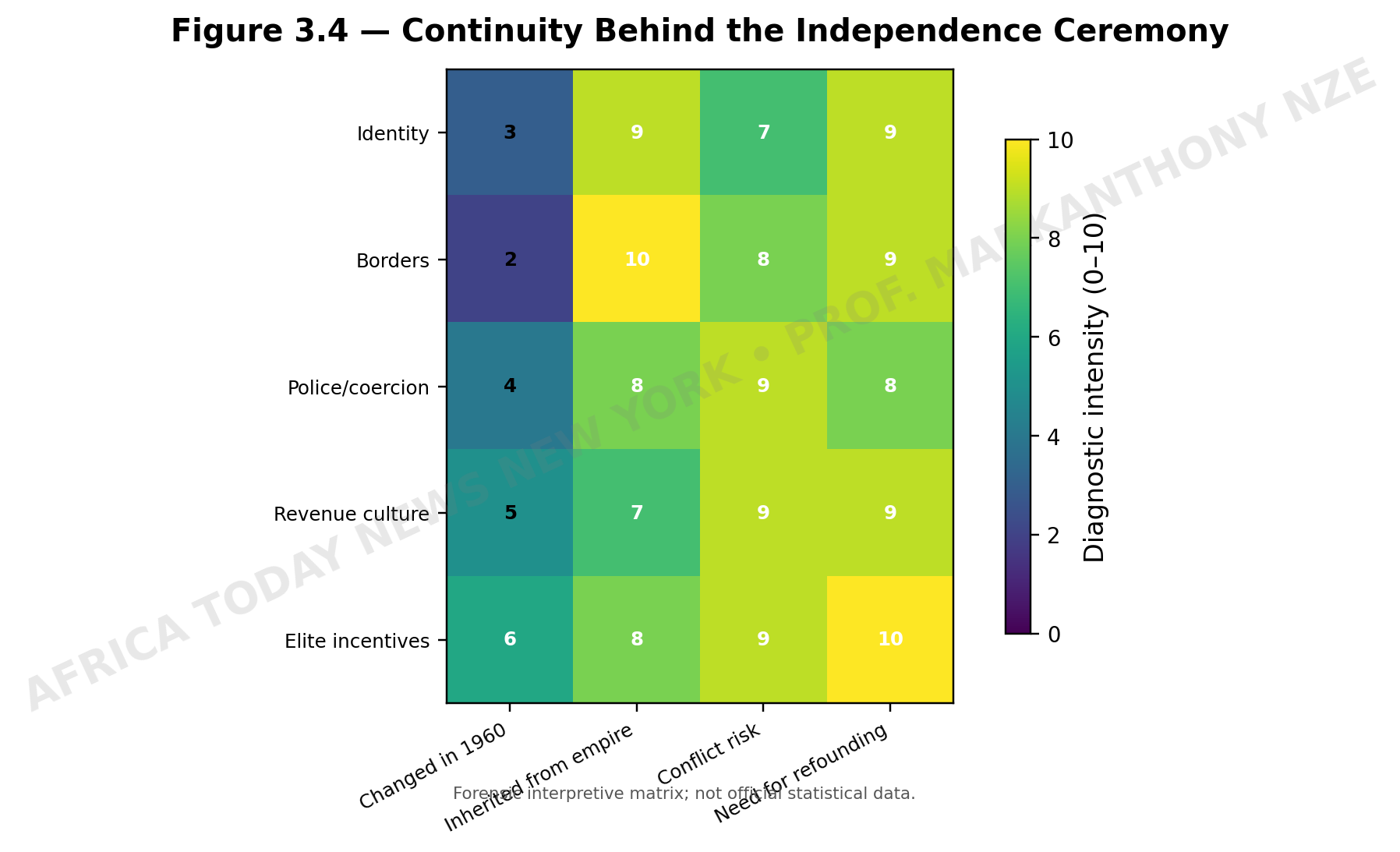
Figure: Evidence matrix showing control, consent, and long-term political effect.
Sentimental nationalism cannot survive this record. The sacrifices of anti-colonial actors remain real, but sovereignty alone did not complete liberation. A flag can fly over an unrepaired state. A passport can carry an imposed name. A parliament can sit inside inherited assumptions. An anthem can bless a union whose peoples were never allowed to renegotiate its moral terms. Independence without deep refounding is ceremony with unfinished business.
Unfinished business now appears in restructuring debates. When Nigerians demand regional autonomy, state policing, fiscal federalism, resource control, or a new constitution, they are not attacking freedom. They are asking for the freedom that 1960 did not complete. They are demanding authorship over a state that has repeatedly demanded loyalty without surrendering control. Restructuring is not a threat to independence. It is the delayed work of independence.
Final finding: October 1 changed the managers of the estate. It did not cleanse the estate. Nigeria inherited the colonial name, preserved the colonial map, occupied the colonial offices, and carried forward many habits by which distant power governs reluctant peoples. The ruling elite called that freedom because the British flag had come down. History must be less polite. Independence without refounding left the cage standing, and the people have spent generations being told to celebrate a key held by others.
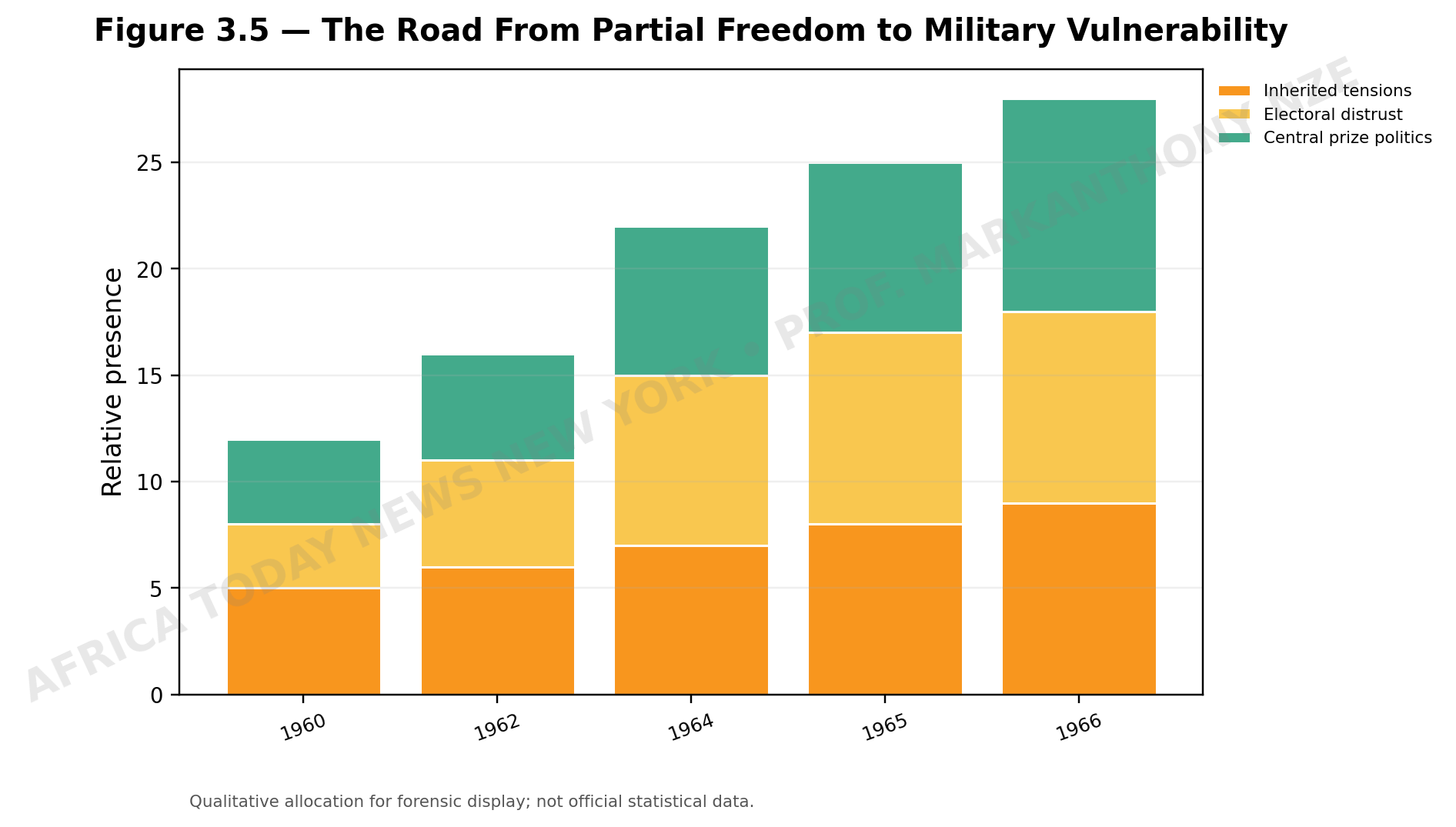
Figure: Stacked forensic profile of the historical burden carried into later state failure.
One sees the cost in the language of national debate. Questions of structure are treated as acts of suspicion; demands for autonomy are treated as threats; calls for constitutional rebirth are pushed aside by elites who benefit from inherited confusion. The state keeps asking for unity while postponing justice, and every postponement returns as anger, insecurity, corruption, or secessionist sentiment. A country cannot indefinitely convert unresolved founding questions into police matters.
Nigeria’s independence should have produced a republic where regions entered the union with clarity, dignity, and enforceable powers. Instead, the center slowly became the altar before which every ambition bowed. That drift did not begin with one president or one party. It began when liberation accepted the colonial container as if the container itself had no history. Part 3 insists on the obvious point that polite history tries to avoid: freedom that refuses to examine inherited domination remains vulnerable to its return.
Evidentiary Sources (APA 7th Edition)
Achebe, C. (1983). The trouble with Nigeria. Fourth Dimension Publishers.
Ake, C. (1996). Democracy and development in Africa. Brookings Institution.
Awolowo, O. (1947). Path to Nigerian freedom. Faber and Faber.
Coleman, J. S. (1958). Nigeria: Background to nationalism. University of California Press.
Diamond, L. (1988). Class, ethnicity and democracy in Nigeria: The failure of the First Republic. Syracuse University Press.
Dudley, B. J. (1982). An introduction to Nigerian government and politics. Indiana University Press.
Ekeh, P. P. (1975). Colonialism and the two publics in Africa: A theoretical statement. Comparative Studies in Society and History, 17(1), 91–112. https://doi.org/10.1017/S0010417500007659
Falola, T., & Heaton, M. M. (2008). A history of Nigeria. Cambridge University Press.
Mackintosh, J. P. (1966). Nigerian government and politics. George Allen & Unwin.
Nwabueze, B. O. (1982). A constitutional history of Nigeria. C. Hurst & Co.
Osaghae, E. E. (1998). Crippled giant: Nigeria since independence. Indiana University Press.
Sklar, R. L. (1963). Nigerian political parties: Power in an emergent African nation. Princeton University Press.