
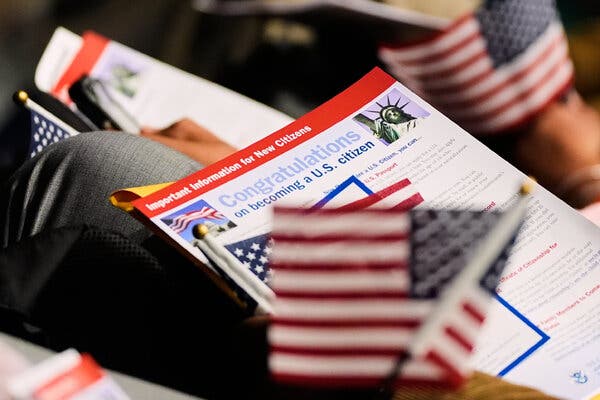
The Trump administration is accelerating efforts to identify and pursue cases in which U.S. citizenship could be revoked for naturalized Americans, according to officials familiar with the plans, part of a wider push within the Department of Homeland Security aimed at tightening immigration enforcement.
Over recent months, U.S. Citizenship and Immigration Services (USCIS) has reassigned personnel and sent trained specialists to field offices around the country to review past naturalization cases for possible fraud or misrepresentation, two people with knowledge of the internal initiative said. The goal, they said, is to generate 100 to 200 potential denaturalization cases per month for referral to the government’s immigration litigation division — a dramatic increase from past practice.
U.S. authorities say denaturalization remains rare and historically has been used in specific circumstances, such as where individuals are later found to have concealed serious criminal histories or human rights violations during the citizenship process. But the scale and structure of the current effort mark a significant expansion compared with earlier years.
Read Also: Tuchel Signs New England Contract To 2028 Euros
During President Donald Trump’s first term, for example, the Justice Department formally filed 102 denaturalization cases over four years, U.S. figures show. In the early months of the current expansion, the number of referrals has already climbed sharply, with 16 cases filed so far in Trump’s second term and seven successful rulings, including one against a U.K.‑born man convicted of distributing sexually explicit images of children.
A Justice Department spokesperson said attorneys are being directed to prioritise denaturalization for a range of cases that could include individuals who pose national security risks, those involved in war crimes or torture, and people suspected of significant fraud against government programmes, such as Medicaid or Medicare. Another provision allows prosecutors to press cases “that the division determines to be sufficiently important to pursue,” a broad standard that officials say gives them discretion.
A spokesman for USCIS, Matthew Tragesser, described the agency’s approach as part of its responsibility to protect the integrity of America’s immigration system. “We maintain a zero‑tolerance policy towards fraud in the naturalization process and will pursue denaturalization proceedings for any individual who lied or misrepresented themselves,” he said in a statement. “We will continue to relentlessly pursue those undermining the integrity of America’s immigration system and work alongside the Department of Justice to ensure that only those who meet citizenship standards retain the privilege of U.S. citizenship.”
USCIS’s reallocation of staff and specialists to field offices is designed to strengthen its ability to detect inconsistencies or omissions in original applications. Officials familiar with the plans said the agency concluded that training personnel across its more than 80 field offices would be a more effective strategy than centralising investigations in a single location, as was done during portions of the previous administration.
For decades, Americans born outside the United States who become naturalised citizens have generally had their status revoked only in cases where significant fraud is discovered — often long after the fact. In the mid‑20th century, such proceedings focused in part on former Nazis who were found to have concealed past affiliations when immigrating. In recent decades, both Democratic and Republican administrations have pursued denaturalization in rare, high‑profile cases.
Legal experts say the current drive to expand investigations raises questions about due process and long‑standing legal standards. Doug Rand, a former USCIS official, said in an interview that no president can unilaterally strip people of citizenship they have already earned. “It’s so important for current and future naturalized U.S. citizens to know that no president can unilaterally strip people of the citizenship they’ve worked so hard to earn,” Rand said.
Sarah Pierce, an immigration policy analyst who previously served at USCIS, noted that citizenship revocation is a time‑consuming process with a high legal bar. Denaturalization proceedings can take years to unfold, and even when someone is stripped of citizenship, deportation proceedings can extend the timeline further.
Read Also: Seoul Says Kim Jong Un Picks Teen Daughter As Heir
Pierce also said that under the new focus, some individuals who initially became citizens without complications could face renewed scrutiny based on policy changes rather than newly discovered evidence. “USCIS has a lot of discretion when it decides to approve someone for naturalization,” she said. “It’s possible that someone who had no issues flagged upon becoming a citizen could face additional scrutiny now.”
The broader context for the expanded effort includes other measures by Homeland Security aimed at tightening legal immigration. These include deploying immigration enforcement officers into U.S. cities for deportation missions, increasing visa revocations — including for individuals involved in pro‑Palestinian protests — and purchasing large facilities to house detainees. Republican lawmakers have also proposed legislation that would make it easier to strip citizenship from people who commit serious crimes, join terrorist groups, or are found to have defrauded the government.
Civil rights advocates and legal groups have raised concerns about the impact of the denaturalization initiative on immigrant communities. Deborah Chen, supervising attorney at the New York Legal Assistance Group’s immigrant protection services, said some clients have faced denials of naturalization based on technical issues such as outstanding taxes, even when they were making payments on agreed plans. She said the heightened enforcement environment could make proving “good moral character” — a requirement for citizenship — more difficult for some applicants.
Margy O’Herron, a senior fellow at the Brennan Center for Justice at New York University School of Law, said the threat of denaturalization can create fear, even when proceedings do not result in removal of citizenship. “Citizens are afraid that if they do or say something the government doesn’t like — even if those things are lawful and protected by the Constitution — they will be a target,” she said.
U.S. Department of Homeland Security and Justice Department officials have not released detailed public data on the expanded initiative’s scope beyond general summaries. It remains unclear how many cases will ultimately result in successful denaturalizations or how long the process will take for the hundreds or potentially thousands of cases under review.