
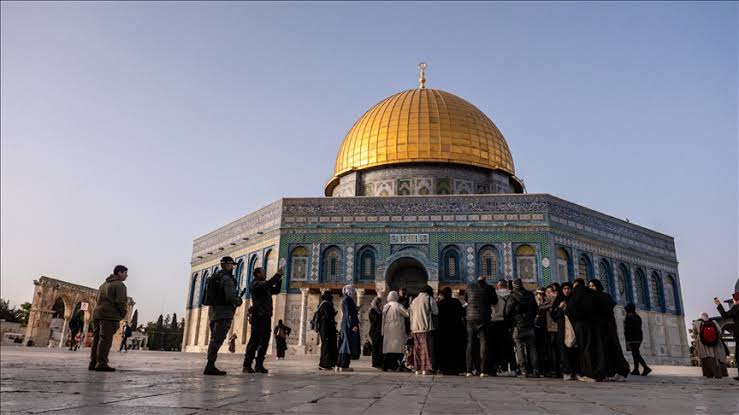
Israel imposed severe restrictions on Palestinian access to the Al-Aqsa Mosque compound in occupied East Jerusalem on Friday, capping the number of West Bank worshippers permitted to attend the first Friday prayers of Ramadan at 10,000, a fraction of the 200,000 or more who have gathered at one of Islam’s holiest sites during normal years, and a ceiling that was reached so quickly at the Qalandiya military checkpoint that permit-holding worshippers were turned back before they could cross.
The Palestinian Authority’s Jerusalem Governorate said thousands of West Bank residents were crowded at Qalandiya, “and the Israeli authorities are refusing to allow them to enter on the grounds that the permitted number for Friday, set at 10,000 people, has been reached.”
Among those turned away were Palestinians who had registered and obtained permits from the first day of the application window. “I registered from the very first day to go to Al-Aqsa and obtained a permit. Early this morning, we set out after Fajr prayer, but when we arrived here, they stopped us at the gate,” said Jihad Basharat, who had travelled from Tammun in the northern West Bank. “When I reached the second gate, they said my permit had been cancelled, and they sent me back.”
About 80,000 people attended Friday prayers inside the compound, according to Jerusalem’s Islamic Waqf, the Jordanian religious authority that administers the site. Israeli police said more than 3,000 officers were deployed across Jerusalem and characterised events as having proceeded “as usual.” The gap between those two descriptions, 80,000 inside, tens of thousands blocked at the gate, and Israeli authorities declaring the day unremarkable, illustrated the degree to which the terms governing access to the compound have shifted in recent years.
The age restrictions imposed by Israeli authorities were strict. Only men over 55, women over 50, and children under 12 were eligible for permits, categories designed to exclude the demographic groups considered most likely to engage in protests or disturbances.
Palestinians in possession of Israeli citizenship faced fewer formal barriers but were subject to the same security posture that brought thousands of uniformed officers onto the streets. The Coordinator of Government Activities in the Territories, the Israeli military body known as COGAT, said all permits were “conditional” and that worshippers travelling to Al-Aqsa would be subject to “digital documentation at the crossings,” a registration requirement that has not previously been applied.
Read Also: Israeli Strikes Kill 12 In Gaza, Threatening Peace Plan
The compound itself has been the subject of escalating institutional and pastoral disruption in the days preceding and surrounding Ramadan. On Monday, Israeli forces detained Sheikh Mohammed al-Abbasi, the imam of Al-Aqsa Mosque, from within the mosque’s courtyards without providing a stated reason. Senior Waqf personnel have been expelled from the compound this year.
Israel’s police also broke a longstanding practice of coordinating crowd management with the Waqf, and Palestinian reports said the authority was prevented from installing shade canopies and temporary medical stations in anticipation of the large numbers expected for Friday prayers.
The former Grand Mufti of Jerusalem, Sheikh Ikrima Sabri, who is himself banned from entering the compound, described the cumulative effect of the measures as deliberate. “Israel’s ambitions towards Al-Aqsa” were confirmed by the restrictions, he said, accusing Israeli authorities of seeking to “disrupt Muslims’ observance of Ramadan through arbitrary actions” and of pursuing what he characterised as an effort to impose temporal and spatial division over the site.
The restrictions are the most visible expression of a broader and worsening pattern of access contraction. In the years before the Gaza war, which began in October 2023, Ramadan Fridays at Al-Aqsa drew crowds approaching 200,000 and were among the largest peaceful religious gatherings in the world.
The October ceasefire between Israel and Hamas, which went into effect in that month last year, was the first since the war’s start, meaning Friday’s prayers were the first Ramadan Friday gathering to take place since the ceasefire, and the first opportunity many West Bank Palestinians had to visit the site in over a year.
“Many Palestinians said the month’s typically festive spirit is eluding them as they struggle with grief and losses following the two-year conflict in Gaza,” the Associated Press reported from the checkpoint.
Read Also: Israel Moves To Register West Bank Lands AS ‘State Property’
The wider context beyond the mosque is one of acute and documented violence. According to the United Nations Office for the Coordination of Humanitarian Affairs, more than 1,100 Palestinians have been killed by Israeli forces and settlers in the West Bank since October 2023, and more than 10,000 people have been forcibly displaced. On Wednesday, a young Palestinian-American man was killed and four others wounded when Israeli settlers, accompanied by Israeli military forces, opened fire on a West Bank village, one of scores of such incidents recorded by UN monitors in the past year.
Earlier this week, Israel’s government approved a plan to reclassify large tracts of occupied West Bank land as Israeli state property, shifting the evidentiary burden to Palestinians to prove ownership of land they occupy and farm, a reversal that international law experts and Palestinian authorities have described as a de facto annexation measure.
More than 80 UN member states condemned the move in a joint statement. Human rights organisations have said the land declaration, combined with the trajectory of access restrictions at Al-Aqsa, represents a systematic effort to alter facts on the ground in ways that would foreclose the possibility of a Palestinian state.
Israel has imposed comparable restrictions at Al-Aqsa during previous periods of heightened tension and has cited security requirements as justification. Israeli police on Friday made no reference to specific threat intelligence and said the day’s operations were conducted in keeping with standing policy.
The Waqf said prayers would continue throughout Ramadan under the conditions now established. Whether the access cap of 10,000 would be revisited for subsequent Fridays had not been indicated by Israeli authorities as of Friday evening.