
The death of Nemesio Oseguera Cervantes in military custody has triggered one of the most coordinated waves of cartel retaliation seen in Mexico in recent years, exposing both the reach of organised crime and the fragility of public security across large swathes of the country.
Oseguera Cervantes, widely known as “El Mencho,” led the Jalisco New Generation Cartel (CJNG), a syndicate that rose within a decade to become one of the most powerful and violent transnational criminal groups operating in the Western Hemisphere. His death on Sunday, shortly after being captured by Mexican special forces, set off a chain reaction that spread across at least 20 Mexican states.
According to Mexico’s defence ministry, El Mencho was seriously wounded in a firefight between his security detail and military commandos dispatched to detain him in Tapalpa, a town in Jalisco state long regarded as part of the cartel’s stronghold. At least six of his bodyguards were killed during the operation, while three members of the armed forces sustained injuries. The drug lord later died while being transported to Mexico City.
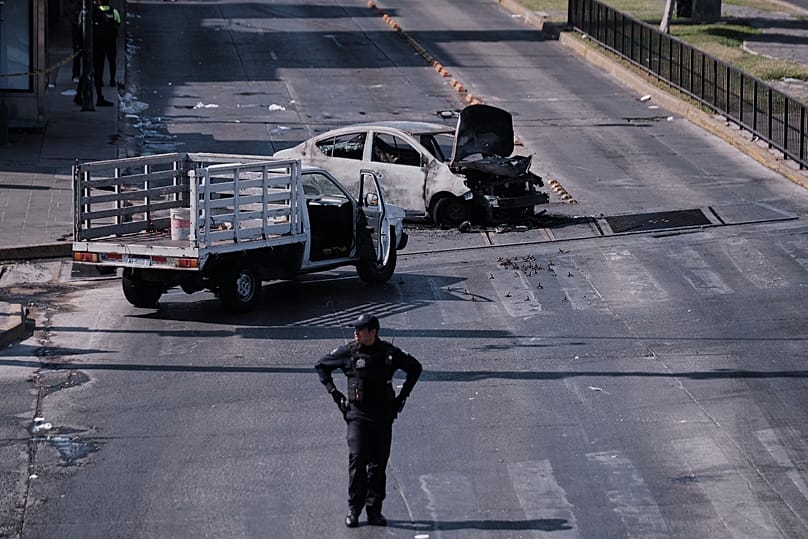
Within hours of confirmation that Mexico’s most wanted man was dead, CJNG operatives initiated retaliatory actions across multiple regions where the organisation maintains influence. Businesses were set ablaze. Roads were rendered impassable through improvised barricades of burning vehicles. Spikes and nails were scattered across highways to disable traffic. In several towns, buses and private vehicles were commandeered and set on fire mid-road, effectively paralysing movement.
Mexican newspaper El Universal reported more than 250 incidents of road blockades across the affected states. Security officials later stated that approximately 90% of these obstructions had been cleared, though tension remains acute, particularly in Jalisco.
Urban centres and tourist destinations were not spared. In Puerto Vallarta, a Pacific coast resort popular with foreign visitors, plumes of black smoke rose over neighbourhoods as vehicles burned. Roughly 300 passengers were stranded at the city’s airport after flights were cancelled amid security concerns. Authorities evacuated them in convoy under heavy police escort to the city centre.
Footage from Guadalajara—scheduled as one of the host cities for the forthcoming FIFA World Cup—captured scenes of confusion at the airport. Travellers were seen crouching on terminal floors as panic spread following reports of gunfire near a highway adjacent to the airport. News outlet Milenio later reported that while a burnt-out vehicle had been spotted nearby, authorities dismissed rumours that shots were fired inside the terminal itself.
Read Also: Ukraine Signals Fresh Talks This Week As Peace Process Stalls
State authorities responded with emergency measures. The governor of Jalisco declared a “code red,” suspending public transport and cancelling mass events and in-person classes. Residents in several municipalities were advised to remain indoors.
Foreign governments also issued advisories. The UK Foreign Office urged visitors in Puerto Vallarta to exercise extreme caution and follow local directives. The US State Department instructed American nationals in Jalisco, Baja California, Quintana Roo and parts of Guanajuato, Guerrero, Michoacán, Oaxaca, Nuevo León and Tamaulipas to shelter in place until further notice.
The violence evoked memories of 2019, when the capture of Ovidio Guzmán López—son of imprisoned kingpin Joaquín Guzmán—triggered such intense firefights in Sinaloa that authorities released him to prevent further bloodshed. Guzmán López was later re-arrested in 2023 and extradited to the United States, where he pleaded guilty to drug-trafficking charges. Since then, retaliatory cartel violence following high-profile arrests has become an increasingly predictable tactic.
The CJNG’s response to El Mencho’s death underscores the cartel’s operational discipline and territorial footprint. Unlike loosely organised criminal bands, CJNG has functioned as a vertically integrated network with paramilitary capabilities. Its influence spans drug production, trafficking routes and local enforcement structures. The group has been central to the trafficking of fentanyl into the United States, a factor that has intensified bilateral security cooperation.
Mexico’s Ministry of Defence stated that the operation to capture El Mencho involved the army, supported by the National Guard and Air Force. Officials acknowledged that “complementary information” from the United States contributed to the success of the raid. The US State Department had previously offered a $15 million reward for information leading to his capture.
Late Sunday, White House Press Secretary Karoline Leavitt described El Mencho as a “top target” for both governments, citing his role in fentanyl trafficking. Mike Vigil, former chief of international operations at the US Drug Enforcement Administration, characterised the operation as one of the most consequential actions in the history of drug enforcement.
President Claudia Sheinbaum urged citizens to remain calm and informed, stating that in most parts of the country normal activities were continuing. She praised the armed forces for executing the mission that led to El Mencho’s capture.
Her administration, however, faces mounting external pressure—particularly from the United States—to demonstrate sustained effectiveness against transnational drug trafficking networks. The Trump administration has repeatedly pressed Mexico to intensify enforcement efforts, framing fentanyl flows as a public health emergency and national security issue.
The broader implications extend beyond one individual’s demise. The CJNG’s retaliatory campaign illustrates a structural dilemma confronting the Mexican state: decapitation strategies may remove leadership figures, but they can also provoke short-term surges in violence as successor factions consolidate control or signal resilience.
Arrests made in the aftermath—25 individuals, including 11 accused of participating in violent acts and 14 detained for alleged looting—represent an immediate enforcement response. Yet the scale of coordinated disruption across 20 states reveals the depth of CJNG’s logistical networks.
Read Also: Hungary Blocks 20th Russia Sanctions On War Anniversary Eve
For Mexico, the episode highlights the complexity of dismantling entrenched criminal economies that operate across borders and within communities. For the United States, it reinforces the interdependence of security strategies in addressing synthetic opioid trafficking.
El Mencho’s death marks a turning point for CJNG, but not necessarily its end. As security forces work to stabilise affected regions, the longer-term question will be whether institutional reforms and cross-border cooperation can translate tactical victories into durable reductions in violence.
For now, smoke has cleared from many highways, but the equilibrium between state authority and cartel power remains unsettled.