
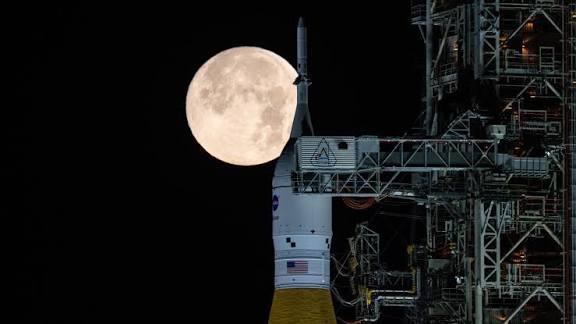
NASA is adding an additional mission in its plans for the Artemis program, which will give astronauts an opportunity to hone their skills in low-Earth orbit before making the historic journey to the Moon, according to reports, in what is seen as a significant adjustment in the space agency’s plans for the mission.
According to the new plan, the Artemis III mission, which is scheduled to send astronauts into orbit around the Moon, will now make its mission in low-Earth orbit in 2027, where it will conduct tests in the docking of the lunar lander, according to NASA officials, who pointed out that the mission is meant to ensure that the technical challenges are well addressed before the historic landing mission in 2028, which is likely to take place in mission Artemis IV or V.
“The current architecture was not a pathway to success,” NASA Administrator Jared Isaacman said to reporters Friday.
“If you’re going to operate, you want to get as many missions as possible in a year. If you’re going to go to the Moon, you want to get there as fast as you can.”
He said that the agency’s practice of flying missions separated by a number of years between uncrewed and crewed missions could actually increase the chances for operational problems.
“You don’t go from one uncrewed launch of SLS, go around the Moon, wait three years, go around the Moon, wait three years, land on it.”
The mission to low Earth orbit will permit astronauts to test the integrated systems for the Orion spacecraft and the lunar lander before landing on the Moon.
Read Also: Rocket Trouble Forces NASA To Postpone Moon Mission
Isaacman noted that there would be opportunities to test the space suits and other gear in orbit, which could minimize possible hazards for the astronauts while on the Moon. “I would certainly much rather have the astronauts test out the integrated systems of the lander and Orion in low Earth orbit than on the Moon.”
NASA also offered details on its Artemis II mission, which is currently scheduled to fly four astronauts around the far side of the Moon and back to Earth.
The mission was tentatively scheduled for March but was put on hold when engineers discovered a helium leak in the SLS rocket.
The rocket has now been moved from the launchpad to the Vehicle Assembly Building at Kennedy Space Center in Florida to perform the necessary repairs.
NASA says the earliest possible launch for the mission is now April, depending on how long the technical work takes.
There are also new challenges for NASA’s Artemis mission to return humans to the Moon for the first time since 1972.
NASA has a contract with SpaceX to build a lunar lander using its Starship technology but is now asking for a revised plan to accelerate its lunar landing mission due to development delays for its Starship program.
NASA has also asked Blue Origin, a company founded by Jeff Bezos, to develop a new plan for a lunar lander capable of supporting missions to the Moon.
According to Isaacman, the test flight to low-Earth orbit might also include docking with one or both of these landers.
The Artemis mission is based on the Orion spacecraft, a crew capsule intended to carry astronauts from Earth to the Moon, and the SLS, a heavy-lift rocket.
The uncrewed mission, Artemis I, was a success, providing a platform for a crewed mission to the Moon, as demonstrated by Artemis II’s flyby mission.
The inclusion of a mission to low-Earth orbit is meant to test the functionality of the Orion and the lander, reducing risks involved before a mission to descend to the Moon is undertaken.
Read Also: NASA Postpones Rocket Launch To Moon After Fuel Leak
International competition is also affecting the schedule of NASA. China has announced plans to send astronauts to the Moon by 2030 and to establish a permanent base near the south pole of the Moon.
Both the United States and China consider the permanently shadowed areas of the south pole of the Moon, where water ice is suspected to be present, to be strategically important locations for establishing bases on the Moon in the future.
The accelerated tests and the proposed additional missions to the Moon by NASA appear to be aimed at maintaining the United States’ supremacy in the exploration of the Moon.
According to officials of NASA, the newly added mission will not affect the overall schedule of the Artemis program to send humans to the Moon again.
This mission to low-Earth orbit is set to take place in 2027, which is expected to be followed by either one or two missions to land on the moon in 2028.
NASA is still assessing the readiness of both Orion and the lunar lander, which is also receiving support from SpaceX and Blue Origin, who are working on a commercial basis.
The program is set to go on as planned once the SLS is repaired, and integration tests show that everything is safe to use together.