
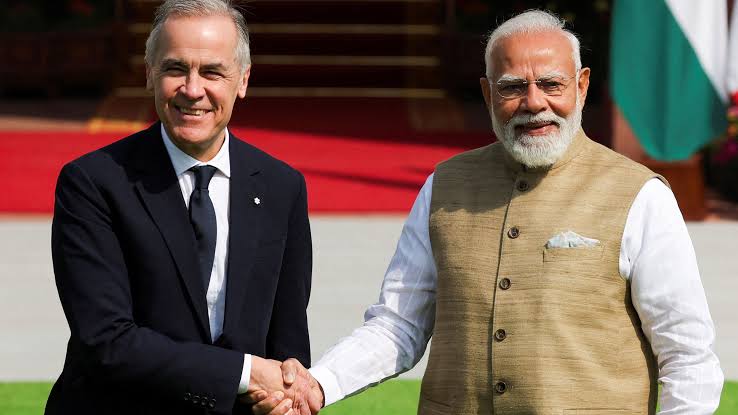
India and Canada announced a series of agreements on Monday, including nuclear energy, technology, critical minerals, space, defense, and education, as the two countries seek to revive ties strained by diplomatic tensions over the past three years.
The agreements were announced after a meeting between Indian Prime Minister Narendra Modi and his Canadian counterpart Mark Carney at Hyderabad House in Delhi.
Some of the key agreements include a civil nuclear energy deal for 10 years to ensure the long-term supply of uranium.
“In civil nuclear energy, we have reached a landmark deal for long-term uranium supply. We will also work together on small modular reactors and advanced reactors,” Modi said after the meeting.
He added that India and Canada would step up cooperation in the field of artificial intelligence, supercomputing, and semiconductors, and hold a renewable energy summit together.
Read Also: Blast At India Explosives Factory Claims 17 Lives
Carney characterized the agreements as a move towards a strategic energy partnership, citing Canada’s ability to provide nuclear fuel to meet the growing energy needs of India.
“There has been more engagement between the Canadian and Indian governments in the last year than there has been in more than two decades combined,” Carney said, adding to the rebuilding of the relationship.
Trade issues were also at the center of the negotiations. Carney and Modi agreed to target the conclusion of a comprehensive economic partnership agreement by the end of 2026.
The economic partnership agreement has been under negotiation for more than 15 years. Modi said the goal is to increase trade between the countries to $50 billion.
He added that the countries want to minimize exposure to punitive U.S. trade tariffs.
The renewed engagement signals a careful re-establishment of relations that had strained since last year following accusations by Carney’s predecessor, former Prime Minister Justin Trudeau, that India was involved in the assassination of the leader of the Sikh separatist group Hardeep Singh Nijjar on Canadian soil.
India had denied any involvement. Relations had been strained, with diplomats from both countries expelled, and the suspension of visa services temporarily.
Since assuming office last year, Carney has been keen on adopting a forward-looking approach, with his administration stating that it does not believe India has anything to do with violent crimes and security threats on Canadian soil.
Legal proceedings for four individuals who face charges for the assassination of Nijjar are still ongoing.
Prior to the Monday summit, Carney met with India’s Foreign Minister S. Jaishankar to discuss “charting a forward-looking partnership,” officials announced.
In a four-day visit that began on February 28 in the city of Mumbai, Carney met with business leaders and ministers to boost trade and investment relations.
This has been analyzed by analysts as “a pragmatic recalibration of Canada’s India policy.” From the viewpoint of India, strengthening its relations with Canada is an important measure in its efforts to reduce its dependence on Russia in the sphere of energy.
Besides the areas of nuclear and trade cooperation, the agreements also include the areas of cooperation in the fields of technology and innovation.
The Indian prime minister has stated, “India and Canada are natural partners in technology and innovation.
Read Also: India And France Overhaul 1992 Tax Treaty In Strategic Reset
We are expanding our cooperation in areas like artificial intelligence, supercomputing, and the development of semiconductors.” Besides these areas, the cooperation of the two nations is also being emphasized in the fields of critical minerals, space research, defense cooperation, and education.
Carney has reiterated the intention of Canada to conclude the economic partnership agreement by the end of the year.
This agreement has been negotiated repeatedly over the past one and a half decades.
This nuclear deal is a prominent feature of the energy and technology relationship between the two nations. As a result of this deal, Canada will provide India with uranium for a decade.
The two nations will also work on the development of small modular reactors as well as advanced reactors.
Modi emphasized the significance of the relationship between the two nations based on their people.
He mentioned the large Indian community living in Canada as well as their relationship in the areas of education, business, and culture.
The two leaders emphasized that the agreement is a long-term strategy aimed at strengthening their relationship as well as minimizing risks associated with external trade and geopolitical pressures.
Following the meetings in Delhi, Carney is expected to proceed to Australia and Japan as part of his tour aimed at diversifying Canada’s relations and attracting investment in the country.
According to the Canadians, the move is a strategy to address the changing nature of relations in the global market and balance Canada’s relations to attract economic opportunities.