
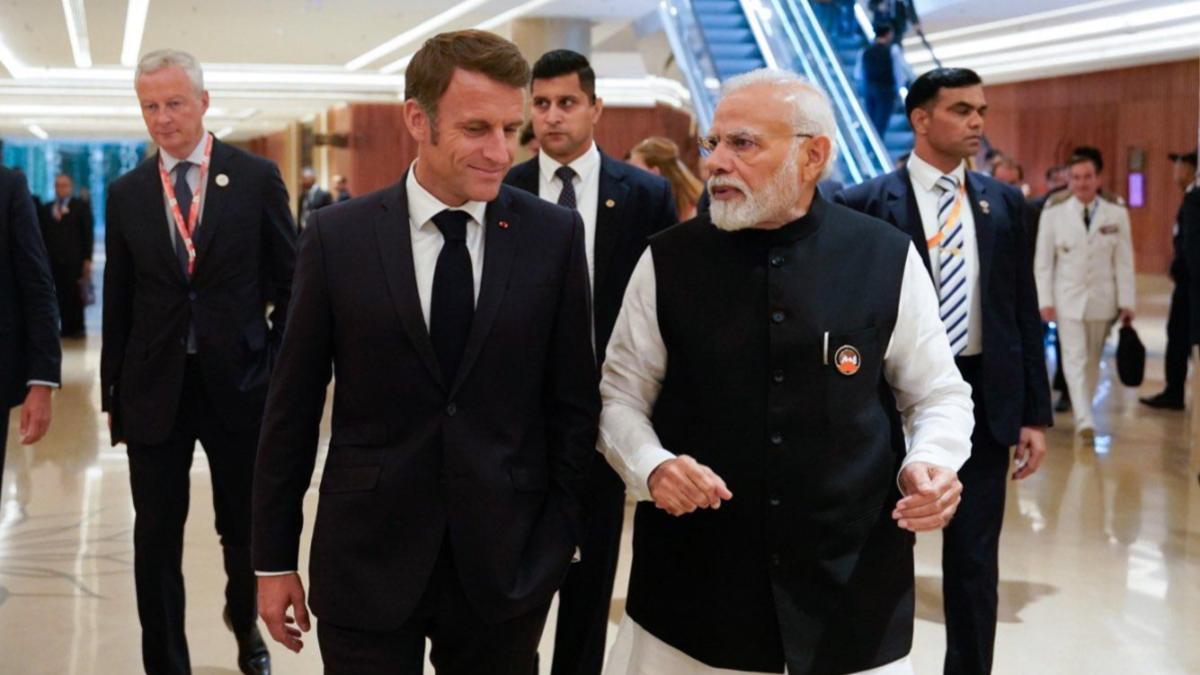
India and France signed a sweeping amendment to their 34-year-old bilateral tax treaty on February 17 during French President Emmanuel Macron’s state visit to New Delhi, restructuring the terms under which French companies and investors are taxed on dividends and capital gains from Indian investments, and permanently resolving a legal dispute over the treaty’s most-favoured-nation clause that had destabilised cross-border tax planning between the two countries since a landmark Supreme Court ruling in 2023.
The Amending Protocol was signed on 23 February 2026, revising the India–France Double Taxation Avoidance Convention originally signed on 29 September 1992. The Protocol was inked by Ravi Agrawal, Chairperson of the Central Board of Direct Taxes, on behalf of the Government of India, and Thierry Mathou, Ambassador of France to India, representing the French Republic.
The most immediately consequential change governs how dividends paid by Indian companies to French shareholders are taxed. The taxation of dividends will now follow a two-tier structure instead of the existing flat 10 per cent withholding tax rate. Dividends will attract 5 per cent tax for shareholders holding at least 10 per cent of the company’s capital, and 15 per cent in all other cases. The reform rewards long-term strategic investors, he Sanofi, L’Oréal, Capgemini, Pernod Ricard, Danone, and Accor subsidiaries whose French parent companies hold significant controlling or substantial minority stakes in Indian operations, while applying a heavier burden on portfolio investors and smaller minority shareholders, whose dividend receipts will be taxed at a rate five percentage points above the previous flat rate.
The move could impact France-based foreign portfolio investors that owned $21 billion worth of shares in Indian companies as of January 2026, according to Indian share depository data.
The second major structural change transfers capital gains taxing rights decisively to India. The updated treaty gives full taxing rights on capital gains from share sales to the country where the company is based. If a French investor sells shares of an Indian company, India will now have full rights to tax the gains. This rule clarifies which country can tax such income, eliminating confusion. Previously, India’s right to tax capital gains was limited to cases where the French seller held more than ten percent of the Indian company’s share capital. Under the new protocol, that ownership threshold is eliminated entirely: India has secured broader rights to tax capital gains arising from the sale of shares by French investors, removing the existing ownership threshold that limited India’s taxing rights.
Read Also: US Ambassador To France Blocked From Official Meetings
The deletion of the most-favoured-nation clause removes the provision that had been the most contentious element of the treaty for the past two years.
The MFN clause had allowed countries to automatically claim lower tax rates if India struck more favourable terms with another OECD nation. The Supreme Court, however, ruled that countries cannot automatically do so, creating tax uncertainty. The issue became one of the main drivers of the renegotiation and the countries ultimately agreed to delete the provision. The Amending Protocol now deletes the MFN clause that existed both in Article 7 of the treaty and in the protocol itself, thereby ending long-standing interpretational disputes. France becomes the latest in a series of treaty partners to lose MFN status in India’s network of double-taxation agreements. Switzerland suspended the application of its own MFN clause with India on January 1, 2025, for the same reason.
Beyond the headline changes, the protocol introduces several technical modernisations that extend India’s tax base over cross-border services. The definition of “Fees for Technical Services” was tweaked to align the language used in the India–US tax treaty, and the concept of “Permanent Establishment” was expanded to include a Service PE, bringing more cross-border service activity into the tax net.
A Service PE provision now means that services performed in India beyond agreed thresholds for related or unrelated parties will trigger a PE and source-country taxation of attributable profits. The protocol also updates exchange of information provisions, introduces a new article on mutual assistance in tax collection, and incorporates all relevant Base Erosion and Profit Shifting Multilateral Instrument provisions applicable between the two countries, aligning the treaty with the OECD’s post-2015 international tax architecture.
Read Also: France Arrests 11 Over Killing Of Far-Right Activist In Lyon
Abheet Sachdeva, partner for mergers and acquisitions tax at Nangia Global, said the protocol simultaneously serves investor and sovereign fiscal interests. “The dividend rate rationalisation, coupled with deletion of the MFN clause, will provide a clear impetus for French FDI into India. At the same time, full capital gains taxing rights with the source state is an important balancing measure that protects Indian revenue,” he said.
KPMG described the revised treaty as one that “realigns the bilateral trade framework with India’s current treaty policy and international tax standards,” adding that it “underscores India’s efforts to safeguard its tax base and promote a stable investment environment.”
The tax treaty revision was one of several deliverables from Macron’s February 17 visit, at which the two countries elevated their bilateral relationship to a “Special Global Strategic Partnership” and announced deepened cooperation in defence procurement and space technology. Bilateral trade between India and France stood at $15 billion in 2025. Both countries’ finance ministries described the treaty revision as creating the certainty necessary to expand that figure significantly.
The treaty will come into effect after completing formalities and legal approval processes in both countries. No timeline for ratification was specified.