
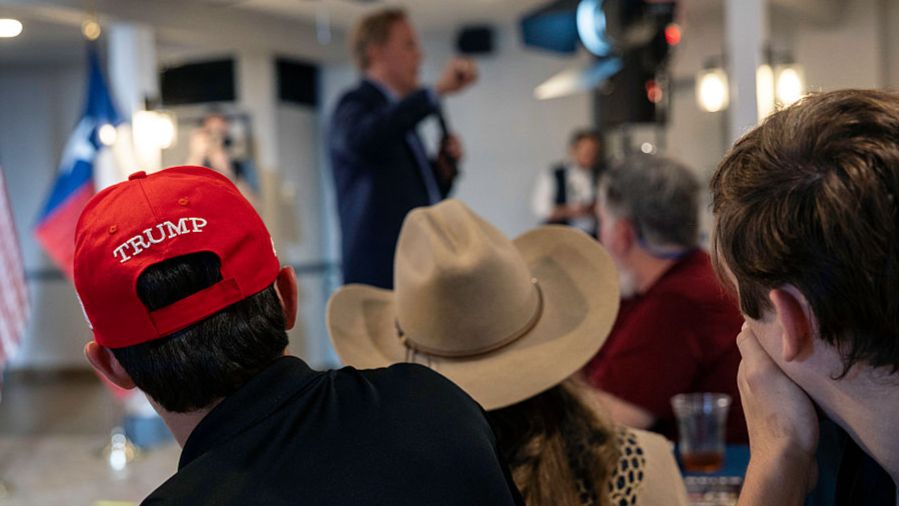
Military escalation between US and Iran is commanding global headlines, yet in Texas—where voters are selecting party nominees ahead of November’s midterm congressional elections—the issue has so far remained secondary to domestic political calculations. Republican candidates across the state have publicly aligned themselves with President Donald Trump’s decision to authorize strikes on Iran, though beneath that solidarity lies a measured unease shaped by two decades of American military entanglements abroad.
The contrast was visible this week in Waco, where Texas Attorney General Ken Paxton addressed supporters inside a crowded banquet hall. Paxton, who is challenging incumbent Senator John Cornyn in a closely watched Republican primary, devoted the overwhelming majority of his remarks to immigration enforcement, federal spending, and gun rights. Iran surfaced only briefly—and indirectly—as he praised civic participation and underscored the importance of ballots over violence in shaping political outcomes.
It was only afterward, in conversation with reporters, that Paxton offered a direct endorsement of the president’s military action. Iran, he stated plainly, represents a significant threat to American security. His support was unequivocal and consistent with his longstanding alignment with Trump’s political agenda.
Across the Republican field, similar language has prevailed. Cornyn characterized the strikes as “decisive action,” signaling confidence in executive judgment. Congressman Wesley Hunt framed the operation as an assertion of “peace through American strength,” reinforcing a traditional conservative doctrine that deterrence rests on credible force. Within party ranks, dissent has been muted.
At the grassroots level, however, the tone is more complex. Many rally attendees in Waco echoed the view that Tehran’s posture toward Washington has for years demanded a firm response. One supporter described the president’s strategy as forward-looking and calculated, suggesting that confronting the threat now could avert greater costs in the future. The language reflected a belief that deferring action carries its own risks.
Yet conversations in the same venue revealed a second strand of thinking—supportive of targeted strikes but wary of escalation. References to Afghanistan and Iraq surfaced repeatedly. Those conflicts, initially framed as limited and necessary interventions, evolved into prolonged engagements with profound human and financial consequences. The fear of a “quagmire” remains embedded in the political memory of many voters.
Read Also: China Removes Three Retired Generals Before Two Sessions
This tension poses a strategic challenge for Trump. During his presidential campaigns in 2016 and again in 2024, he positioned himself as a critic of protracted Middle Eastern wars, arguing that the United States had squandered resources on open-ended nation-building efforts. His recent State of the Union address devoted only a brief segment to Iran, and although he has issued video statements following the strikes, he has not delivered a formal prime-time address outlining a broader doctrine or long-term objective.
The relatively subdued public reaction nationwide may be partly attributable to that restrained communication. In Trump’s second term, military actions abroad have generally been swift and tightly defined. A strike last year targeting Iranian nuclear facilities unfolded within a single night. The capture of Venezuelan President Nicolás Maduro was similarly rapid, concluding before most Americans had registered the operation’s scope.
The current campaign against Iranian targets differs in duration and potential implications. The strikes have continued for multiple days, and the president has indicated they could extend for weeks. Even so, many supporters in Texas appear to interpret the operation through the lens of earlier limited engagements, assuming that it will conclude without a sustained ground presence.
Aaron Reitz, a former Marine and Trump administration official now seeking to succeed Paxton as attorney general, articulated that confidence explicitly. In his view, the president’s record demonstrates precision and restraint rather than an appetite for occupation. The assumption underlying much Republican support is that calibrated force can achieve deterrence without dragging the United States into a broader regional conflict.
Whether that assumption holds will depend in part on external variables beyond Washington’s immediate control. Energy markets have already reacted to the escalation, and sustained increases in oil prices would reverberate through the American economy. Only days before authorizing the strikes, Trump highlighted declining fuel prices as evidence of economic stability. A reversal would complicate that narrative and potentially reshape voter perceptions ahead of November.
Security concerns also loom. U.S. officials have warned of possible retaliatory actions by Iranian-aligned groups targeting American personnel or interests. The conflict has already resulted in the deaths of six U.S. soldiers, with the president acknowledging the possibility of further casualties. A broader pattern of attacks—whether abroad or domestically—would test public tolerance and political resolve.
Polling data underscore the fragility of consensus. Surveys conducted before the reported fatalities showed the country divided. One national poll recorded 41 percent support for the strikes, with 42 percent favoring additional diplomatic efforts. Another found opposition exceeding support by a significant margin. These figures suggest that while Republican primary voters in Texas are largely unified, the national electorate remains unsettled.
Administration officials have sought to preempt comparisons with past conflicts. Defense Secretary Pete Hegseth has emphasized that the operation is not designed as an open-ended campaign. He has drawn a clear distinction between targeted military action and the “nation-building” missions that defined earlier decades. The message is calibrated: resolve without occupation, force without permanence.
For now, that framing appears sufficient to maintain Republican cohesion in Texas. But the political durability of the strategy will depend on outcomes—economic stability, containment of retaliation, and clarity of objectives. If oil prices surge or regional instability deepens, domestic debate could intensify rapidly.
Read Also: Middle East Violence Batters Yen, Euro Over Fuel Concerns
Outside the Waco rally, the mood among ordinary Texans captured the duality of support and skepticism. Paul Barbieri, a construction worker who had not intended to attend the event, described the strikes as “probably necessary” while expressing discomfort with Americans fighting on foreign soil. Having come of age during the Iraq War, he spoke of friends who served and died. His position was neither isolationist nor interventionist; it was shaped by experience.
That perspective may prove instructive. In Texas, as elsewhere in the United States, there remains a constituency willing to endorse decisive action against perceived threats. Yet there is also a deep reservoir of caution informed by history. The administration’s challenge is to reconcile those instincts—to demonstrate strategic clarity abroad while preserving political trust at home.
The coming weeks will reveal whether the current operation remains a contained assertion of power or evolves into something more consequential. For now, Republican leaders in Texas stand firmly behind the president. Whether the broader electorate will continue to do so depends on events that are still unfolding.