
Somalia’s federal military seized the South West State capital of Baidoa on Monday and the region’s president resigned hours later, ending a weeks-long standoff between Mogadishu and one of its most strategically significant federal states in a swift military operation brokered in its final hours by the African Union.
Federal troops, backed by armed groups aligned with regional opposition leaders, entered Baidoa following intense clashes with South West State forces that killed at least two people and wounded 25. The regional forces were quickly overwhelmed, with some retreating and others surrendering. Videos circulating on social media showed federal troops, including Turkish-trained elite units in armored personnel carriers, moving through the city’s main streets to cheers from some residents. Baidoa, located approximately 245 kilometers northwest of Mogadishu, is the administrative capital of South West State and hosts international peacekeepers and humanitarian agencies serving a population battered by drought, displacement, and recurring conflict.
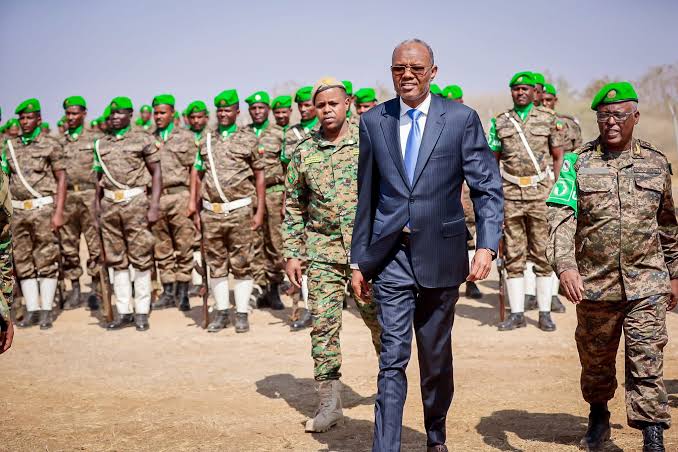
The African Union Support and Stabilization Mission in Somalia brokered a last-minute agreement that sources said prevented an imminent and potentially far bloodier military confrontation. AUSSOM’s Baidoa contingent positioned itself between the two sides as federal forces advanced. Diplomatic sources said the mission persuaded President Hassan Sheikh Mohamud to accept a negotiated exit, despite reported internal pressure to arrest Laftagareen. The talks, which lasted nearly three hours, produced a transition framework under which Laftagareen agreed to resign, appoint an acting president, and leave the country without restriction.
Read Also: Somalia Flight Overruns Runway, All 55 Onboard Survive
Laftagareen departed from Baidoa’s Shaati Gaduud airport and flew to Nairobi, where he is expected to remain. In a Facebook post, he announced his departure with a single sentence: “I, Abdiaziz Hassan Mohamed Laftagareen, effective today, 30 March 2026, have resigned from the position of President of Southwest State.” He offered no explanation and left no instructions publicly. South West State’s Finance Minister Ahmed Mohamed Hussein was named acting president to oversee the transition until a political settlement is reached.
The crisis was triggered by a confluence of disputes that had been building for months. At its core was Mogadishu’s opposition to constitutional amendments the federal parliament passed extending the mandates of federal institutions from four years to five, which South West State, along with several other member states and opposition groups, rejected as lacking consensus and threatening the country’s fragile federal architecture. Two weeks before the military action, Laftagareen’s administration announced it was severing ties with the federal government, a declaration Mogadishu dismissed as illegitimate. The federal government immediately rejected the regional parliament’s re-election of Laftagareen as president, calling the vote illegal and a sham.
Somali Information Minister Daud Aweis said federal forces had been welcomed in Baidoa and that the government was committed to a peaceful transition.
“The Federal Government of Somalia remains committed to stability, protecting lives and property, and ensuring no persecution or retaliation,” he said. Local elder Adan Hussein described the city as calm but deserted. “Federal forces have taken over Baidoa. It is now calm, but it looks like a ghost town,” he told Reuters. A shopkeeper confirmed troops were present throughout his neighborhood. Many residents had already fled in the preceding week, and some aid agencies suspended operations amid fears of prolonged fighting.
Read Also: Somalia, Saudi Arabia Sign Military Cooperation Agreement
Analysts warned that the harder challenge lay ahead: fostering genuine reconciliation in a region divided along clan lines, divisions exacerbated by repeated cycles of federal intervention and authority disputes. A crowded field of political figures from South West State, many aligned with Mogadishu, were already positioning for leadership of the region. The federal government has not announced a timeline for new elections or the process by which a permanent regional administration will be constituted.
The episode is the sharpest escalation yet in a pattern of recurring tension between Somalia’s federal center and its constituent states over the balance of power in a country that has operated under a fragile federal system since 2012. Previous disputes involving Jubaland and Puntland have produced sustained political deadlocks but not the kind of direct military seizure of a regional capital seen Monday. Clashes in South West State over recent weeks had already displaced approximately 45,000 civilians, according to a UN warning issued before Monday’s military advance.
The United Nations and international partners had not issued formal statements on the military operation as of Monday evening. The African Union’s role in brokering the exit agreement was not acknowledged publicly by the federal government in its initial statements. Acting President Ahmed Mohamed Hussein had not issued a public address as of Tuesday morning.