
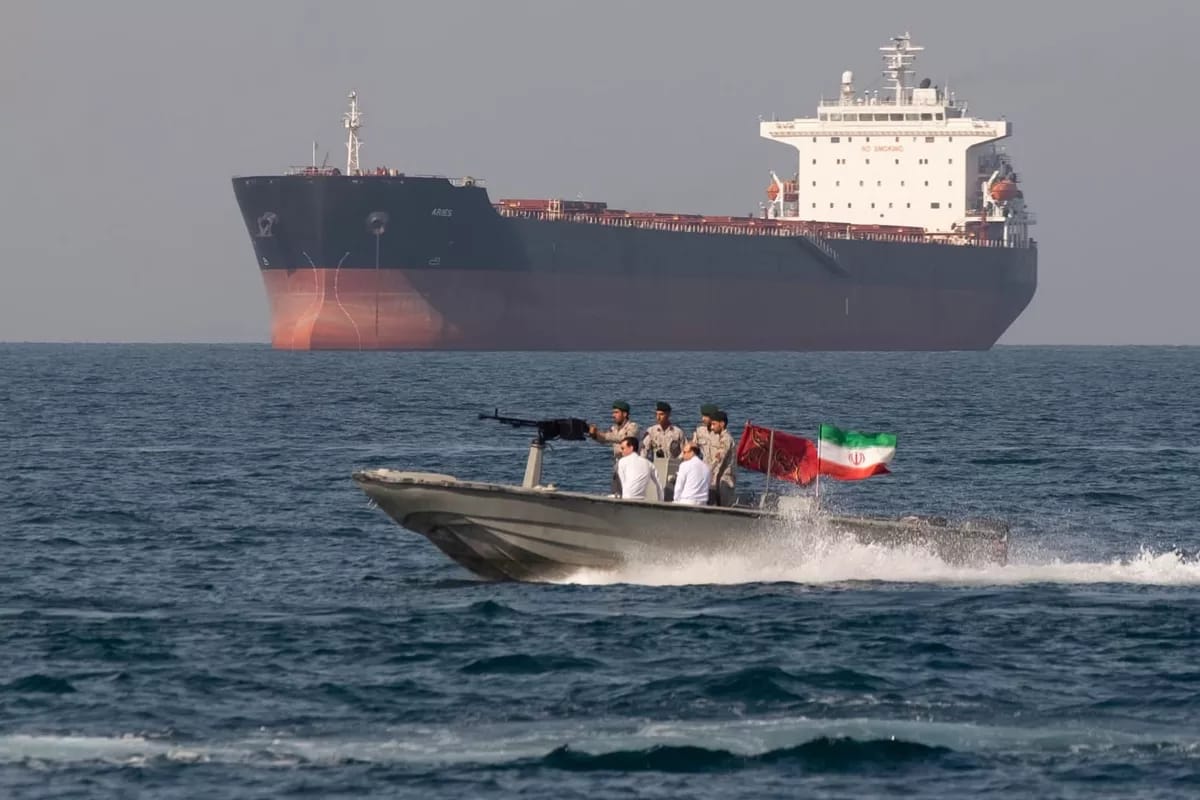
Iran announced Friday that Iraq would be exempt from the shipping restrictions it has imposed on the Strait of Hormuz, a declaration that could restore as much as three million barrels of Iraqi crude per day to global markets — and that signals Tehran is beginning, selectively and on its own terms, to loosen its grip on the waterway that has strangled energy flows for five weeks.
Iran’s military spokesman delivered the announcement in Arabic rather than Persian, a deliberate linguistic choice directed at an Arab audience and at Baghdad specifically. He thanked the Iraqi people for their support since the war began and distinguished “brotherly” Iraq from the “hostile” states to which Tehran has repeatedly said the strait remains closed. The framing — religious, fraternal, geopolitical — reflects the layered relationship between two neighbours whose majority Shia populations and interlocking economic dependencies have made them close partners despite a brutal eight-year war in the 1980s that killed hundreds of thousands on both sides.
The practical significance of the exemption is substantial, if it holds and if the logistics can be assembled to take advantage of it. Iraq is OPEC’s second-largest producer after Saudi Arabia. When the Hormuz closure effectively sealed the Persian Gulf’s main export route in the early weeks of the conflict, Iraqi seaborne crude shipments collapsed by roughly 97 percent — from normal volumes to a daily average of 99,000 barrels in March, with exports rerouted almost entirely through the Kirkuk-Ceyhan pipeline traversing Turkey to the Mediterranean. Storage tanks filled. Production shrank. The economic damage to a country that depends on oil revenues for the vast majority of its government budget was severe and immediate.
Restoring seaborne access through Hormuz does not instantly reverse that damage. Several obstacles remain between Friday’s announcement and three million barrels a day flowing through the strait again. Iraq’s oil fields need time to ramp production back up after weeks of constrained output. Tanker capacity — the physical ships needed to load and move crude from Persian Gulf terminals — has been disrupted by weeks of uncertainty, with many vessels rerouted or idled, and it is not clear how quickly sufficient tonnage can be positioned to resume normal loading operations. The announcement opens a door; walking through it requires infrastructure and logistics that take time to reconstitute.
Read also: WHO Documents 20+ Assaults On Iranian Hospitals Since March
The exemption also arrives against a backdrop of cautious, tentative reopening for other vessels. In the past week, a French container ship and a Japanese-owned tanker completed what appeared to be the first transits by vessels linked to Western-aligned nations since the conflict began. Traffic through the strait has been increasing incrementally, though it remains a small fraction of the pre-war rate when roughly 20 million barrels of oil and liquefied natural gas passed through the 34-mile narrows daily. Whether those transits resulted from diplomatic negotiation, commercial arrangement with individual shipping companies, or some combination of both has not been clarified by Iranian authorities.
The pattern of selective exemption — Iraq yes, hostile states no, Western vessels perhaps on terms not publicly disclosed — suggests Tehran is managing the strait’s reopening as a political instrument rather than simply lifting restrictions uniformly. Each exemption or permitted transit can be granted or withdrawn, can be used to reward cooperation or punish defiance, can generate revenue through whatever tolling or permission mechanisms Iran is developing. The announcement does not represent an abandonment of Iran’s Hormuz strategy so much as a refinement of it — maintaining leverage while releasing enough pressure to serve specific relationships and avoid complete economic isolation.
For global energy markets, any meaningful increase in Iraqi exports would provide some relief to a supply situation that has pushed oil prices up 50 percent since the war began. Iraq’s crude, if flowing at closer to normal volumes through the Gulf, would add meaningful supply to a market that has been running short since the Hormuz closure interrupted flows from multiple producers simultaneously. Whether that relief materialises, and how quickly, depends on the operational questions that Friday’s announcement left unanswered.
Tracking exactly what is moving through the strait adds its own complications. Electronic interference with vessel transponders, deliberate disabling of tracking signals by ships navigating dangerous waters, and the general disruption of normal maritime monitoring in an active conflict zone make vessel movement data less reliable than usual. The picture of what is actually transiting Hormuz, and under what conditions, is considerably murkier than the pre-war period when commercial shipping moved through the waterway with the confidence of routine.
Iran spoke to Iraq on Friday in Arabic, with warmth, calling it brotherly. The oil markets heard something else: a narrow opening in a door that Tehran is still very much holding.