
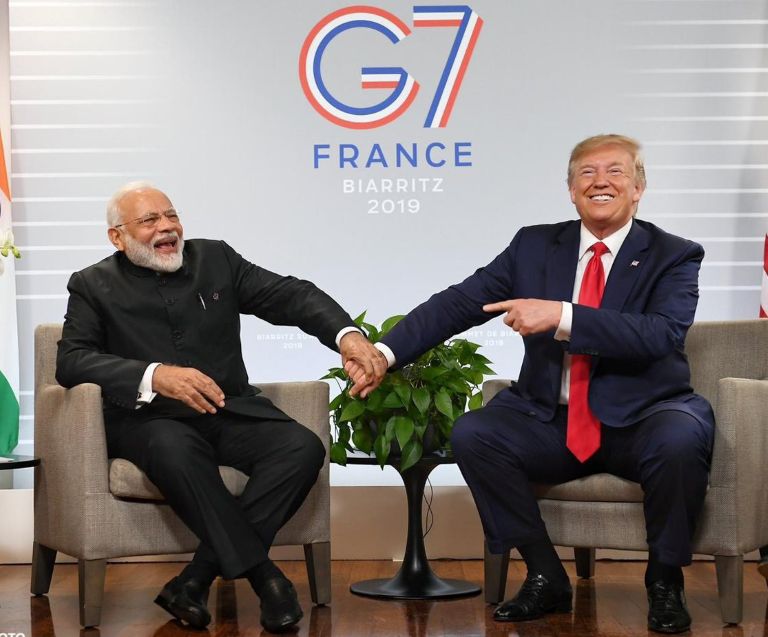
A senior U.S. administration official confirmed Saturday that Greer’s post-summit trip is part of a deliberate sequencing — one in which President Donald Trump and Prime Minister Narendra Modi will use the G7 margins to take stock of where negotiations stand, while leaving the technical work of closing an agreement to a subsequent round.
The G7, convening June 15 to 17 in the French Alpine town of Evian-les-Bains, will not produce a finalized accord, the official said. That outcome was never expected. What the summit offers is political altitude — a leader-level moment to signal shared intent before negotiators return to the details.
Read also: US Kills Tren De Aragua Leader In Airstrike Trump Says
“We think a potential trade deal is part of that,” the official said, citing Modi’s stated ambitions for the U.S.-India relationship and India’s desire for a more prominent role in global economic architecture.
Trump, the official added, would not accept terms that fell short of his standard threshold.
The two sides have been moving faster in recent weeks than the fraught earlier months of the relationship would have suggested. India’s commerce minister, Piyush Goyal, said last week that the first tranche of a bilateral agreement could be completed by mid-July. New Delhi is pressing for preferential tariff treatment in exchange for market access and other concessions as part of an interim deal framework.
But the path to that deadline now runs through something more complicated than tariff schedules and trade volumes.
Three Indian sailors are dead.
India formally demanded Thursday that Washington halt its strikes on shipping in the Strait of Hormuz, following three attacks in a single week on tankers crewed by Indian nationals. The deaths marked the first confirmed casualties since the United States began its naval blockade of Iran-linked shipping on April 13 — an operation that has disabled eight vessels and turned back more than 100 others.
The episode did not stay in maritime channels. U.S. Secretary of State Marco Rubio spoke Friday with Indian External Affairs Minister Subrahmanyam Jaishankar in a call the State Department confirmed Saturday. State Department spokesman Tommy Pigott said Rubio made clear that commercial vessels must comply immediately with orders from U.S. forces in the Strait, and that “violations of the U.S. blockade and the illicit transport of Iranian oil will not be tolerated.”
The message was unambiguous. Whether it satisfies New Delhi is another question.
Indian officials said Trump and Modi are expected to raise geopolitical matters alongside trade, including energy security and the possibility of Indian purchases of Venezuelan crude — a sensitive subject given U.S. efforts to pressure both Caracas and Tehran simultaneously.
The layered tensions are a reminder of how much has had to be managed to get this bilateral relationship to its current, relatively improved state. U.S. tariffs on Indian goods, imposed earlier this year, remain in effect. Trump’s repeated public claims that he personally intervened to end India’s brief military confrontation with Pakistan last year still rankle in New Delhi, which has consistently denied any American role in bringing hostilities to a close. Those disputes have not been resolved — they have been deferred in favor of economic opportunity.
The G7 summit is also expected to surface parallel trade conversations. Canada has reached out to U.S. officials seeking further engagement, the senior American official said, and Washington offered measured approval of Ottawa’s decision in recent days to pull back on threatened trade measures targeting American streaming platforms. Discussions under the U.S.-Mexico-Canada Agreement have been running on a separate, lower-key track — frequent but informal, with no major developments expected from the Evian gathering.
For India, the week ahead holds more than a diplomatic photo opportunity. A deal framework that Goyal has penciled in for mid-July is now six weeks away. The seafarers killed in the Strait of Hormuz have already become a domestic political matter in India. And the official tasked with actually closing a trade agreement boards a flight to New Delhi once the summit ends.