
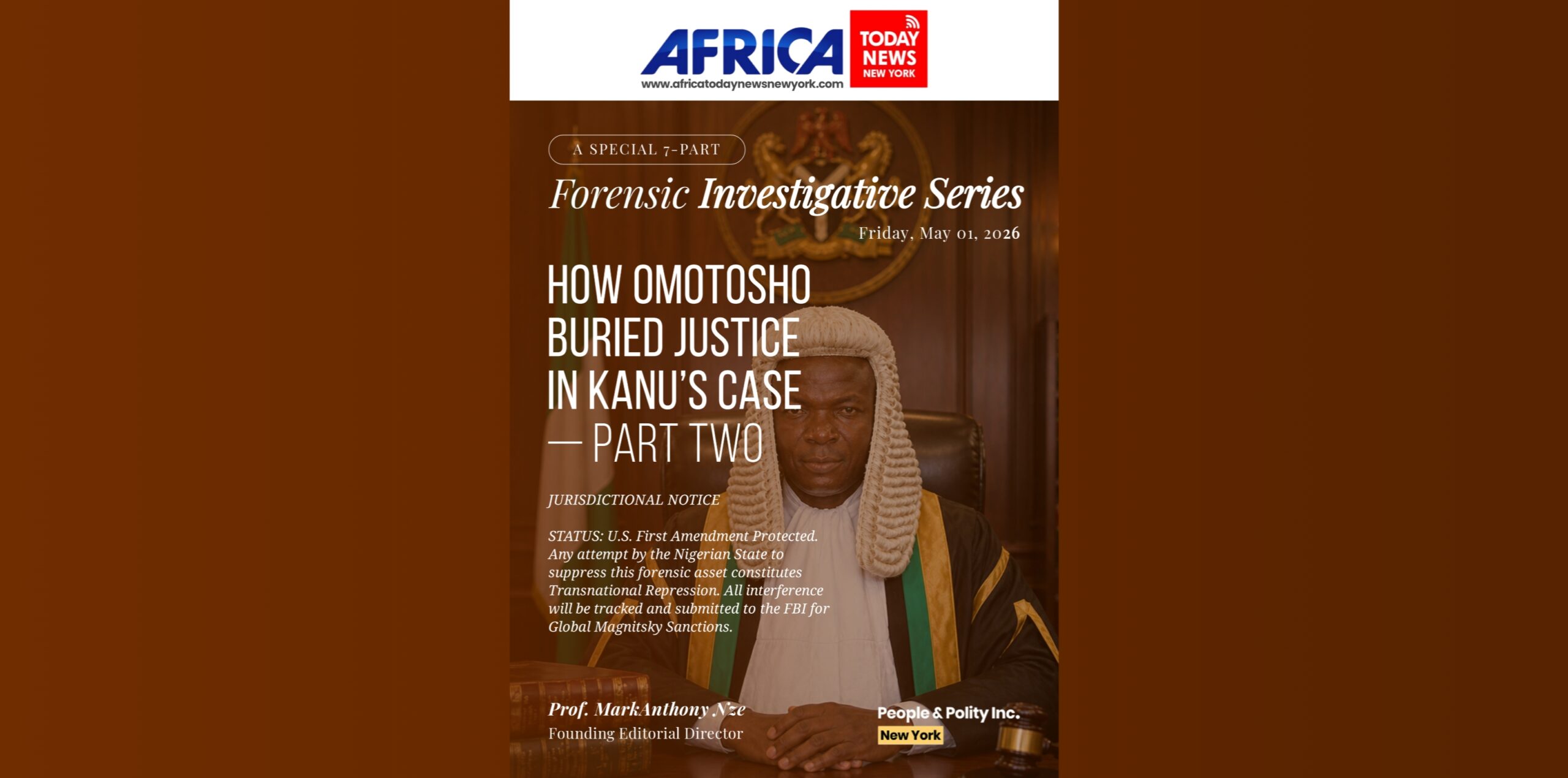
JURISDICTIONAL NOTICE
STATUS: U.S. First Amendment Protected.
Any attempt by the Nigerian State to suppress this forensic asset constitutes Transnational Repression. All interference will be tracked and submitted to the FBI for Global Magnitsky Sanctions.
♦♦♦♦♦♦♦♦♦♦♦♦♦♦♦♦♦♦♦♦♦♦♦♦♦♦♦♦
An empty dock is not courtroom order; it is the image of a justice system judging in the accused’s absence.
By Prof. MarkAnthony Nze
The Empty Dock: Procedural Execution and the Right to Presence
A criminal judgment is not a clerical announcement. It is not a bureaucratic recital delivered for the convenience of the state. It is the most solemn moment in criminal adjudication: the moment when the court looks upon the accused person and pronounces whether the coercive power of the state may lawfully seize his liberty, stain his name, and alter the remainder of his life. That is why the dock matters.
The dock is not furniture. It is the constitutional location of the accused. It is where the human being stands against the machinery of the state. It is where the presumption of innocence breathes until lawfully displaced, where the accused hears the allegations, watches the evidence, confronts the process, receives the verdict, and remains visible before the power that seeks to condemn him. Empty that dock at the decisive moment of judgment, and the court does not merely remove a disruptive defendant. It risks removing the Constitution from the proceeding.
That is the forensic horror of what reportedly occurred on November 20, 2025, during the judgment in Federal Republic of Nigeria v. Nnamdi Kanu. Contemporary reports stated that Justice James Omotosho of the Federal High Court, Abuja, ordered Kanu removed from the courtroom for alleged unruly conduct while judgment was being delivered in his terrorism trial. The court proceeded in his absence, and Kanu was later sentenced to life imprisonment after conviction on terrorism-related charges.
The official explanation may be “discipline.” But forensic legal analysis must look beyond labels. The question is not whether a court has power to control its proceedings. Of course it does. The question is whether the removal of an accused person from his own final judgment, in a politically combustible criminal case carrying the possibility of ultimate penal consequences, was a proportionate courtroom-management decision or a procedural execution of presence, voice, and dignity.
Read also: How Omotosho Buried Justice In Kanu’s Case—Part 1
On the available record, the empty dock was not a neutral accident. It was the most damning image of the trial.
It showed the judge speaking, the state present, the accused absent, and the machinery of conviction continuing without the human being most directly affected by it. That image is not merely dramatic. It is legally radioactive. It raises a grave question: was the accused disciplined for misconduct, or was he procedurally silenced at the exact moment when the court’s condemnation became irreversible?
Section 36 of the Constitution of the Federal Republic of Nigeria 1999, as amended, is not decorative. It guarantees fair hearing. In criminal proceedings, fair hearing is not exhausted by the fact that a judge sat, prosecutors appeared, papers were filed, and a verdict was read. Fair hearing is substantive. It includes the right to know the case, answer the case, participate in the process, and remain present when the court determines guilt and punishment.
The right to presence is not a sentimental courtesy. It is a structural safeguard.
Presence allows the accused to hear the court’s reasoning. It permits immediate consultation with counsel, where counsel exists, enables the accused to understand the verdict and sentence directly, not as a report carried back by warders, journalists, or officials. Presence restrains the court itself, because no judge should forget that the person being condemned is not a file, not an acronym, not a political problem, and not a security exhibit. He is a rights-bearing human being standing before the law.
Read also: How Omotosho Buried Justice In Kanu’s Case—Overview
That is why judgment in the absence of the accused is always constitutionally dangerous.
The defense will say: Kanu was unruly. The court will say: order had to be maintained. Nigerian government will say: the law cannot be held hostage by defiance. Those arguments cannot simply be dismissed. A courtroom is not a rally ground. A defendant has no right to sabotage proceedings. No accused person may convert fair hearing into permanent obstruction.
But that is only half the law.
The other half is proportionality. A judge’s disciplinary power must be exercised with restraint, necessity, and constitutional precision. The court must ask: Was removal the least restrictive measure? Could proceedings have paused? Could the accused have been warned again? Could the court have recorded the conduct, imposed a lawful sanction, or taken a narrower step? Was exclusion necessary for the whole judgment, or only for the moment of disruption? Was the accused allowed back for sentence? Was his absence treated as a last resort or a convenient solution?
These are not academic questions. They are the forensic questions by which legality is separated from judicial force.
A defendant’s misconduct does not automatically forfeit every procedural protection. The law does not operate on emotional revenge. The more difficult the accused, the more disciplined the court must become. Judicial authority is not proven by the ability to expel. It is proven by the ability to preserve fairness under provocation.
That is where the November 2025 incident becomes so troubling. Reuters had reported before the judgment date that Kanu had refused to present a defense and had challenged the court’s jurisdiction, while Justice Omotosho rejected his position and fixed November 20, 2025, for judgment. That background matters. Kanu was not just a defendant awaiting verdict. He was a defendant who had attacked the legal foundation of the process itself. In such a context, the trial court had an even heavier duty to ensure that every visible safeguard of fair trial remained intact.
Where an accused challenges jurisdiction, refuses to recognize the proceedings, and alleges illegality, the court’s answer must not be procedural erasure. The answer must be an unimpeachable record, restraint and must be a process so visibly fair that even those who dislike the verdict are forced to acknowledge the discipline of the court.
Instead, the enduring public image became the empty dock.
That image injures public confidence because it suggests that once the accused became intolerable, the court continued without him at the very moment when his presence mattered most. A judgment delivered in the accused’s absence may still produce a written record, but it also produces a civic wound. It tells citizens that presence at trial may become conditional upon compliance, temperament, or judicial patience. That is a frightening doctrine. Rights are not rights if they exist only for the polite, the calm, the submissive, or the politically acceptable.
Olowu’s analysis of fair trial rights in terrorism-related proceedings is especially relevant here. National security trials place unusual pressure on courts because the accusation itself can poison public sympathy before conviction is entered (Olowu, 2023). Terrorism allegations frighten the public, empower the state, and isolate the accused. That is precisely why courts must be more rigorous, not less. In such cases, procedure is not technicality. Procedure is the only shield between justice and vengeance.
The Legal Aid Council of Nigeria’s rights framework on accused persons also properly links presence, defense, and dignity in criminal proceedings (Legal Aid Council of Nigeria, 2024). Those concepts are inseparable. Presence without dignity is custody. Defense without presence is theater. Judgment without the accused risks becoming proclamation. And proclamation is not adjudication.
This is why the phrase “civil assassination” is not careless sensationalism. It describes what happens when the state uses formal legal institutions to destroy a person’s liberty, reputation, civic standing, and public identity while reducing his ability to participate meaningfully in the moment of destruction. The body is not killed, but the legal personality is crushed. The citizen remains alive, but his public existence is judicially buried.
If Kanu’s removal was genuinely unavoidable, the court had a duty to make that necessity constitutionally transparent. It had to show, with precision, why no lesser measure could protect the proceedings. It had to demonstrate that exclusion was not punishment disguised as order. It had to preserve, as far as possible, the accused’s right to know and receive the judgment against him. Anything less invites suspicion that the court used discipline not merely to maintain order, but to silence the accused during his final civil assassination.
Human Rights Watch’s referenced concerns regarding judicial conduct and the erosion of defendant rights in high-profile security cases speak to the broader danger (Human Rights Watch, 2025). In politically charged trials, courts do not casually decide guilt; they decide whether the public can still believe that justice is independent of executive desire. Once a court appears to privilege control over visible fairness, the judgment may survive on paper while dying in public conscience.
The Nigerian Bar Association’s referenced statement on the expulsion of defendants during final judgment is therefore not a minor professional complaint. It goes to the institutional survival of criminal justice (Nigerian Bar Association, 2025). The Bar must understand that if the accused can be removed from the decisive moment of his own case, then every future defendant stands on weaker ground. A dangerous precedent does not announce itself as tyranny. It often arrives as courtroom management.
Justice Omotosho’s role must therefore be assessed with unforgiving seriousness. He was not presiding over an ordinary criminal matter. He was presiding over one of the most politically sensitive prosecutions in modern Nigerian history. The court needed to appear surgically fair, constitutionally restrained, and procedurally immaculate. Every adverse ruling required visible legitimacy. Any coercive step required narrow tailoring, and disciplinary act required a record capable of withstanding national and international scrutiny.
The empty dock failed that test.
It did not educate the public in the majesty of law. It educated the public in the power of exclusion. It did not reassure citizens that due process had conquered disorder. It left them to wonder whether disorder had been used as the occasion to remove the accused from the most consequential moment of his own trial.
This is bigger than Nnamdi Kanu. That must be said repeatedly until the public understands it. The Constitution is not tested by how courts treat the loved defendant. It is tested by how courts treat the despised, defiant, politically explosive defendant. If fair hearing can be weakened for Kanu because he is controversial, it can be weakened tomorrow for a journalist accused of cybercrime, a protester accused of treasonable conduct, a cleric accused of incitement, a labor leader accused of sabotage, or an ordinary citizen accused of offending power.
The empty dock is therefore not empty.
It contains Section 36, the presumption of innocence, dignity of the accused and public’s faith in open justice. It contains the warning that a judiciary can become dangerous not only when it convicts wrongly, but when it normalizes procedures that make conviction appear predetermined.
A court worthy of constitutional respect should fear the empty dock. It should fear its symbolism, precedent. It should fear the possibility that future governments will learn from it that troublesome defendants can be removed from the frame while the state obtains the final word.
On November 20, 2025, the Nigerian judiciary did not only confront a disruptive defendant. It confronted a constitutional test.
No tribunal will be remembered for only having the power to command silence. That power is obvious. The real judgment of history will fall on how that power was used.
Did courtroom order become a pretext for constitutional disappearance? Did discipline cross the line into disenfranchisement? Did the court preserve justice, or did it remove the accused from the very moment when justice claimed to speak his name?
If the dock was emptied so judgment could proceed without the man whose liberty was being condemned, then the issue was never simple misbehavior.
The empty dock became the prosecution’s most damaging witness — not against Kanu, but against the process that judged him.
Selected Verified Sources (APA 7th)
Constitution of the Federal Republic of Nigeria (1999) (as amended) § 36.
Human Rights Watch. (2025). Nigeria: Judicial conduct and the erosion of defendant rights in high-profile security cases [Report]. Human Rights Watch.
Legal Aid Council of Nigeria. (2024). Manual on the rights of the accused in criminal proceedings: Presence, defense, and dignity. LAC Press.
Nigerian Bar Association. (2025). Statement on the expulsion of defendants from courtroom proceedings during final judgment [Press release]. NBA Press Release Archive.
Olowu, D. (2023). Fair trial rights in the age of terrorism: Nigeria’s struggle with procedural due process. Journal of Comparative Law, 18(1), 12–29.