
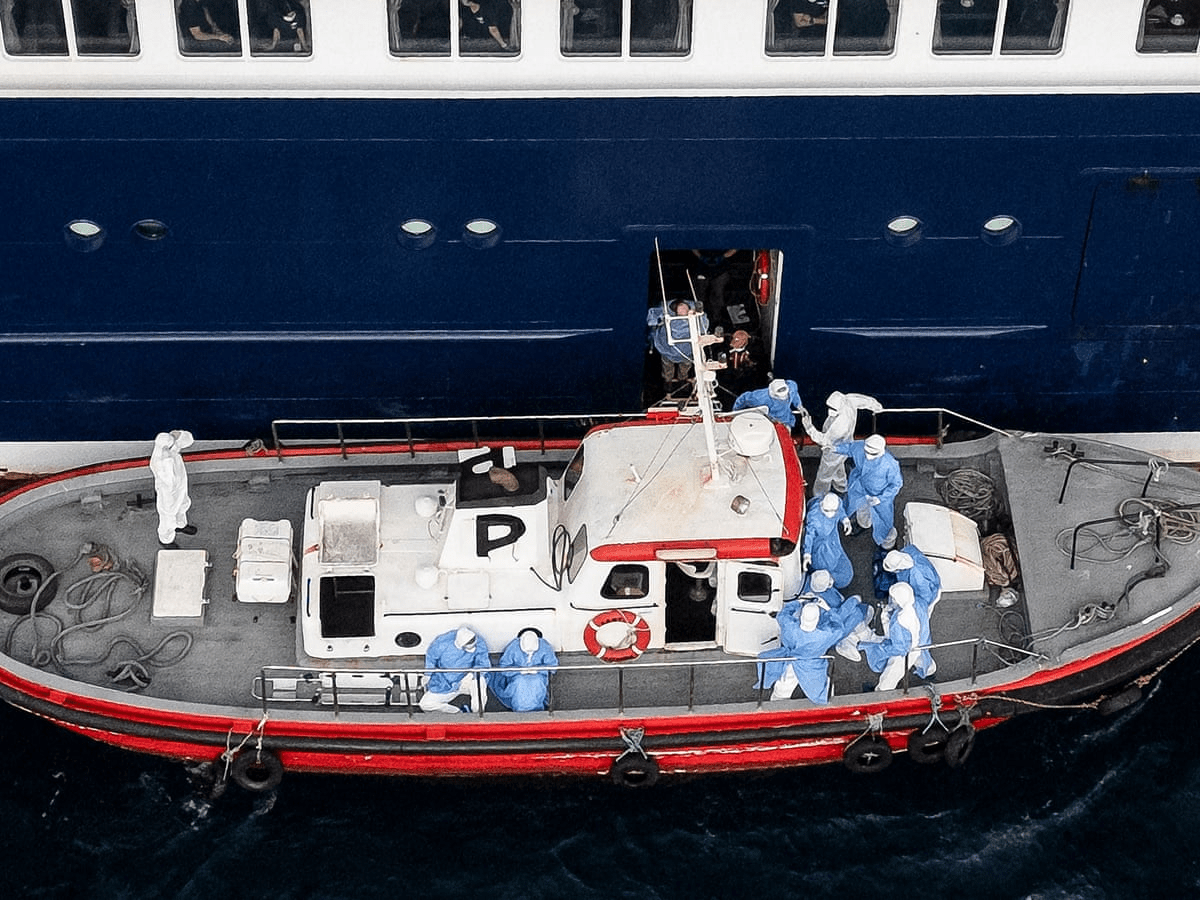
A suspected hantavirus outbreak aboard the expedition cruise vessel MV Hondius has evolved into a multinational public health operation spanning several continents, as European, African and North American authorities coordinate monitoring, evacuations and containment measures linked to one of the most closely watched infectious disease incidents at sea in recent years.
What began as an isolated medical emergency during a transatlantic voyage has now triggered an expanding international response involving the World Health Organization, multiple national health ministries, aviation authorities and maritime regulators. The situation illustrates how rapidly infectious disease threats can move across jurisdictions through global tourism networks, particularly in confined environments such as cruise vessels where prolonged interpersonal contact increases transmission risks.
The vessel, operated by Oceanwide Expeditions, departed from Ushuaia in southern Argentina in March for a month-long voyage across the South Atlantic before becoming the centre of an escalating health emergency. Three passengers have died since the ship began its journey, while eight hantavirus cases—three confirmed and five suspected—have now been identified among people connected to the vessel.
Two passengers in serious condition were evacuated to the Netherlands for specialist treatment, while a third medically vulnerable passenger remains in transit after delays affecting a separate evacuation flight. The evacuees include British, Dutch and German nationals, reflecting the international character of the ship’s passenger profile. A 41-year-old Dutch crew member has also been removed from the vessel for medical observation.
Read Also: Georgia Woman Charged With Murder Over Abortion Pills
The British passenger evacuated from the ship has been identified by several media outlets as Martin Anstee, a 56-year-old former police officer, who is currently reported to be in stable condition in the Netherlands. The German evacuee is understood to have been closely connected to a German woman who died aboard the vessel earlier this month.
The ship itself has resumed movement after remaining anchored for several days near Cape Verde. It is now sailing toward the Canary Islands under strict medical protocols as authorities negotiate the logistics of disembarkation, quarantine and repatriation.
At the centre of the concern is the Andes strain of hantavirus, a variant more commonly associated with parts of Latin America. South African health authorities confirmed that laboratory testing identified this strain in two confirmed patients linked to the cruise. Unlike many other hantavirus variants, the Andes strain has historically demonstrated limited but documented human-to-human transmission during previous outbreaks, significantly raising the level of international concern.
That distinction has altered the operational posture of public health agencies. Hantavirus infections are traditionally associated with exposure to rodents or contaminated environments containing rodent saliva, urine or faeces. Human-to-human spread is considered rare in most forms of the virus. The possibility that transmission aboard the vessel may have occurred between passengers, however, changes the risk calculus substantially.
The outbreak has already extended beyond the maritime setting itself. Swiss authorities confirmed that a passenger who returned to Switzerland after leaving the ship tested positive and is receiving treatment in Zurich. In a public statement, WHO Director-General Tedros Adhanom Ghebreyesus noted that the individual sought medical attention after being contacted by the cruise operator regarding the onboard health event.
Meanwhile, authorities in the United States are monitoring passengers who disembarked earlier in the voyage and subsequently travelled home. Public health departments in Georgia and Arizona confirmed that monitored individuals currently show no symptoms.
Attention has also shifted toward commercial aviation exposure risks. Dutch media reported that a flight attendant employed by KLM Royal Dutch Airlines was hospitalised in Amsterdam after potential contact with a Dutch passenger later linked to the outbreak. The passenger, a 69-year-old woman, had briefly boarded a flight in Johannesburg before airline personnel determined she was too unwell to continue travelling. She later died in South Africa, and her case remains under investigation by local health authorities.
The outbreak has consequently become a test case for cross-border outbreak coordination in an era of highly mobile populations. The movement of passengers through multiple countries before the outbreak was fully recognised has complicated contact tracing efforts and expanded the scope of surveillance operations.
A total of 146 people from 23 countries remain aboard the MV Hondius under enhanced precautionary measures. Health monitoring, testing and isolation procedures continue as officials attempt to determine the full extent of transmission aboard the vessel.
Read Also: Man Charged With Murder Of 5-Year-Old Australian Girl
The response from Spanish authorities has also highlighted tensions between public health management and regional political concerns. Spain authorised the ship’s movement toward Tenerife for controlled medical processing and repatriation. However, Fernando Clavijo publicly opposed the decision, arguing that local authorities had not received sufficient technical information to justify the arrival of the vessel.
Spain’s Health Minister Mónica García has attempted to reassure residents by stating that all passengers will undergo medical assessments upon arrival and that quarantine procedures will be strictly managed to avoid public exposure. Spanish nationals are expected to be transferred to a defence hospital in Madrid, while international passengers deemed medically fit will be repatriated to their home countries.
The outbreak also exposes broader structural questions facing the global cruise industry. Expedition tourism has expanded significantly in recent years, particularly in remote polar and transoceanic routes where medical infrastructure is limited and evacuation logistics are complex. Operators increasingly face scrutiny over onboard disease preparedness, isolation capacity and emergency response planning.
For global health authorities, the incident serves as a reminder that infectious disease risks remain deeply intertwined with international mobility systems. Cruise ships, airlines and transnational travel corridors can rapidly transform localised outbreaks into multinational coordination challenges requiring simultaneous engagement from health, transport and border authorities.
Despite the growing international response, health officials continue to emphasise that the risk to the wider public remains low. Investigations into the source and transmission dynamics of the outbreak remain ongoing, and authorities have urged caution against premature conclusions while testing and contact tracing continue across multiple countries.