
A 30-year-old handyman in Ellenwood, Georgia pulls a lawnmower cord, folds his knees to his ears, and rides a motorized pink Barbie toy car to the grocery store. His 1996 Mercedes convertible costs $90 to fill. The Barbie camper cost him nothing — he pulled it from someone’s trash.
Mali Hightower’s solution is extreme. The problem driving it is not.
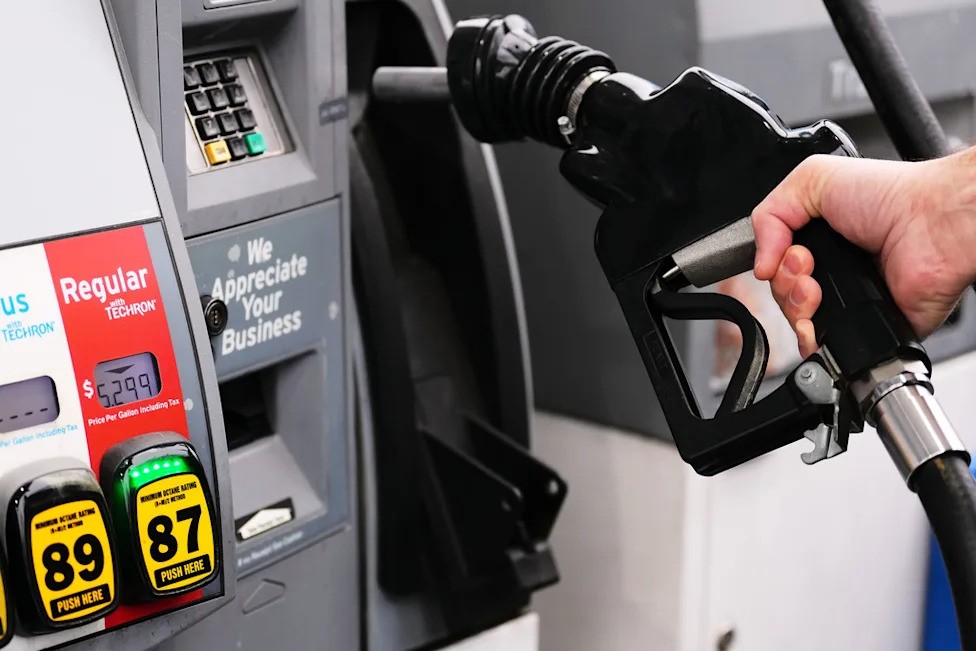
Gasoline averaged $4.52 a gallon nationally as of May 18, up from roughly $3 before the Iran war began driving energy prices higher, according to AAA. In an April poll conducted by Ipsos for the Washington Post and ABC News, 44 percent of Americans said they had already cut back on driving. Across the country — in Maine bus depots, Los Angeles freeway interchanges, Chicago church parking lots, and a California gas station where drivers queued for over an hour chasing a $100 fuel giveaway — the same calculation is being made by people with very little in common except the cost of a full tank.
Hightower mounted a grocery rack on top of his toy car. He straps on a dirt bike helmet and goes.
“That’s too much,” he said of the $90 fill-up. “I drive this when I can.”
The behavioral shift is measurable where it might least be expected. In Bangor, Maine, ridership on the city’s public bus network has climbed 21 percent since January, with the sharpest growth concentrated in peak commuting hours. Transit administrator Laurie Linscott said she started watching passengers to get a sense of who was switching.
“It was every walk of life,” she said.
In Los Angeles, content creator Dafne Flores visits from Silverdale, Washington several times a year. During her most recent two-month stay, she parked her Toyota Highlander in Glendale on arrival and did not move it. Filling the SUV now runs at least $95. Near freeways, she has seen prices push toward $9 a gallon. She takes the bus instead — editing videos during the commute, avoiding parking fees, staying within five miles of home when she does drive.
Read also: Fuel Costs To ‘Drop Like Rock’ After Iran War —Trump
“We’re used to expensive gas prices,” said Flores, 28, “but never this expensive.” She added that videos of people her age discussing the same choices are spreading rapidly online. “I’m seeing a lot of videos of people taking the bus.”
Not everyone is absorbing the cost quietly. Some are finding angles.
Renee Tocci, executive director of Camp Farley in Mashpee, Massachusetts, spent nearly $40 more than usual filling her Buick Enclave and returned to her office with a marketing idea. She began framing sleep-away camp enrollment as a financial relief strategy for parents facing a summer of driving children from activity to activity at current fuel prices. The pitch went directly onto social media and into marketing emails.
“Here’s a budgeting tip no one talks about,” one of her posts read. “Send your kids to overnight camp.”
Her colleague thought it was a joke. Tocci said she was entirely serious.
Churches are stepping in where budgets have broken down. CityPoint Community Church in Chicago is distributing $5,000 worth of $25 gas cards over the coming weeks. Pastor Demetrius Davis said more than 70 cards went out after Mother’s Day services alone.
Read also: Fuel Crunch Looms As Grounding Threat Grows For Airlines
“Transportation is not a luxury for many families,” Davis said. “It’s survival.”
In El Segundo, California, a Las Vegas tourism agency stationed itself at a gas station on a recent Thursday, offering up to $100 in free fuel to the first 100 drivers in line — an attempt to stimulate travel to the city. The line stretched for more than an hour. Vacation was not what most people standing in it had in mind.
Robert Jackson, who lives nearby, said the free tank would last only a few days. He has started walking and taking the train. Segette Frank of Los Angeles described a sharply contracted daily geography. She used to drive across the sprawling city to shop. She no longer does.
“I stay close now because I don’t want to run out of gas,” she said.
The crisis has not produced a surge in electric vehicle sales, but it has handed current EV owners a moment of public vindication — particularly Tesla drivers who spent much of last year absorbing political backlash tied to CEO Elon Musk. John Stringer, president of Tesla Owners of Silicon Valley, posted a TikTok video panning from a gas station sign showing sky-high prices to his Cybertruck, deadpanning that he wished fuel costs were a problem he had to deal with.
The joke landed, but his relief, he said, is genuine.
“I don’t know the last time I looked at gas prices,” Stringer said, “except for that video.”
Hightower, meanwhile, keeps his Mercedes parked. He has a rack full of groceries to bring home and a pink Barbie camper that runs just fine.