
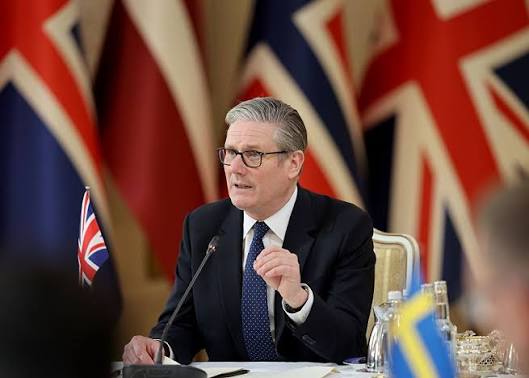
Keir Starmer is doing the arithmetic of political survival behind the closed gates of Chequers, and by Sunday night, people close to the Labour Party were betting he had already done the sum and come up short.
The Observer reported that the prime minister was working through the decision with his wife, weighing not whether to go but how to leave with something resembling control over the exit — a timetable, a chosen moment, the appearance of a man stepping down rather than being pushed. Senior Labour figures told the paper they expected a statement on his future as soon as Monday. A government source disputed the framing entirely, insisting Starmer’s attention remained fixed on governing and pointing back to his own words from two days earlier, when he stood in front of cameras and promised to fight.
That promise now looks like it was made in the moment a trapdoor opened beneath it.
Andy Burnham won a parliamentary seat on Friday, a result that on its surface settled nothing and beneath the surface settled everything. The seat itself was never in doubt — Burnham brushed aside Nigel Farage’s populist challenge with the comfort of a man who has spent a decade building a political machine in Greater Manchester that answers to him alone. What the win actually delivered was a legal foothold: a Commons seat is the minimum credential required to mount a formal leadership bid, and Burnham now holds it. He did not announce a challenge. He didn’t have to. His victory speech spoke of a different path for the country, phrased with the deliberate vagueness of a man who wants the threat understood without yet making it official.
Read also: Burnham Clears Key Hurdle In Bid To Challenge Starmer
Starmer’s defiance and Burnham’s ascent are now operating on a collision course that neither man controls completely, because the decisive variable belongs to neither of them. It belongs to roughly a quarter of the parliamentary Labour Party.
Reuters has tallied more than 100 Labour lawmakers who have called publicly for Starmer to resign or name an exit date — a bloc large enough to make the question of his survival arithmetic rather than sentiment.
The Observer’s account, sourced anonymously, described a prime minister who reached his current position only after a series of private conversations with cabinet ministers, party donors and trade union leaders, each conversation apparently functioning as a data point in a verdict he had not yet been willing to accept. Whether that verdict has actually landed, or whether the government’s public denial reflects genuine resolve rather than a holding action, is the one fact neither side will confirm.
Two years ago this would have seemed unthinkable. Starmer’s 2024 landslide remade British politics, ending fourteen years of Conservative government and handing Labour the kind of majority that is supposed to buy a leader time. It bought him almost none. A run of reversed policies and unforced controversies left the public with a settled impression — not of malice, but of inadequacy, of a government that promised a tangible lift in living standards and delivered explanations instead. Popularity curdled into something closer to exhaustion, and exhaustion proved more dangerous to him than outrage would have been.
Read also: Starmer Faces Calls To Quit As Second Aide Resigns
If Starmer goes, voluntarily or otherwise, Britain installs its seventh prime minister in barely a decade, a turnover rate the country has not seen in nearly two hundred years. That number has become a grievance in its own right, evidence to many voters that the political class cannot hold a government together long enough to fix the immigration system or repair public services, regardless of which party is nominally in charge.
Burnham’s path to this moment was built deliberately, mayoralty by mayoralty, in a city that gave him something Westminster rarely grants its politicians: a base that exists independent of the parliamentary party’s approval. That independence is precisely what makes Labour’s old guard nervous about him, and precisely what makes his allies’ weekend push — urging Starmer toward a negotiated handover rather than a bloody contest — look less like loyalty and more like a hedge against the alternative.
He is not alone in eyeing the job. Wes Streeting, the former health secretary, has said he would stand in any contest, a declaration that complicates the binary version of this story without yet threatening to overturn it.
The Times added a detail Saturday that Reuters has not independently verified: Burnham’s advisers have reportedly already decided that Chancellor Rachel Reeves would not survive a change in leadership, concluding she represents too little distance from the government voters have grown tired of. If true, it suggests Burnham’s team is not merely preparing for a contest. It is preparing for a government.
Starmer, for now, has said nothing publicly since Friday. His silence is being read by both sides as exactly the kind of evidence each wanted to find in it.