
Why Nigeria Must Withhold Its Mandate
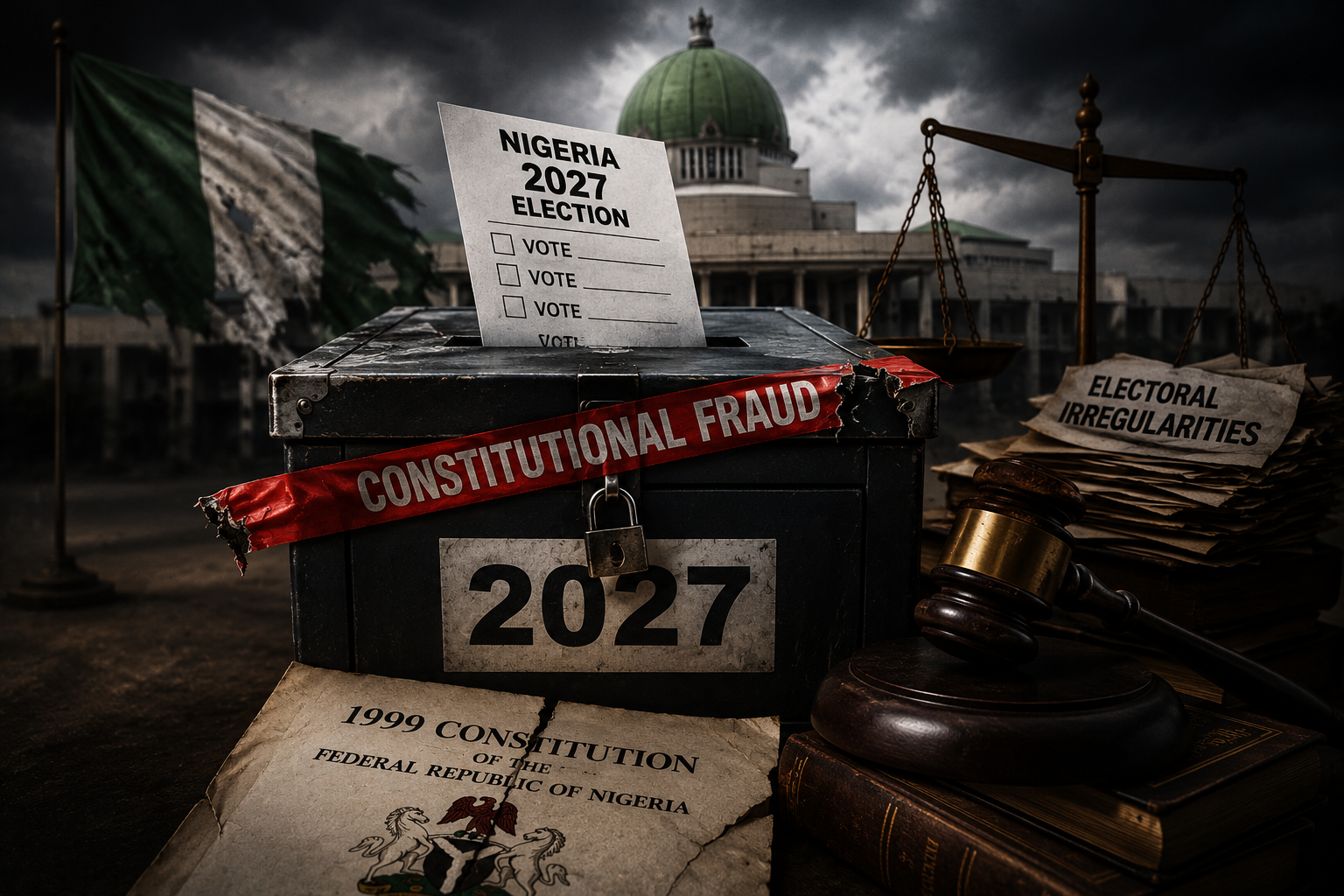
Nigeria’s 2027 election should be pleaded first as a constitutional cause of action, not as a routine civic event. The ballot is offered as remedy while the injury sits in the founding instrument: a military-born constitutional order, clothed in the language of popular sovereignty, still demanding validation from citizens whose constituent authority it never received. That injury cannot be waived by turnout.
A vote under that arrangement may install officials, settle party succession, and satisfy foreign observers seeking procedural evidence of democracy. It does not cure the deeper defect. Where the supreme law derives its authority from command rather than a genuine act of the people, every election beneath it risks becoming a certificate of acquiescence issued by the victims of the arrangement.
Legally, the question is whether Nigerians should keep supplying mandate to a political order that asks for participation while refusing to reopen the union. A republic cannot indefinitely borrow legitimacy from citizens it denies constitutional authorship.
1999 Constitution: Military Origin, Civilian Costume
Nigeria’s 1999 Constitution was promulgated through Constitution of the Federal Republic of Nigeria (Promulgation) Decree No. 24 of 1999 during the transition from military rule to civilian government. Its opening claim, “We the People,” therefore carries a legal and moral contradiction: the text speaks in the voice of popular sovereignty, while its birth bears the imprint of military command.
Decree No. 24 could hand Nigeria a government; it could not give the country a consensual founding. That distinction is the wound. A military instrument may acquire courtrooms, oath books, gazettes, ministries, budget cycles, election calendars, and decades of administrative habit, but habit is not authorship. Judges can enforce the document because the state needs an operating text. Presidents can swear by it because power requires ceremony. Legislators can amend it because the system permits internal repair. None of those acts supplies what was missing at birth: a sovereign moment in which the peoples of Nigeria sat as constitutional owners and gave the union its terms.
Read also: The Foreign Vaults That Shield Africa’s Looters—Part III
Federalism By Label, Central Capture By Design
Nigeria’s federal problem is not hidden in theory; it appears every month in the allocation queue, every election season in the battle for Abuja, and every security crisis in the paralysis of distant command. The present order places too much money, coercive authority, mineral control, appointment power, regulatory discretion, and patronage inside the federal center. Once that much national life is stored in one place, the presidency stops being a public trust and becomes a vault with a flag over it.
That is why presidential elections acquire the mood of siege. The contestants are not only seeking office; they are fighting for command over distribution, protection, punishment, access, contracts, prosecutions, police attention, institutional silence, and the political oxygen by which allies survive. A healthier federation would make states work, tax, produce, secure, compete, and answer for failure. Nigeria’s present arrangement does the opposite: it makes Abuja fat, states dependent, citizens distant from real power, and every national election a struggle over who controls the center rather than who serves the republic.
Resource, Security, And Fiscal Servitude
Nigeria calls itself a federation, but many states function as fiscal dependents. They wait for allocations, bargain for federal favor, and govern without the discipline that production imposes. A serious federation should force its component units to tax honestly, develop resources, secure communities, compete for investment, and answer directly to citizens.
Resource control exposes the wound. A country that centralizes mineral authority while affected communities endure poverty, pollution, and insecurity has chosen extraction over federal justice. Security centralization deepens the same failure, because one distant police chain cannot respond with equal intelligence to banditry, terrorism, kidnapping, separatist violence, oil theft, and communal conflict across different territories.
2027 As Civic Laundering
Voting in 2027 without restructuring would function as civic laundering. Winners would claim mandate; losers would litigate; observers would issue careful language; courts would inherit the quarrel; citizens would return to hardship under the same unrepaired order. Participation would then be used as proof of consent.
That is the trap. The voter may intend protest, but the regime records attendance. A ballot cast inside a defective order can become evidence against the citizen’s own objection.
Strategic Silence As Constitutional Protest
Strategic silence is a lawful constitutional remedy when participation itself has been converted into evidence of consent. A mass boycott, openly declared and tied to restructuring, would deny the political class the ceremony it needs to refresh derivative legitimacy. Empty polling units would speak with unusual precision: the electorate is withholding mandate until the union is renegotiated.
Such abstention must be disciplined enough to survive mischaracterization. No violence, no ethnic capture, no party substitution, no street chaos, no candidate cult. The demand must remain severe and intelligible: a sovereign constituent process before another national election is treated as morally valid.
Re-Founding Before Another Ballot
A constituent process is not ordinary amendment. Amendment assumes the legitimacy of the existing document and works inside its boundaries; re-founding asks whether that document has earned the right to command obedience at all. Nigeria’s problem is not a drafting inconvenience. It is a sovereignty dispute.
A sovereign constitutional convention must answer the questions Nigeria’s political class keeps postponing: resource control, fiscal federalism, state police, local government autonomy, revenue allocation, judicial independence, electoral administration, minority protection, and the lawful limits of federal power.
Any product of that process must return to the people for ratification. Without that act, sovereignty remains trapped inside a legal order whose origin is already contested. A constitution that claims to speak for the people must eventually face the people directly.
Final Demand
Nigeria’s lawful demand should be simple: restructure first, elections after. Until the country confronts its origin, fiscal distortion, security centralization, and overfed center, every election remains ceremony over an untreated wound.
2027 should be the year citizens stop donating legitimacy to a chain and start demanding a republic worthy of consent. A people who own a country do not beg under a document they never truly made; they compel power back to its source.
Verified Sources Used (APA 7th)
Ajayi, O. O., & Akinlo, A. E. (2017). Ownership and control of natural resources under the Nigerian Constitution 1999 and its implications for environmental law and practice. International Law Research, 6(1), 162–174. https://doi.org/10.5539/ilr.v6n1p162
Constitution of the Federal Republic of Nigeria (Promulgation) Decree No. 24 of 1999. (1999). ConstitutionNet. https://constitutionnet.org/sites/default/files/constitution_promulgation_decree.pdf
Princeton University. (n.d.). Nigeria 1999. Political Constitution Writing and Conflict Resolution. https://pcwcr.princeton.edu/reports/nigeria1999.html
Reuters. (2026, June 11). Nigeria lawmakers advance state police reform to curb insecurity. Reuters. https://www.reuters.com/world/africa/nigeria-lawmakers-advance-state-police-reform-curb-insecurity-2026-06-11/