
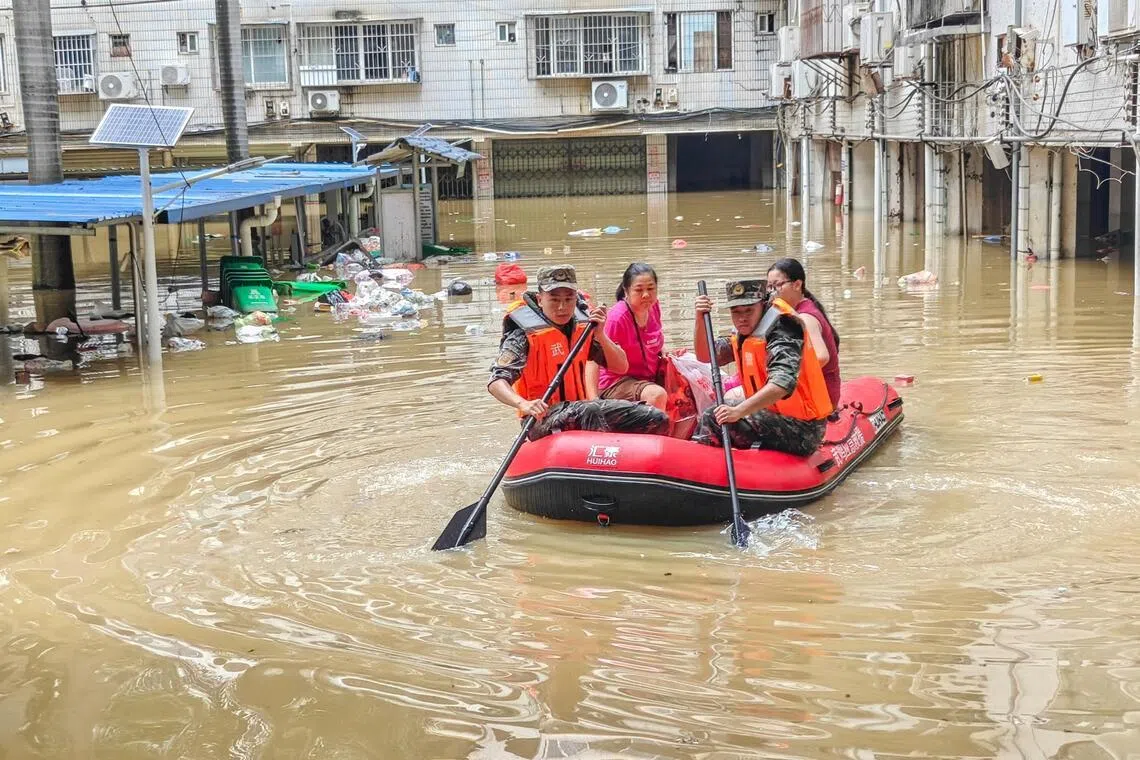
Sixteen people are still missing beneath a Gansu mountainside. Eleven are confirmed dead in Hubei province, where tornadoes touched down in a region that manufactures cars and builds technology for the rest of the country. And a typhoon packing 180-mile-per-hour winds is now bearing down on Taiwan, four days out from landfall.
China is absorbing three simultaneous disasters, and none of them shows signs of easing.
The Hubei tornadoes hit somewhere they almost never do. Wang Xiaoling, an expert with the provincial meteorological bureau, told Hubei Daily that the last tornado recorded in the province struck in May 2021 — a five-year gap broken Monday evening when two separate twisters tore through the cities of Huangshi, Huanggang, Ezhou and Xianning over four hours. Winds reached 149 kilometers per hour, registering level 13 on the extended Beaufort scale, according to Hubei’s emergency management authorities as reported by state news agency Xinhua.
Read also: Death Toll Rises To 21 As Storms Sweep Across US Cities
Hubei isn’t a coastal province accustomed to storm rotation. It’s a manufacturing corridor, home to automotive plants and technology firms that form part of the backbone of China’s industrial output — precisely the kind of infrastructure now shown twisted and shredded in footage broadcast by state broadcaster CCTV.
One clip captured rescue crews in Huanggang examining a truck cab mangled by corrugated steel ripped clean off a nearby building’s roof. Another showed a car flattened against a lamp post, surrounded by sheets of torn metal.
At least one person remains unaccounted for in Hubei.
Six hundred miles west, in Gansu province, rescue crews are searching for 16 people still missing after a landslide swept away 33 people in the early hours of the morning in a mountainous county, according to state media reports. President Xi Jinping has already called for “all-out efforts” to reach those affected, CCTV reported Tuesday — a directive that places the disaster among the government’s most urgent domestic priorities this week.
Guangxi has its own count of dead. Typhoon Maysak killed at least four people in the regional capital of Nanning over the preceding days, and forecasters now warn the region should brace for up to 260 millimeters of additional rain within 24 hours, a volume capable of triggering fresh landslides on ground already saturated.
That’s not the only rain warning on the board. China’s National Meteorological Centre flagged heavy to torrential rainfall Tuesday for northeastern Hubei, plus additional risk zones stretching from Guangdong and Hainan in the south to Jilin, Shandong and Liaoning in the north — a forecast footprint covering much of the country’s eastern half simultaneously.
Then there’s Bavi. The super typhoon tore across Guam, Tinian, Saipan and Rota on Monday with sustained winds hitting 289 kilometers per hour, and it hasn’t finished. Forecasters expect landfall along China’s eastern coast by the weekend, with Taiwan bracing for impact even sooner — winds and rain beginning Friday, intensifying through Saturday.
Read also: 5 Dead, Over 35 Injured As Tornadoes Rip Through Iowa
Taiwan’s government isn’t waiting to find out how bad it gets. Cabinet Secretary-General Xavier Chang wrote on Facebook that Bavi could dump more than a meter of rain across parts of the island, and the government has placed nearly 29,000 military personnel on standby for relief operations. Island meteorologists expect some weakening as Bavi tracks toward northern Taiwan, but caution the storm will likely remain large regardless — somewhere between a strong and a moderate typhoon by the time it arrives.
Climate researchers have been tracking a broader pattern behind weeks like this one.
China’s exposure to extreme weather has intensified in recent years, a shift experts link directly to climate change, and the country now absorbs tens of billions of dollars in annual losses from gale-force winds, torrential rain and punishing summer heat. Industry stalls. Crops fail. Provinces rebuild, and the cycle resets with the next season.
What’s unusual this week isn’t any single event on that list. It’s the arithmetic: a landslide, a pair of tornadoes in a province that hasn’t seen one in half a decade, a typhoon’s aftermath still killing people in Guangxi, and a second typhoon already gathering strength offshore before the first set of dead has even been fully counted.