
Case File: Cardiometabolic
Diabetes, Hypertension and Cardiometabolic Infertility
Glucose and blood pressure do not stay politely inside a primary-care chart. They travel the same vessels and nerves that run erections, ovulation, and pregnancy.
A man is handed a pill for erections and sent home. A woman is told her cycles are irregular and offered a hormone. In both rooms, a larger diagnosis is standing in plain sight and going unnamed: the blood sugar, the blood pressure, the widening waist. Diabetes and hypertension are treated as somebody else’s department — the physician’s chart, not the fertility file — but the vessels, nerves, and metabolism they damage are the very machinery of erections, sperm, ovulation, and pregnancy. A fertility plan that ignores them is not a fertility plan; it is half of one.
Begin with the organ that links a man’s erection to his heart: the lining of his blood vessels. Every artery is lined by a single active layer, the endothelium, that tells the vessel when to relax and open. High glucose and high blood pressure injure that lining, so vessels stiffen, narrow, and fail to widen on demand. An erection is, mechanically, a rush of blood into a small organ fed by small arteries — and because those penile arteries are narrow, they clog and fail earlier than the larger vessels of the heart. This is why erectile dysfunction is not merely a bedroom complaint: it is often the first visible signal of vascular disease, which is exactly why the Princeton IV consensus tells clinicians to treat a man with new erectile dysfunction as a cardiac risk until proven otherwise.
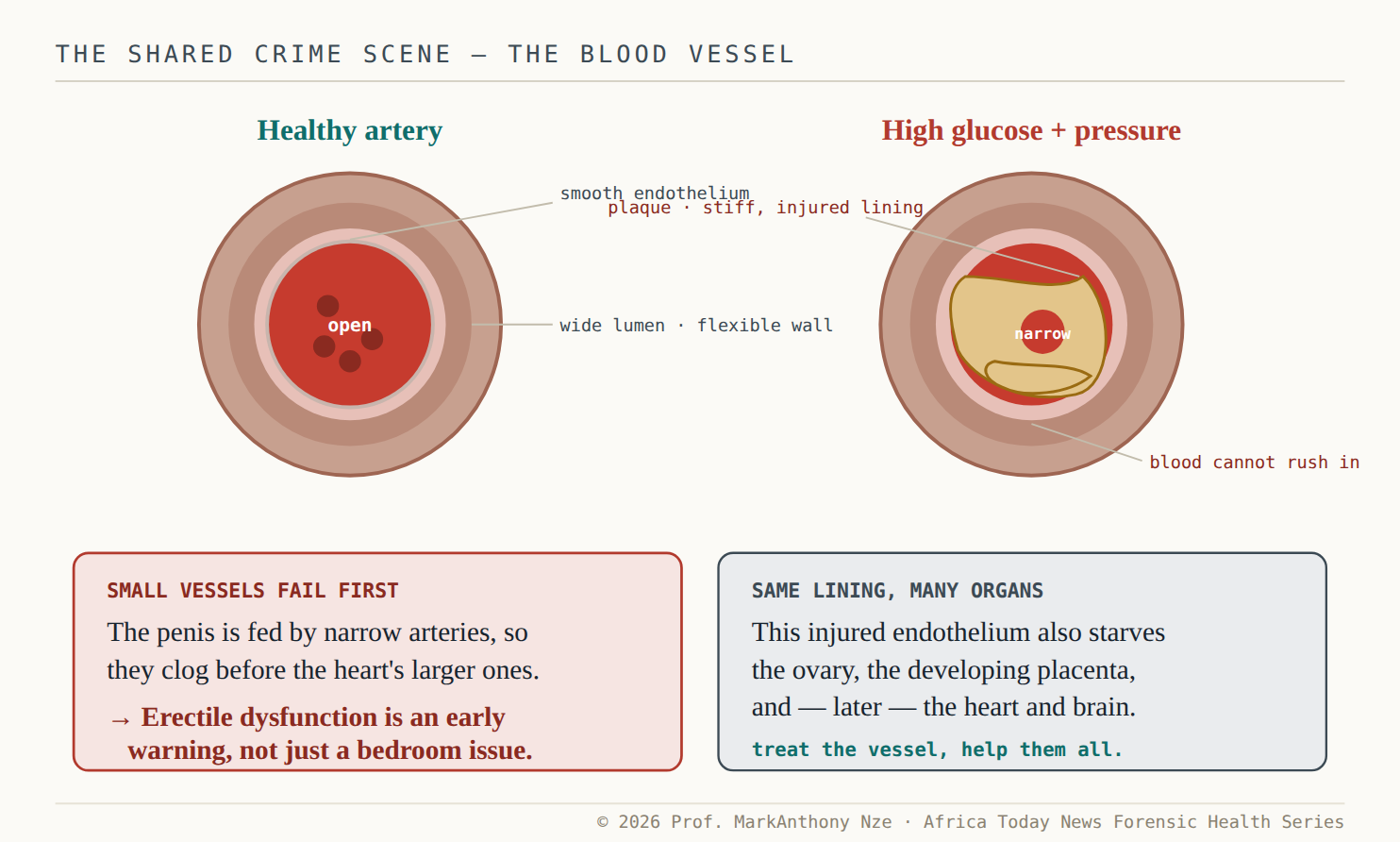
Fig. 26.1 One vessel, one disease. High glucose and pressure injure the artery’s lining. Because penile arteries are small, they fail first — making erectile dysfunction an early alarm for the heart, and a clue no fertility plan should ignore.
Read also: The Fertility Repair Series III — Part 25
The same illness reaches the woman and the pregnancy
The reach does not stop at men. In women, the metabolic engine of cardiometabolic disease — insulin resistance — is also a driver of disordered ovulation, which is why it overlaps so heavily with polycystic ovary syndrome (Part 22). The ASRM’s review of obesity and reproduction is blunt about the mechanism and, encouragingly, about the remedy: excess weight and insulin resistance disrupt ovulation in women and degrade sperm production in men, and modest weight loss reverses much of it. In one program cited by the committee, obese women who were not ovulating lost roughly a tenth of their weight; ovulation returned in about nine in ten of them, and most went on to conceive. The lever here is unglamorous and real, and it works on both partners at once.