
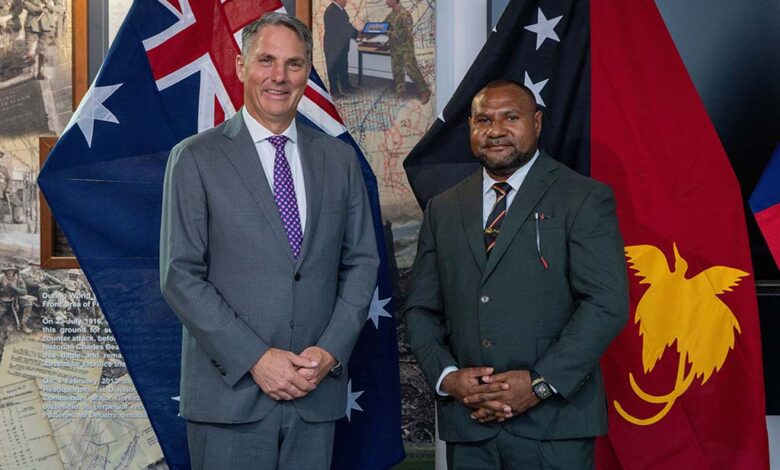
Australia and Papua New Guinea (PNG) have signed a landmark mutual defence treaty in Canberra, strengthening military cooperation between the two Pacific neighbours and underscoring their historic and geographic ties.
The agreement, announced on Monday, was signed by Australian Prime Minister Anthony Albanese and his Papua New Guinean counterpart, James Marape. Both leaders said the full text of the treaty will be released soon.
Marape described the pact as a product of shared geography and history rather than great-power rivalry, rejecting suggestions that it was driven by growing geopolitical competition involving China and the United States in the Pacific.
“This treaty was drawn up out of geography, history, and the enduring reality of our shared neighbourhood,” Marape said, according to the Australian Broadcasting Corporation (ABC). “It is about one bigger fence that secures two houses that have their own yard space.”
He added, “This treaty was not conceived out of geopolitics or any other reason. We maintain friendships to all nations and advocate peace wherever we engage.”
Read also: New Zealand Loosens Residency Laws To Attract Skilled Workers
Prime Minister Albanese said the treaty “makes very explicit” the interoperability of the two countries’ defence forces, adding that “our greatest asset is our people.”
According to Marape’s office, the pact—dubbed the Pukpuk Treaty—will pave the way for up to 10,000 Papua New Guineans to serve in the Australian Defence Force, while PNG seeks to expand its own military strength to 7,000 troops.
The agreement comes just weeks after Papua New Guinea celebrated 50 years of independence from Australia, which administered the territory from 1902 until independence in 1975.
Australia has long played a key role in the region’s security. In 2013, the two countries signed a controversial memorandum of understanding that established an offshore migrant detention centre on PNG’s Manus Island—closed in 2017 after years of criticism.
Canberra is also seeking to expand its regional partnerships, including a planned security agreement with Fiji and a landmark treaty with Tuvalu offering climate visas to citizens displaced by rising sea levels.
Climate change remains a major security concern across the Pacific, as Australia and its neighbours jointly bid to host the 2026 UN Climate Change Conference (COP31). Turkiye has also launched a formal bid to host the same summit.