
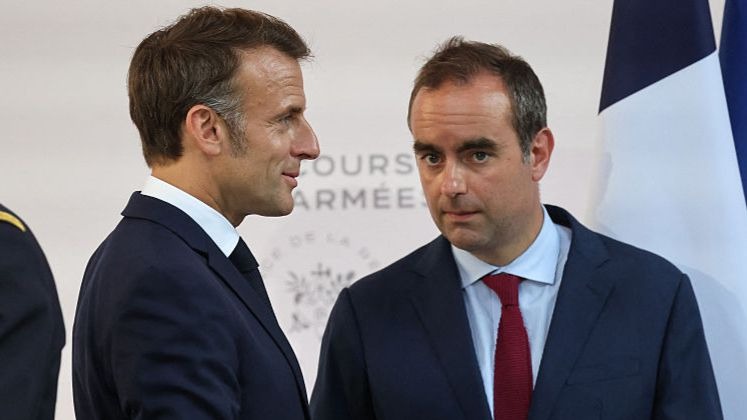
After days of speculation and political upheaval, French President Emmanuel Macron has reinstated Sébastien Lecornu as prime minister — barely four days after his resignation plunged France into turmoil. The decision, announced late Friday from the Élysée Palace, capped a week of frantic backroom negotiations and mounting uncertainty in Paris.
Macron’s announcement came after hours of consultations with leaders of France’s main political blocs — pointedly excluding the far-right and far-left parties — as the president struggled to find a candidate capable of stabilising a government fraying under debt pressures and internal dissent. Lecornu’s comeback, once dismissed as improbable even by the man himself, stunned many in the French political establishment. Only days earlier, the 39-year-old had told national television that his “mission was over” and that he was “not chasing the job.”
Now back at the helm, Lecornu faces a daunting to-do list. France’s next budget must be presented to parliament by Monday, and with Macron’s approval ratings at a record low — just 14 percent, according to an Elabe poll — the new prime minister must rally a parliament where the president no longer commands a majority.
Read also: Macron To Name France’s Next Prime Minister Within 2 Days
In a statement posted on X, Lecornu said he accepted the position “out of duty,” vowing to “provide France with a budget by year’s end and respond to the everyday problems of our compatriots.” Describing himself as a “soldier-monk,” he promised to “do everything to succeed.”
France’s fiscal situation looms large over his return. Public debt now stands at nearly 114 percent of GDP, among the highest in the eurozone, while this year’s budget deficit is projected to reach 5.4 percent. Two of Macron’s last three prime ministers have fallen over budget disputes — a reminder of how perilous the job can be.
Lecornu’s challenge is compounded by political fragmentation. Republican leader Bruno Retailleau, whose criticism toppled the last coalition, has already declared the centrist-conservative alliance “dead.” With conservatives splintered, Lecornu may be forced to reach across the aisle toward the left — a move Macron’s team hopes to sweeten with talk of delaying parts of his controversial 2023 pension reform that raised the retirement age from 62 to 64.
Meanwhile, far-right leader Jordan Bardella dismissed the reappointment as a “bad joke,” accusing Macron of isolation and detachment. He vowed to bring an immediate vote of no confidence against what he called “a coalition born of fear.”