
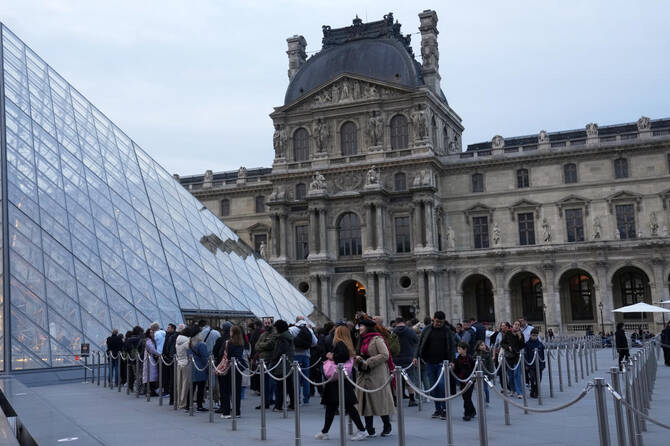
The Louvre Museum in Paris has reopened its doors on Wednesday, three days after thieves who broke in with a crane, carried out a daring jewellery heist worth an estimated €88 million, that led to public outrage and a political storm over alleged security lapses at the world-renowned institution.
Even as it just reopened, hundreds of visitors were already queuing to enter into the museum, but the Galerie d’Apollon, the hall that housed the royal jewels that were stolen remained closed to the public.
The theft took place early Sunday when hooded assailants reportedly used a stolen movers’ lift to access a second-floor window before breaking in and fleeing with jewels from the royal collection.
French Interior Minister Laurent Nunez described the incident as a “failure,” despite insisting that security systems functioned as designed.
Read Also: Louvre Jewel Heist: Thieves Use Crane In Paris Museum Robbery
“There was a burglary at the Louvre, and some of France’s most precious jewels were stolen. So obviously, it’s a failure, there’s nothing else I can say,” Nunez told Europe 1 radio. “The alarm system worked perfectly, police were on the scene within three minutes, but what happened has happened.”
His comments came as Culture Minister Rachida Dati faced backlash for telling lawmakers on Tuesday that there had been no security lapse. She has since launched an administrative inquiry into the handling of the museum’s security.
Later on Wednesday, museum director Laurence des Cars appeared before the French Senate to respond to lawmakers’ questions. Des Cars, who previously warned that the centuries-old Louvre Palace was in “a dire state,” will likely face scrutiny over both maintenance and security practices.
The Louvre, originally built in the late 12th century as a royal fortress, has undergone numerous transformations throughout French history. It was converted into a public museum in 1793 after the French Revolution and today draws millions of visitors annually. In 2023 alone, it recorded around 8.7 million visitors, making it the most-visited museum in the world.
The heist has reignited debate about France’s cultural heritage security. President Emmanuel Macron has already announced a six-year renovation plan for the Louvre, which will include new funding for security improvements.
Meanwhile, Pierre Moscovici, head of France’s national audit office, rejected claims that budget cuts had compromised museum safety. “The Louvre is richly endowed—it benefits from sponsorships and state support. It’s not lacking in resources,” he said on RTL radio.