
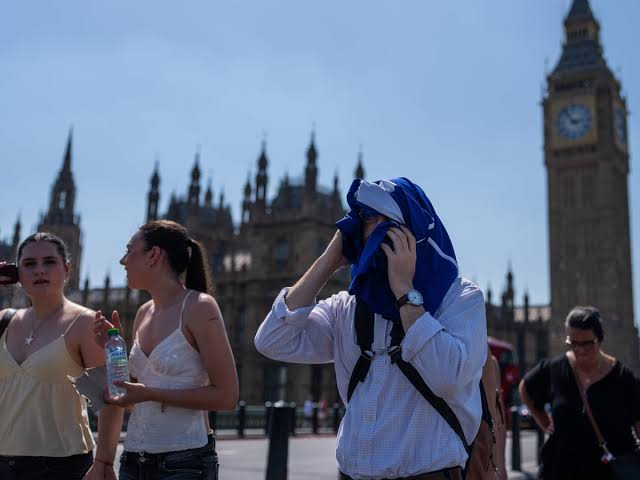
France‘s public health agency has counted 1,000 excess deaths tied to the country’s heatwave, the bulk of them among older residents, and cautioned that the toll will likely climb as data from nursing homes and private residences continues to come in.
The figure landed even as the weather itself began to break. Storms tore through parts of France late Saturday, cutting power to 36,000 households in the north and center by Sunday afternoon, according to grid operator Enedis. The system brought a measure of cooler air with it, but officials are not calling the danger over.
Health Minister Stephanie Rist told broadcaster BFM that the episode was “not finished,” and warned in a separate interview with La Tribune that the heatwave’s effects on public health could persist for up to 10 days after temperatures actually drop.
That lag is the story now. A heatwave that began June 20 and is being described by scientists as the most severe ever recorded in Europe has left a trail that will outlast the heat itself.
The numbers behind it are stark. Temperatures reached 40 degrees Celsius, or 104 Fahrenheit, in parts of the continent on Sunday, with records broken in Austria, the Czech Republic, Germany and Poland. WHO Director-General Tedros Adhanom Ghebreyesus put the human scale of it bluntly in a post on X, saying 150 million people are currently living under extreme heat conditions, with schools shut and power grids under strain in multiple countries.
Read also: France Deploys Carrier Group, Plans Hormuz Escort Mission
He went further, framing the event as a marker of a broader pattern rather than an aberration. Heatwaves once described as “once-in-a-generation” are now arriving annually, he wrote, and he placed the blame squarely on climate change, adding that European housing, schools and workplaces were not built to withstand this kind of heat.
That framing has scientific backing. Researchers have concluded the heatwave would have been “virtually impossible” without human-driven climate change, and that the warming has made this week’s extreme overnight temperatures 100 times more likely than they would have been twenty years ago.
The physical damage stretches well beyond households losing power. Rail and tram networks buckled under the heat. In western Germany, a major line in North Rhine-Westphalia cut back service, while trams in the eastern city of Leipzig were suspended entirely. Local media reported that many residents simply stayed indoors, waiting out the daylight hours before venturing outside.
Rivers absorbed their own share of the damage. In Hungary, the Paks nuclear plant was forced to scale back output for a second time as the Danube, which the facility relies on for cooling, grew too warm to do its job efficiently. Italy’s Po River saw its flow shrink so severely that seawater pushed roughly 18 kilometers, or 11 miles, inland, threatening farmland and protected wetlands in the delta region.
The heat has also proven lethal beyond the official death toll tied directly to it. Dozens of people seeking relief in open water are reported to have drowned across the affected region. Among the search efforts under way is one for the husband of Italian cabinet minister Eugenia Roccella, who disappeared Saturday while swimming in Lake Vico, about 70 kilometers, or 44 miles, from Rome.
Read also: France Summons US Envoy Kushner Over Lyon Killing Remarks
Not every scene was one of crisis management. In Rome, Pope Leo offered thanks to worshippers who turned out for Sunday prayers in Saint Peter’s Square despite the conditions, a small acknowledgment of endurance amid a continent-wide strain.
The weather itself is now shifting east. Meteorologists expect thunderstorms to move through France, Germany and the Czech Republic over the coming day or two, with much of Western Europe seeing cooler conditions this week as the system pushes into Central Europe and the Balkans. France’s national weather service said the most extreme heat has already eased across most of the country, though a heat advisory remains active in the northeast.
The Czech Republic, meanwhile, is contending with a secondary hazard. Authorities there issued smog warnings for the central and northern regions, citing elevated ground-level ozone driven by the heat, and urged residents to limit physical activity outdoors.
What emerges from the numbers is a heatwave whose damage did not end when the thermometer did. France’s death toll is still being assembled. Power is still being restored. And a health minister has gone on national television to say, in effect, that the danger has not actually passed — it has only changed shape.