
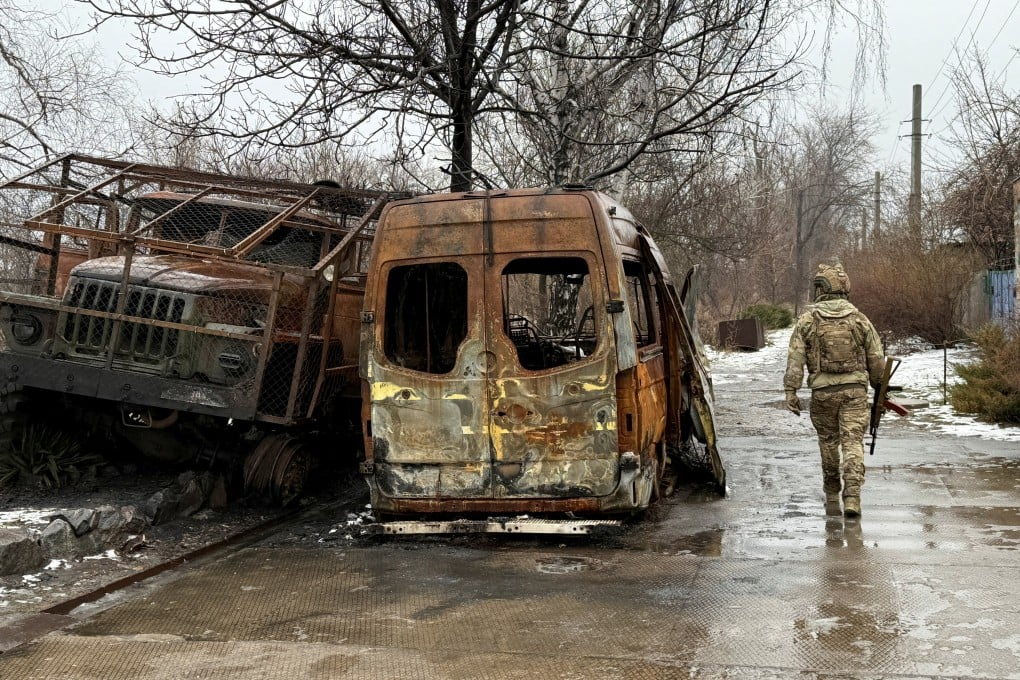
The road north out of Kostiantynivka is too dangerous now for standard vehicles to carry the dead or wounded. Soldiers patrolling it move everything on foot, according to 34-year-old serviceman Oleksandr Kosmin, who is among those tasked with defending the route against drones and remotely dropped mines.
That single detail captures what Russia’s slow encirclement of the city has done to the people still inside it.
Fiber-optic cable used to guide first-person-view drones is strewn across the anti-drone netting draped over the road, glinting in the heat. Ground robots now carry food, water and supplies through what troops call the “kill zone,” while soldiers race past on quad bikes, the fastest way left to move.
Kostiantynivka sits at the southern end of a defensive line Ukraine has built across its eastern Donetsk region, a string of four settlements collectively known as the “fortress belt.” Russian troops have begun probing the city’s outskirts in small groups, senior Ukrainian commanders said last week, a development that could open the way to close-quarters fighting inside the city itself.
The numbers tell their own story. A pre-war population of nearly 70,000 has dropped to roughly 2,000.
President Vladimir Putin claimed last week that Russian forces were close to taking the city outright. Commanders of Ukraine’s 19th Army Corps called that an exaggeration, telling Ukrainian media their troops were systematically eliminating the small groups of Russian soldiers who had managed to slip in. Maj. Gen. Viktor Nikoliuk, head of Ukraine’s eastern operational command, told the country’s public broadcaster Thursday that the city could hold if current levels of manpower and resources are sustained.
The U.S.-based Institute for the Study of War reached a similar conclusion in a June 23 assessment, noting that Russian infiltration had not yet produced what it called a rapid operational breakthrough.
Read also: Zelensky Warns US Russia Oil Waiver Funds War Against Ukraine
But assessments like that mask a harder truth on the ground, according to Ukrainian open-source analyst Ruslan Mykula of the DeepState mapping group. Russian forces are working to envelop the city through pincer movements, he said, a strategy that steadily drives up the price of holding it. Kyiv, he said, will eventually face a binary choice: commit more, or pull out. Emil Kastehelmi of the Finland-based Black Bird conflict analysis team went further, calling the city’s eventual fall largely a matter of timing.
Russia’s manpower advantage remains the throughline of the entire eastern front. Analysts say Ukrainian mid-range drone strikes have degraded Russian logistics and inflicted significant losses in the rear, but not enough to interrupt offensive operations in key sectors. Kastehelmi put it plainly: the damage hasn’t forced Moscow to pause.
A Russian foothold in Kostiantynivka would let Moscow’s forces push north along the rest of the fortress belt, the axis now driving its broader campaign. History suggests that push would come at steep cost. Sieges of Pokrovsk and Avdiivka, two other cities along the same defensive line, dragged on for months and bled both sides heavily before falling.
Putin has said Russia will not end the war without controlling the entirety of Donetsk. More than four years in, Ukraine still holds about a fifth of the region.
Read also: Southern Territory Reclaimed As Ukraine War Hits Year Five
The fortress belt’s northern edge is also under strain. Sloviansk and Kramatorsk, the line’s other anchor cities, face near-constant air and drone strikes launched from as close as 15 kilometers, or 9 miles, away. The road connecting them to Kostiantynivka is itself under sustained bombardment from artillery, drones and guided bombs, according to soldiers stationed nearby.
For civilians, the war no longer waits at the front line. In Druzhkivka, about 12 kilometers north of Kostiantynivka, residents are being evacuated as fighting closes in. On one tree-lined street, a husband and wife lay dead inside a van struck by a Russian drone, white ribbons marking it as civilian still fluttering on the roof.
Larysa Sereda, 59, was among those leaving. Speaking from inside a police evacuation van, she said fear, not certainty, was driving her out — drones were flying, and she didn’t want to be caught beneath them. But she was already planning her return, telling a reporter she had no interest in staying somewhere unfamiliar once the war ends.
Russia’s gains are coming even as cracks show elsewhere in its war machine. Ukrainian strikes on supply lines feeding Crimea, along with longer-range attacks on the oil sector, have pushed Russian-installed authorities on the peninsula to declare a state of emergency and suspend all fuel sales to individuals and businesses.
Mykula said Russian assaults across the wider front now often involve no more than one or two soldiers at a time, a sign, he argued, of a military stretched past its limits. Denis Pushilin, the Kremlin-installed head of occupied Donetsk, waved off questions about the pace of the campaign in comments to Reuters, saying speed was beside the point.
Hardliners inside Russia are pushing in the opposite direction, urging Putin to abandon the U.S.-backed peace process altogether as Ukrainian strikes intensify, including attacks reaching Moscow itself.
Sereda’s words linger longer than any battlefield assessment. She is leaving her home because she is afraid of what flies overhead. She still intends to go back.