
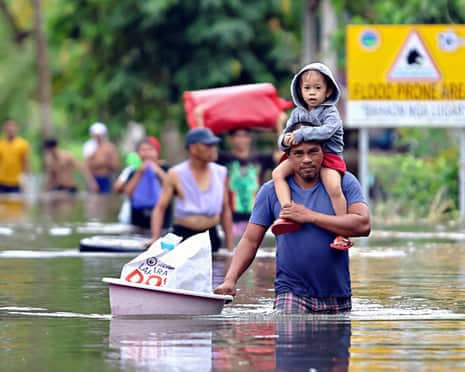
The Philippines is racing against time to evacuate nearly a million people as Super Typhoon Fung-wong barrels toward the archipelago’s eastern coast, threatening a country still reeling from another deadly storm that killed over 200 just days ago.
Fung-wong intensified rapidly as it approached landfall Sunday night, packing sustained winds of 115 mph and gusts reaching 140 mph. The storm has already begun battering coastal areas, knocking out power and forcing the evacuation of 916,860 residents from high-risk zones across the nation’s northeastern provinces.
Defense Secretary Gilberto Teodoro Jr. warned the typhoon could devastate a vast swath of the country, from the capital Manila to Cebu—the central province that absorbed the worst of Typhoon Kalmaegi’s fury earlier this month. That earlier storm claimed more than 200 lives, with roughly 100 people still missing.
“We ask people to pre-emptively evacuate so that we don’t end up having to conduct rescues at the last minute, which could put the lives of police, soldiers, firefighters and coast guard personnel at risk,” Teodoro said in a public address, warning that refusing evacuation orders was both dangerous and unlawful.
The Bicol region, a coastal area particularly vulnerable to Pacific cyclones, faces compound threats. Beyond Fung-wong’s winds and storm surge, authorities fear mudflows from Mayon, one of the Philippines’ most active volcanoes, could be triggered by torrential rains—a deadly combination that has devastated communities in past typhoons.
Forecasters predict Fung-wong will slam into Aurora province in central Luzon by Sunday night at the earliest, though the storm’s trajectory could shift. The Office of Civil Defence estimates more than 30 million Filipinos could face hazards from the typhoon—a staggering figure that underscores the archipelago’s geographic vulnerability to Pacific storm systems.
In Isabela province in northern Luzon, evacuation centers are filling rapidly. Christopher Sanchez, 50, huddled with his extended family at a basketball court converted into emergency shelter. “We’re scared,” he said. “We’re here with our grandchildren and our kids. The whole family is in the evacuation area.”
Read also: Typhoon Kalmaegi Death Toll In Philippines Hit At Least 85
The country’s civil aviation regulator reported nearly 400 domestic and international flight cancellations, stranding travelers and disrupting cargo operations crucial to the island economy. Ports have closed, leaving ferries docked and inter-island transport paralyzed.
The Philippines’ location makes it one of the world’s most typhoon-prone nations, typically enduring about 20 major storms annually. But Fung-wong’s arrival so soon after Kalmaegi’s destruction has stretched disaster response capabilities thin. Emergency supplies haven’t been fully replenished, temporary shelters remain occupied by earlier evacuees, and rescue teams are exhausted.
Climate scientists note that warming ocean temperatures are intensifying tropical cyclones, allowing storms to strengthen more rapidly and carry greater destructive potential. Fung-wong’s swift escalation to super typhoon status follows that pattern, giving authorities less time to prepare and evacuate vulnerable populations.
The storm threatens agricultural heartlands already damaged by Kalmaegi. Rice paddies flooded by the earlier typhoon face additional inundation, potentially decimating harvests in a nation where food security remains precarious for millions. Coconut plantations, fishing communities, and small-scale farmers—the backbone of rural economies—stand to absorb catastrophic losses if Fung-wong tracks through densely populated agricultural zones.
Philippine disaster authorities have improved early warning systems and evacuation protocols following past typhoon disasters, particularly the 2013 Super Typhoon Haiyan that killed more than 6,300 people. But even sophisticated forecasting and mandatory evacuations can’t eliminate casualties when storms of this magnitude strike densely populated coastal areas with substandard housing.
Teodoro’s warning that refusing evacuation is unlawful reflects authorities’ frustration with residents who decline to leave homes despite danger. Cultural factors—reluctance to abandon property, distrust of government facilities, family ties to ancestral land—often override safety considerations, forcing last-minute rescues that endanger both residents and emergency personnel.
Meanwhile, across the Pacific in Brazil, a separate weather catastrophe unfolded Saturday when a powerful tornado tore through Paraná state in the south, killing at least six and injuring over 750. The twister left destruction in its wake—downed trees, overturned vehicles, damaged buildings—demonstrating how extreme weather is simultaneously battering multiple continents.