
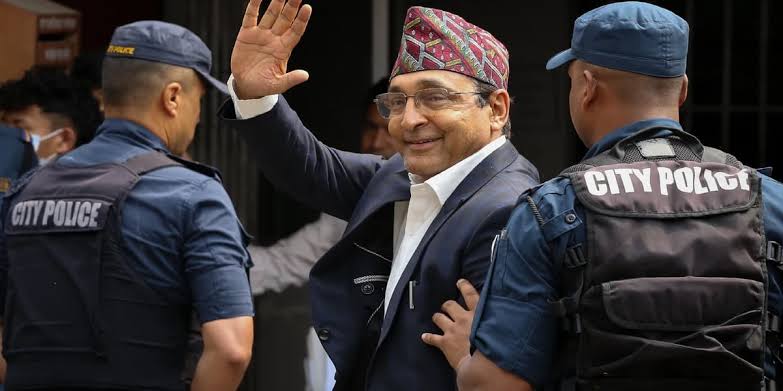
A Kathmandu court sentenced former Deputy Prime Minister Top Bahadur Rayamajhi to four years in prison and former Home Minister Bal Krishna Khand to two years on Tuesday, convicting them and 14 others in a scheme that forged Nepali citizens’ identities as Bhutanese refugees to secure their resettlement in the United States.
A single bench of Judge Tej Bahadur Khadka at the Kathmandu District Court handed down the sentences late Tuesday. Rayamajhi was convicted of fraud, organized crime and offenses against the state and fined 40,000 rupees; Khand was convicted as an accomplice to those offenses, receiving half the principal sentence and a 20,000-rupee fine, court officials said.
Prosecutors had accused 30 people of defrauding Nepali citizens by falsely promising to resettle them in the United States under fabricated Bhutanese refugee status, collecting roughly 288 million rupees, or about $2.1 million, from victims across the scheme. The Kathmandu District Government Attorney’s Office filed the case in May 2023 after victims began lodging complaints with the Kathmandu Valley Crime Investigation Office the previous year; one group of 81 victims alone paid more than 136 million rupees to the ring, according to the police investigation that underpinned the charges.
Read also: Nepal Votes In Post-Protest Election, RSP Favoured To Lead
The scheme traced back to 2019, when Nepal’s government formed a task force under then-Home Secretary Bal Krishna Panthi to document unregistered Bhutanese refugees still living in the country. Investigators said members of the syndicate tampered with the task force’s official report, inserting fabricated appendices that listed ordinary Nepali citizens as refugees who had never actually fled Bhutan.
Tek Narayan Pandey, who served as home secretary during part of the scheme, was also sentenced to four years and fined 40,000 rupees. Tek Nath Rizal, a longtime leader of the Bhutanese refugee community, was convicted on forgery-related counts and sentenced to two years. Four other co-defendants — Sandesh Sharma, Sagar Rai, Govinda Kumar Chaudhary and former Nepali Congress lawmaker Ang Tawa Sherpa — each received four-year terms, while four lower-level defendants were sentenced to one year apiece. Under Nepali sentencing rules, each defendant convicted on multiple counts will serve only the longest of the terms imposed rather than consecutive sentences, though fines for every count must be paid in full.
The court acquitted seven other defendants who had faced charges in the case: Ram Sharan KC, Tank Kumar Gurung, Sandip Rayamajhi, Pratik Thapa, Laxmi Maharjan, Keshav Tuladhar and Ashish Budhathoki. One convicted defendant, Indrajit Rai, a former security adviser to a past home minister, had his four-year sentence cut by 75% under a legal provision for defendants over 75.
The charge sheet described the scheme as damaging to Nepal’s sovereignty and international reputation, and prosecutors had sought additional prison time for several defendants on the grounds that they held public office when the fraud occurred. Nepali media reports have said the case involved hundreds of victims who paid the ring for help reaching the United States and received nothing in return.
Dharma Raj Regmi, a lawyer representing Rayamajhi, said his client “was never involved in policy making for the refugees” and confirmed the defense would appeal. Rayamajhi remains in custody, while Khand is free on bail; both men, unavailable for comment following the ruling, have previously denied any involvement in the scheme.
Read also: Young Voters Propel Rapper Toward Nepal Leadership
The case reaches back to one of the largest forced displacements in South Asia’s recent history. More than 100,000 ethnic Nepali-speaking Lhotshampa fled Bhutan in the early 1990s, roughly a sixth of the kingdom’s population at the time, after Bhutan’s monarchy introduced a “One Nation, One People” policy in 1985 that made national dress compulsory, restricted use of the Nepali language and stripped many Lhotshampa of their citizenship. Most of those who fled settled in refugee camps in eastern Nepal, and a Western-backed resettlement program for camp residents ran from 2007 to 2018 after years of failed negotiations over their return to Bhutan.
The case has drawn fresh attention since Nepal’s new government, led by 36-year-old former Kathmandu mayor Balendra Shah, made investigating corruption under previous administrations a stated priority after taking office earlier this year. Rayamajhi’s legal team said Tuesday it intends to file its appeal within the period allowed under Nepali law, while prosecutors have not said whether they plan to challenge any of the acquittals.