
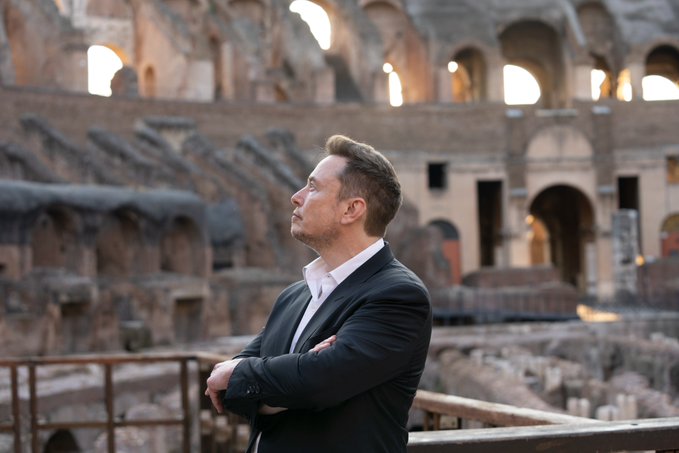
Tesla CEO Elon Musk donates $1 million to the American Institute for Roman Culture, backing an AI-powered effort to rediscover and digitally preserve ancient Rome.
Elon Musk is lending his fortune and fascination with history to a high-tech revival of ancient Rome, funding an ambitious archaeology project that could reshape how the world understands one of history’s most influential civilizations.
The Tesla and SpaceX CEO recently donated $1 million through the Musk Foundation to the American Institute for Roman Culture (AIRC), a U.S.-based nonprofit dedicated to preserving Roman heritage. The funds will support the institute’s Ancient Rome Live platform — part of its Expandere Conscientiae Lumen initiative — which uses digital tools to document archaeological discoveries and expand public access to Roman history.
At a ceremony hosted by AIRC on October 24, 2025, Musk said his interest in Rome stemmed from its profound influence on Western civilization. “I am interested in history, and Rome constitutes a large part of the history of Western civilization,” he said, according to the Times of London.
Read Also: Tesla Bets $1 Trillion On Keeping Musk At The Wheel
Musk also suggested that artificial intelligence could revolutionize the field, helping “write a new history book based entirely on ancient material and archaeology.” His remarks reflect growing optimism among researchers who believe machine learning can fill in lost historical details by analyzing ancient texts, reconstructing artifacts, and digitally mapping ruins.
AIRC Director Darius Arya described Musk’s grant as “a pivotal moment” for the organization. “We are deeply honored by the Musk Foundation’s recognition of our work,” Arya said. “This confirms our mission to foster global understanding of the ancient Roman world through education, research, and innovation.”
The partnership highlights the increasing intersection of technology and archaeology. AI tools have already advanced discoveries in other fields — such as identifying new fragments of the Dead Sea Scrolls and refining the dating of ancient manuscripts.
Musk’s fascination with Rome is well-documented. Earlier in 2025, he visited the Coliseum and Pantheon, and in an August post on X, mused about the leadership of Emperor Marcus Aurelius. He has also drawn parallels between ancient Rome and modern America, once calling the U.S. “the New Rome.”
For AIRC, the Musk Foundation’s backing could accelerate its work to digitally reconstruct ancient structures and preserve historical data for future generations — blending one of humanity’s oldest civilizations with some of its newest technology.