
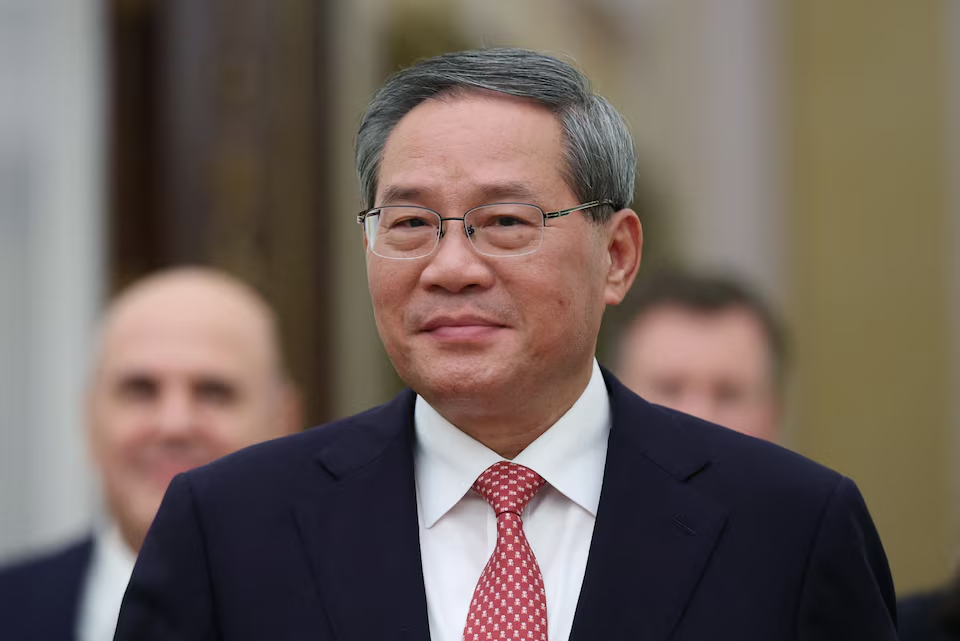
Zambia will welcome Chinese Premier Li Qiang on Wednesday, marking the first visit by a Chinese premier in nearly three decades and signaling a renewed push by Beijing to expand its foothold in the copper-rich nation as it recovers from a prolonged debt crisis.
Li’s two-day stop in Lusaka comes at a moment when Zambia is emerging from years of financial strain, with a new repayment plan in place for its $13.4 billion external debt. China is Zambia’s largest official creditor, holding $5.7 billion, and has frequently pointed to the country as a successful example of President Xi Jinping’s Belt and Road initiative.
The visit also underscores China’s intent to strengthen political and commercial ties at a time when the United States and European partners are stepping up their own engagement across southern Africa.
Beijing sees Zambia as a key partner for securing commodities and expanding demand for Chinese exports, particularly tractors, electrical equipment, and construction vehicles. Zambian officials, meanwhile, are looking for fresh capital to expand mining operations, rebuild infrastructure, and grow domestic manufacturing.
Read Also: Trump Defends MBS Over Khashoggi, Form New Pact
The World Bank projects Zambia’s economy will grow 6.5 percent next year, well above the country’s average pace of the past two decades. Analysts say that momentum has made Zambia an increasingly competitive arena for outside powers seeking long-term influence.
“Li is going to bolster China’s presence in a strategically vital country,” said Eric Olander, co-founder of the China-Global South Project. He noted that both President Hakainde Hichilema’s government and major Chinese mining firms need political support. Olander referenced an acid spill in February at a Chinese-operated copper plant that released contaminated water into the Kafue River, an incident now featuring prominently in Zambia’s election debate.
China has approved a major overhaul of the Tazara Railway, the historic line it financed in the 1970s to connect Tanzania’s eastern coast with Zambia’s inland copper belt. The project is widely viewed as Beijing’s answer to the Western-backed Lobito Corridor, a trade route supported by the United States and European Union that links Zambia and the Democratic Republic of the Congo to Angola’s Atlantic coast.
“The debt issue is largely seen as settled,” Olander said, adding that China’s role in the restructuring was often misunderstood because Zambia had to coordinate with a long list of Chinese lenders.
Chinese Ambassador Han Jing said on Facebook that Li’s visit is expected to produce dozens of cooperation agreements. “The impact of Chinese aid and investments can be felt across the country as an important force for economic transformation and the social progress of Zambia,” the ambassador wrote.
Across Africa, governments have turned to private investment rather than heavy borrowing after the pandemic left many nations struggling to service debt. Zambia’s restructuring took three and a half years, slowed in part by the sheer number of Chinese creditors involved in negotiations, according to analysts.
Earlier this month, the European Union’s top development official visited Zambia to announce new investments along the Lobito Corridor. And on Sunday, President Hichilema hosted Donald Trump Jr., according to a post on the Zambian leader’s X account, signaling Washington’s growing interest in Lusaka’s economic and political trajectory.