
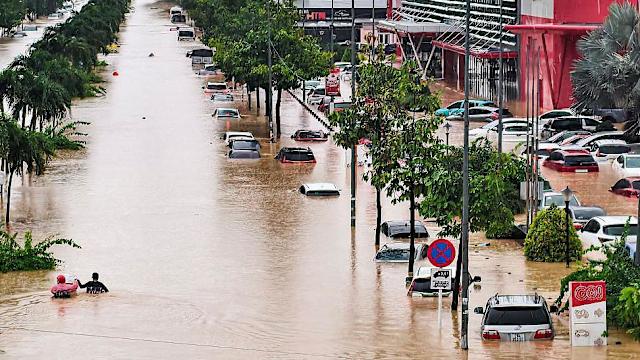
Central Vietnam has been battered by relentless rainfall and widespread flooding, killing at least 41 people since the weekend, with nine more still missing, according to state media. Tens of thousands of residents have been forced to evacuate as floodwaters rise, while over 52,000 homes remain submerged and hundreds of thousands of households and businesses have lost electricity.
The ongoing storm has caused major disruption to daily life, with roads, bridges, and public infrastructure severely affected.
Rainfall in several areas has exceeded 1.5 meters (5 feet) over the past three days, surpassing the 1993 flood peak of 5.2 meters in certain regions. Local media have captured striking images of residents stranded on rooftops as floodwaters engulf their homes. In Lam Dong province, a suspension bridge was torn from its anchors, while in Nha Trang, restaurant owner Bui Quoc Vinh told AFP that his shops were submerged by roughly a meter of water. “I am worried about our furniture in my restaurants and shops, but of course I cannot do anything now,” he said. “I don’t think the water is going to recede soon, as the rain has not stopped.”
Read Also: Typhoon Kalmaegi Death Toll In Philippines Hit At Least 85
The current floods follow a string of extreme weather events that have battered central Vietnam in recent months. Typhoon Kalmaegi killed at least five people earlier this month, uprooting trees, tearing off roofs, and flooding homes. In September, Typhoon Bualoi claimed at least 11 lives and brought sustained winds of up to 117 km/h (73 mph). Kalmaegi also caused heavy fatalities in the Philippines, with at least 188 deaths reported on the island of Cebu.
Experts have warned that climate change is worsening extreme weather patterns in the region, making typhoons more powerful, more frequent, and increasingly destructive. Flooding of this magnitude not only threatens lives but also causes long-term economic damage, destroying crops, infrastructure, and businesses.
Authorities continue intensive rescue and relief operations, including evacuations and the provision of emergency supplies. However, forecasts indicate that heavy rainfall will persist in central Vietnam for several more days, prolonging the flooding crisis and complicating recovery efforts for affected communities.