
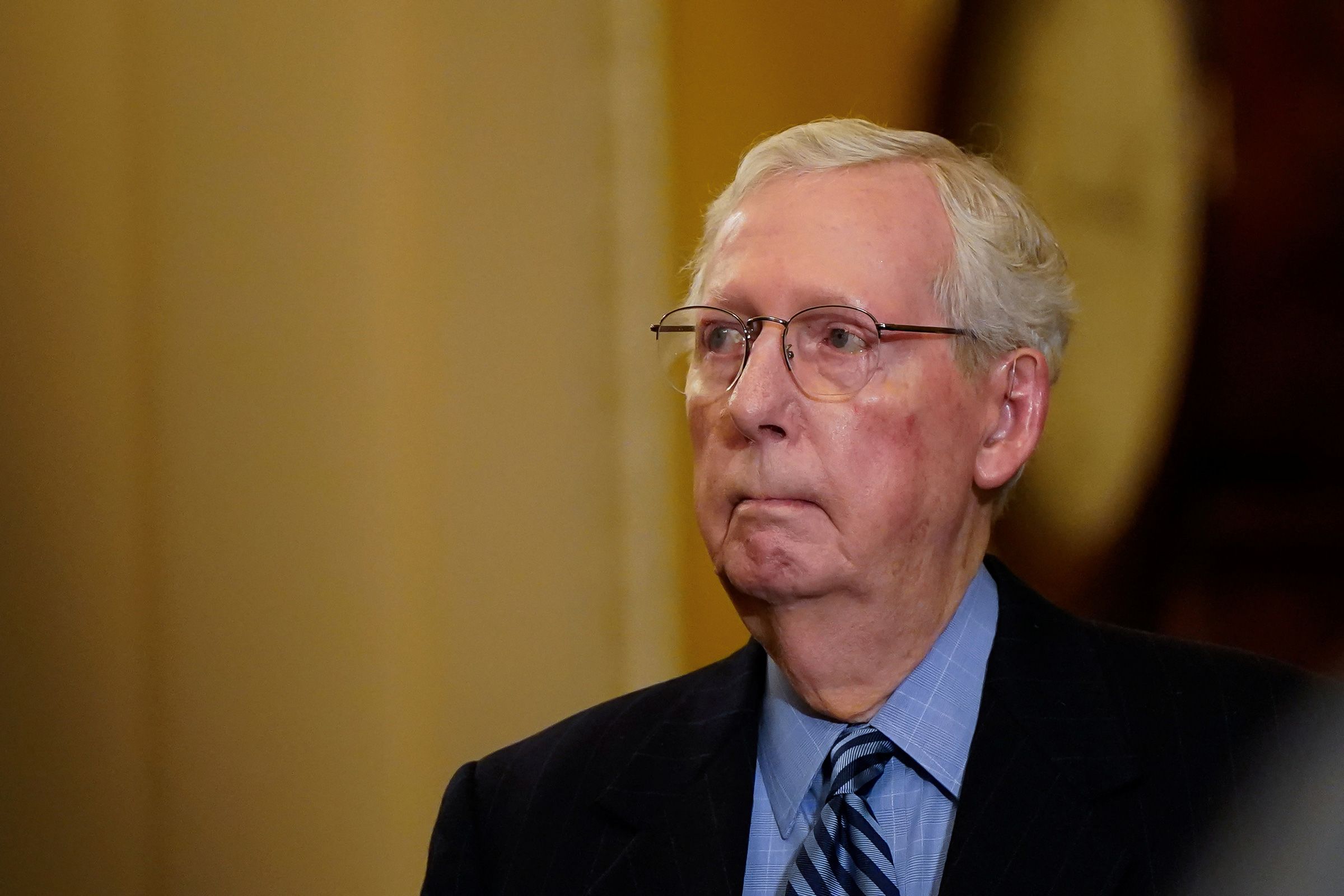
Sen. Mitch McConnell said Sunday he will not return to the Senate floor to vote “quite yet,” as the Kentucky Republican’s monthlong hospitalization stretched into the chamber’s return from its Fourth of July recess.
“As much as it frustrates me, this process takes time,” McConnell wrote in a statement shared with The Hill, adding that he remained engaged in Senate business from outside the Capitol. He said he had been working with his legislative staff on current issues, coordinating constituent services with his Kentucky team, and staying in touch with Senate colleagues on the appropriations process and midterm politics.
McConnell, 84, has been hospitalized since June 14, when he fell at his Washington home and was briefly knocked unconscious. His physician’s office said a multidisciplinary medical evaluation found no fractures, no concussion, no heart attack or stroke, and no tumors or hemorrhages, though he developed a mild case of pneumonia early in his stay that responded quickly to antibiotics. The office attributed the fall to mobility problems tied to McConnell’s childhood polio, noting he has fallen several times this year, and said his continuing hospital stay has focused on physical therapy meant to reduce his risk of falling again.
McConnell has since moved to a rehabilitation center, where his office said he has been medically cleared to keep participating in an intensive physical therapy program. His wife, former Transportation Secretary Elaine Chao, has been with him.
Read also: McConnell To Resign As Senate Republican Leader In November
McConnell’s office had disclosed few details about his condition for nearly a month, a silence that fueled speculation, including unverified reports that emergency responders had been called to his home for a cardiac arrest. Kentucky Gov. Andy Beshear, a Democrat, sent McConnell a public letter last week pressing him to update constituents on his health and fitness to serve. The statement McConnell’s office released Sunday included a photo of the senator seated in a hospital chair beside Chao, holding a copy of that day’s Washington Post.
Sunday’s disclosure adds to a string of health episodes that have drawn scrutiny to McConnell’s ability to serve out his final term. He was hospitalized after a concussion sustained in a fall at a Washington hotel in March 2023, and he has twice frozen at the podium during public appearances in recent years, prompting aides to escort him away each time. Those earlier episodes have made his current absence, and the sparse information his office released about it, a recurring subject of speculation on Capitol Hill.
The senator has not cast a Senate vote since June 11. His absence carries particular weight this month: the chamber returned Monday for a four-week work period expected to include votes on defense and national security legislation, an area McConnell has long shaped as chairman of the Senate Rules Committee and the Appropriations Subcommittee on Defense. His absence, combined with the recent death of Sen. Lindsey Graham, R-S.C., whom a medical examiner’s preliminary findings attributed to an aortic dissection, has narrowed the Republican margin on the full Appropriations Committee as lawmakers take up the National Defense Authorization Act for fiscal 2027, the annual package that sets military policy, personnel levels and Pentagon funding.
Extended absences have already affected floor outcomes this year. McConnell and Rep. Thomas Kean, R-N.J., who was away from the House for four months while being treated for depression, both missed votes on Iran war powers resolutions that ultimately passed by narrow margins.
Read also: Lindsey Graham, Trump Ally & Senate Hawk, Dies At 71
McConnell’s limited disclosures have added to a broader debate in Congress over what lawmakers owe the public when their health affects their ability to serve. Rep. Jamie Raskin, D-Md., who disclosed his own cancer diagnosis in 2022, said the calculus differs from lawmaker to lawmaker. “I felt my constituents had a right to know,” Raskin said of his own decision, while acknowledging there is no single correct approach for every member of Congress.
McConnell is the longest-serving party leader in Senate history, having led Senate Republicans for 18 years before stepping down at the start of this Congress in favor of Sen. John Thune, R-S.D. He is serving his final term and has said he will not seek reelection. A Thune spokesperson said the two men spoke by phone this month in what the spokesperson described as a lengthy conversation touching on national security and other matters.
The Senate’s four-week work period is expected to carry defense legislation toward a floor vote in the coming weeks, with no date yet set for McConnell’s return.